Got Passion?

18 08 2011

***This is an excerpt from a newsletter I wrote to all the EXL clients this last April, so it’s a little out of season, but the message is timeless.***

This time of year is challenging for me.  I find it hard to transition from winter to spring, from ski season to mountain bike season.  Because the snow has been so soggy I’ve forced myself to do a few spring bike rides.  Ya, I was slow.  A ride that normally takes me 90 minutes took me close to 2 hours.  I can probably chalk it up to being out of biking shape, but more importantly I contribute it to a lack of passion.  My heart just wasn’t in the ride.  Passion is what drives us to excel.  I will find my passion again for biking, it’ll probably take a few miserable spring ski adventures, but I will find it.

“If there is no passion in your life, then have you really lived? Find your passion, whatever it may be.  Become it, and let it become you and you will find great things happen FOR you, TO you and BECAUSE of you.” T. Alan Armstrong

Speaking of passion, I recently had the opportunity of training an individual that I believe epitomizes passion.  Some of you know him, he’s been a regular 6am camper for the last 3 or 4 months and he has gone through an amazing transformation.  His name is Stanton.  Stanton is a gym teacher at Orem High School.  He came to me at the end of last year asking for my help.  He told me he was going to win the Gold’s Gym Body Transformation Contest that would begin at the new year.  He told me he didn’t have the money to pay for my services, but he would once he won the contest (I believe there was a $1200 purse for the contest).  I was impressed, so impressed that I took him up on his offer.  I would train him and he could pay me later. For the next 3 months Stanton was the first camper at boot camp showing up early everyday.  Not only did he do the regular boot camp workout he doubled up his exercise by performing cardio intervals in the evening.  As far as nutrition went we worked on eliminating the bad habits for the first month, then we worked on eating healthy…lots of lean protein, veggies and healthy carbs. In month 2 we started rotating his carb intake.  Never once did he give me the excuse, “But, Mat, I can’t eat that much protein.” or “Mat, I’m so sick of cottage cheese and chicken.”  He was passionately chasing his goal.  I could’ve told him to skip backwards down State Street while shaking a shake weight would’ve helped him lose a few extra pounds and he would’ve done it.  Passion and compliance, it’s a magical formula for success.  Now, Stanton won’t know the results of the contest for a couple of weeks. To be quite honest, the results don’t matter.  In my eyes, Stanton has already won.  He is a champion.

Champions do not become champions when they win the event, but in the hours, weeks, months and years they spend preparing for it. The victorious performance itself is merely the demonstration of their championship character.  T. Alan Armstrong

My challenge for you is to find your passion.  What is it that drives you to workout?  To plan out your meals?  To skip dessert?  Is it to look good naked?  Or maybe you want to feel younger, healthier, stronger…?  Whatever it is find it, grab a hold of it, internalize it.  Write your passion down.  Write in down in powerful language that describes your fire within.  Post it in places  so that you will see it often.  And then share your passion with others.  If you can’t go through the simple task of writing it down or muster the courage to share it with family and friends, then how passionate is your passion?  Passionate enough to be a champion?

Passionately,

Mat “the trainer”

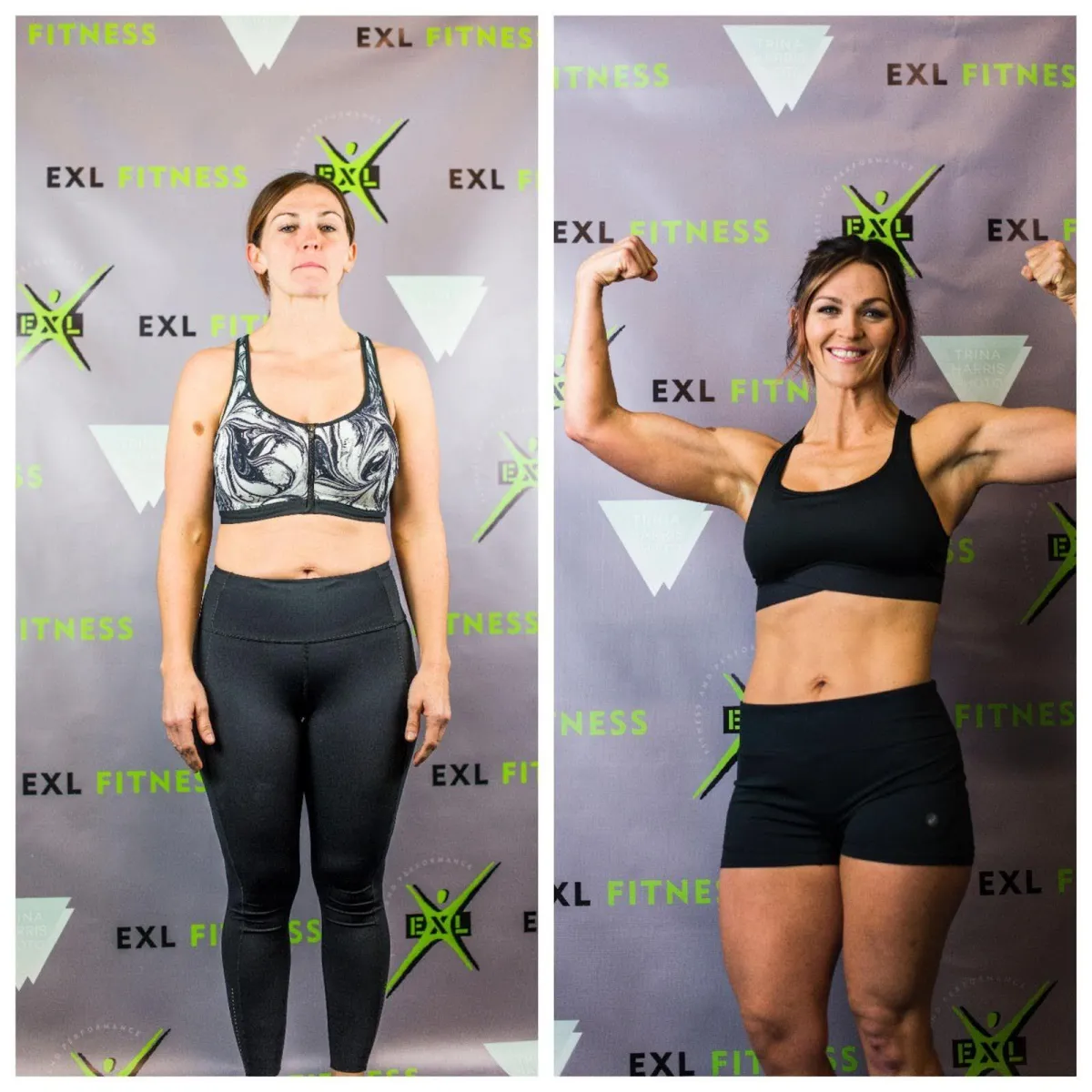
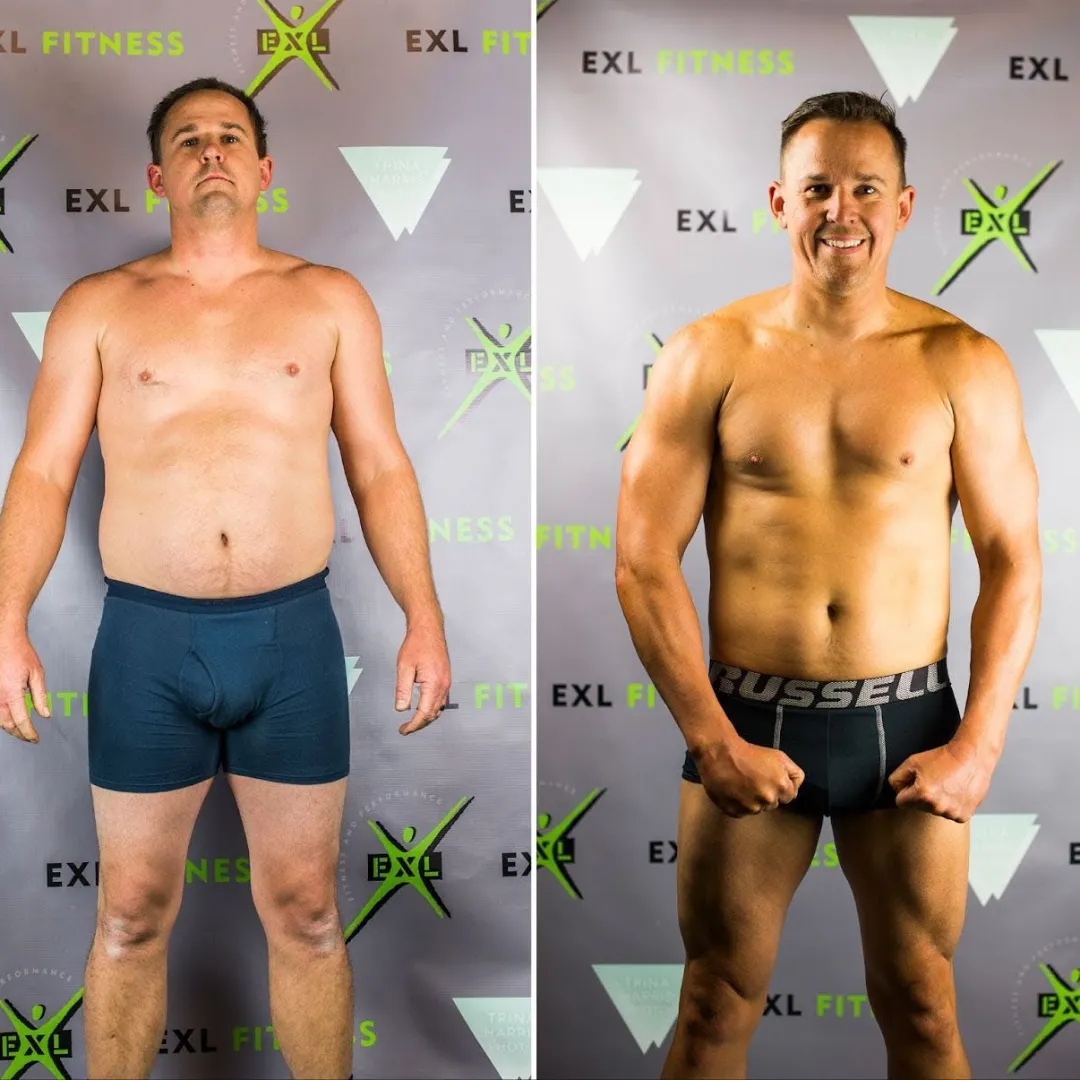
Not that it matters, but, here are Stanton’s before and after pics…and not only did he win the state wide contest he won his age division nationally and was runner up overall…Well done Stanton, my friend!!!

Drop the white socks, sport a smile and a spray on tan and you too can have a transformation like Stanton...oh yeah and a whole lot of sweat.


Rubber Band Core

18 04 2009

exl_rgb4NOTE:  This is a newsletter emailed in January ’09, I’m posting it for archival purposes.


Hey, everyone, Mat the trainer again.  In the last few emails we have been discussing the core.  We have discussed some of the muscles that make up the core; some are obvious, some not so obvious.  Let’s review the function of the core again.  The core bolsters the spine and creates a stable platform from which muscles can contract to generate force (remember the battleship vs. canoe example).  The core also transfers force from the lower body to the upper body, like in a golf swing.  In the golf swing the muscles of the legs push against the ground to produce a force which then travels up the body through the core to the upper body and finally to the golf club.  In essence the core links the upper and lower body.  If the core is weak, energy is lost through the core as excess movement in the spine, hips and or shoulder girdle.  To help clarify this, imagine your “core” as a bunch of rubber bands.  As you torque your hips to swing the golf club, energy travels from your legs to your arms.  Which kind of rubber bands would you like to have in your core connecting your legs to your arms? Thin, weak bands that don’t have a lot of snap?  Or, thick, heavy bands with a lot of snap?  Obviously the bands with a lot of snap.  So the snappier (don’t even know if that’s a word) we get our core the less power we lose in our swing.  This same example works with any movement pattern.  The stronger the core the less energy is lost.  So how do we strengthen it?  Heck, how do we even contract our core?  I’ll answer that question next time, and then we’ll get into the exercises.
The inaugural boot camp went off great.  We still have some openings for those that have been procrastinating.  Just ping me back or give me a call.
MAT “the trainer”
(801) 836.7185
EXL Fitness & Performance
a personal and group training studio


Bench Press is a core workout?

18 04 2009

NOTE:   this is a previous newsletter, emailed out in the middle of Januaray ’09.  I’m posting it to for archive purposes.


Hey everyone, Mat the trainer, again.  I’m sure you guys have been losing some serious sleep over the “pecs are part of your core” idea and the possibility of bench press being a core workout.  Well, let me explicate…your core is involved in every exercise.  In fact, a correctly functioning core should fire and stabilize the trunk milliseconds before any movement is initiated.  When the core muscles don’t engage, or they aren’t strong enough to stabilize the trunk, energy is lost through the instability of the movable segments of the spine. in order to maximize your movements your musculature needs a solid base, your trunk, from which to initiate movement.  A common analogy is that of trying to fire a canon from a battleship and also from a canoe.  When a canon is fired from a battleship the ship hardly moves, but when a canon is fired from a canoe the canoe tips over and the canon loses power and accuracy.  The battleship represents a stable platform or strong core from which to initiate the fired round.  The canoe, on the other hand, is a weak platform and the energy and efficiency of the round is compromised.  So back to the pecs and bench press, the core should fire before the movement of the bench press begins so the pecs have a stable platform from which to contract from to produce force.  The pecs are not acting as stabilizers in this exercise they are prime movers.  They are the canon and the other muscle of the core are providing the battleship from which to fire the guns.  If your squirming, shifting side to side or picking a foot off the floor stability is lost and performance decreases.  Not to mention the strain and trauma placed on the shoulder, elbow and spine from the compensation pattern.  So yes, the bench press utilizes the core, but the pecs are not functioning as a part of the core in the bench press.  So if you find yourself feeling like a canoe while bench pressing or doing any other exercise, look to strengthen the other muscle of the core.  Which brings us to our closing questions…”What are some effective core exercises, and which ones utilize the pecs in the core?”  My boot campers will learn some next week.  And I’m sure to write a follow up email with some examples, but isn’t it better to learn by doing?  Come on down to EXL for a free 1 week trial, there is no risk and I guarantee you will see results.

BTW, it seems a few of your are not morning folk (that’s too bad, because the glory of the day is in the morning) and you have made some suggestions  for me to open up a boot camp during a later hour of the day.  If there is enough interest I would be much obliged to do so.  Email me what other times you would prefer…mid morning, lunch time, evening…?
Till Then, Stay Fit
MAT “the trainer”
(801) 836.7185
EXL Fitness & Performance
a personal and group training studio


Core equals abs, but abs do not equal core

18 04 2009

Note:  This is a previous newsletter I sent out about a month ago, I’m merely posting it so the information can be archived.

Hey everyone, Mat, the trainer here to clear up a common misconception.  The misconception is that your abdominal muscles are your core muscles.  This is a half truth.  While your abs, more correctly your internal and external obliques as well as your transverse abdominus, are a component to your core musculature they are not the whole package.  So your core entails your abdominals (core equals abs) as well as other muscles, but your abs are not your core (abs does not equal core).   “Core” muscles are any muscle that helps stabilize your spine, especially in preventing rotation.  So by definition not only are your abdominals included in the list but also the deep intrinsic muscles of your lower back (multifidus) as well as the muscles that run up and down the sides of your spine (iliacus, spinalis, longisimus).  These may seem obvious but the list continues…the muscles of the hips (glutes, psoas) and the shoulders (pecs, lats) also contribute to core stability.  ”Pecs?” you say.  ”So by doing bench press, I’m working my core?”  the answer…..well, check in the next email for the answer.  Till then here are a few coupons for a free 1 week trial of our new Empower Hour Boot Camp, which start next Monday at 6 and 7am.  Make sure to contact me to reserve your spot and so I can get you some EXL paperwork to fill out as well.

Stay Fit,
MAT “the trainer”
(801) 836.7185
EXL Fitness & Performance
a personal and group training studio


The “kneel & reach”

18 04 2009
exl_rgb16Hey, Mat “the trainer” here,
Over the years I’ve trained hundreds of people.  And there is one thing they all have in common… an inefficient core.  No matter if I’m training a professional athlete, a yoga instructor or a lunch lady they all need a stronger core.  But most people have no idea how to contract their transverse abdominus or multifidus.  Heck most of us struggle just to pronounce the names of these muscles.  Here is a simple “core activation” exercise I use with first time clients to help them understand how to contract/flex their core.  It’s called the “kneel and reach”.  First, get on the floor and stand on your knees.  From this position reach directly above your head as high as you can reach.  Imagine you’re trying to place an extra jug of delicious protein powder on the top shelf of your pantry (we’ve all been there).  But, you’re not quite tall enough to reach the shelf.  I mean really reach.  If you notice, as your body works to stabilize the extra inches you’re getting out of your spine your midsection braces or draws in.  This is your core contracting.  Your deep abdominals and lower back muscles contract and draw in your mid section to create a pseudo-weight belt to bolster up the extra inches in your spine.  Now I want you to repeat that reach, but now exhale strongly as you reach and exaggerate the drawing in as you reach.  Sometimes it helps to imagine you’re pulling your bellybutton into your spine. I constantly remind my clients in the gym to get tall and skinny, it’s not because I want them to be underwear models, but because I want them to contract their core.  I can already see it; some of you are sitting reading this on your computer with your arms above your head and your lower back swayed like an old mule.  Or you’re reaching slightly in front of you and your shoulders are rounded forward.  Here is where the glutes and lats work as core muscles to stabilize your torso.  To correct these flaws, you will need to flex your glutes to prevent your back from swaying excessively and also contract the muscle of your back including your lats and the muscles around your shoulder blades to pull your shoulders back in perfect spinal alignment.  Now repeat the “kneel and reach” with perfect posture 5-10 reps holding each rep for 5 seconds. (http://www.youtube.com/watch?v=_MqzaEbVtY8)    Now that I’ve introduced you to your core go out and use it.


We’ve just recently added the MW 7pm boot camp for all of you night owls.  Give it a try, risk free.  Call me or email me back.


Stay Fit
MAT GOVER
(801) 836.7185
EXL Fitness & Performance
a personal and group training studio


Anti-Crunch Six Pack Workout

3 02 2009

exl_rgb10Face it- we all want a flat, sexy midsection. But for many of us no amount of crunches or sit-ups seems to get the job done. I can’t tell you how many times people have asked me the following questions:


“I do hundreds of crunches and sit-ups a day and I still have a flabby midsection. What gives?”


Well, before I reveal your six-pack abs blueprint, let’s first debunk some very important myths about how to get six-pack abs:


Myth#1- Weight loss is the key to seeing your abs


WRONG!


The key to seeing your abs is FAT loss, not weight loss. Let me further explain: your body consists of fat mass and lean body mass (water, muscle, bone, organs, anything that is not fat). You want to minimize your fat mass and maximize your lean body mass to build a high metabolism: one that starves fat and builds muscle like clockwork. By improving body composition you will put yourself in the best position to rock that coveted six-pack.


So if you lose 17 lbs on the scale at the expense of losing some lean muscle mass in the process you will end up slowing your metabolism, decreasing performance, and losing that good looking muscle tone. But if you lose 17 lbs on the scale and you manage to keep or gain lean muscle mass you will increase performance, see more visible definition throughout your body, and lose primarily body fat.


The scale has far too many variables to account for that lead to frequent fluctuations such as hydration levels, sodium intake, and for women the menstrual cycle. I firmly believe one should NOT keep a scale at their home- it is such an anchor, particularly for women. Get off the scale.  To accurately measure your progress get a body composition analysis performed every other week and make adjustments based on the trends established from consistent measurements. The true goal is fat loss, not weight loss. Focus on clothing size reduction, before and after pictures, and of course the mirror for the most accurate progress tracking.


Myth#2- Do lots of abs work to preferentially burn off stomach fat


WRONG!


Spot reduction doesn’t work. You can’t just work the muscles of a certain area of your body and expect to have the fat in that region go away. Think about it: millions of gym goers do crunches but proportionately very few people perform total body workouts. So, with all of these crunches, we’d expect to see nothing but people with flat tummies and fat everywhere else on their body (arms, legs, etc.). But think of how many people you see at the gym in the “ab section” doing crunches and sit ups but still have more than a few inches to lose in their midsection. See what I mean- spot reduction doesn’t work!


See, your body loses and gains fat in a genetically pre-determined way.  You have no control where your body puts on body fat and vice versa you have no control of where it comes off.  True fat loss is acquired when there is an appropriate caloric deficit AND hormonal environment created by proper eating and training. So your best bet is to focus on burning as many calories during your workouts as possible by engaging your whole body each and every training session (not just your abs). Compound, multi-joint movements like squats, push-ups, lunges, etc. (or better yet, total body exercises like squat to presses) burn a lot more calories than isolation movements like crunches and sit-ups. So be sure to focus on these movements first and then if you have time, you can do some extra core work to please the abs training Gods.


Myth#3- Crunches and Sit-ups are the best exercises for your abs


WRONG!


The scientific term for your six-pack muscles are your rectus abdominis. For years now, we have been conditioned to think that the best way to work your rectus abdominis is by doing endless crunches and sit-ups since these trunk flexion exercises make the muscles you want to see in the mirror “burn.” However, the true function of the rectus abdominis is to prevent hyperextension (swaying of the lower back), not to flex forward over and over again. Anytime you brace your abs (think kneel & reach) and pull your navel into your spine you effectively stabilize your spine into a safe, neutral position. And the moment you relax your abs and lose that braced abs position; your back will begin to hyperextend putting you at greater risk for injury.


So, we focus on stabilization exercises in all three planes of movement (saggital- front to back, frontal- side to side, and transverse- rotational) by using pillar exercise variations (also know as planks). Besides training the true “anti-extension” function of your superficial ab muscles, these bridging/stabilization exercises also activate the key transverse abdominus muscles, or your deep abdominal stabilizers, that wrap around your spine and support your internal organs. Strengthening these inner ab muscles is the key to optimal posture and performance in addition to injury prevention, yet another benefit to performing pillars over primitive crunches and sit-ups that often cause unwanted neck and back pain.


Myth#4- Do lots of long-duration cardio to burn the fat covering your abs


WRONG!


Both scientific research and real world case studies show that aerobic training for fat loss alone doesn’t work. Total body resistance training is the true foundation of any solid fat loss plan. In addition, interval training, where you alternate between bouts of maximum effort and active recovery, is scientifically proven to burn nine times more fat than ordinary exercise.

Without further adieu…


The Anti-Crunch Six-Pack Abs Blueprint:


Step#1- Lose the fat that is covering your abs so that you can see them


A.) The 10 Habits of Highly Lean Eaters (also good for optimum performance and overall good health)


1.  Eat every 2-4 hrs, that means 5-6 meals a day

2.  Eat lean protein with every meal about 20-30gr per meal

3.  Eat veggies with every meal, and have a couple of servings of fruit every day

4.  Eat other carbs (breads, pasta, rice) only within 1-2 hours of intense exercise

5.  Don’t drink your calories, the exception being a workout shake, or a meal replacement shake that follows rules 2,3 and 6

6.  Eat healthy fats throughout the day (everyone should supplement with fish oil)

7.  Focus on whole foods

8.  Plan out your nutrition and prepare your food

9.  Plan on not following the rules 10% of the time (cheat meals)

10.  Don’t eat the same thing everyday, have variety in your diet  


B.) Train to lose fat and elevate metabolism


- Monday, Wednesday, and Friday- Perform Total Body Circuit Strength Training


Sample Total Body Circuit Strength Workout- 20 Minutes (not including five minute warm-up and cool-down)


50-10 Interval Five Exercise Total Body Circuit- You will alternate between 50 seconds of work and 10 s of rest for each exercise in the following five-exercise circuit. Perform this 5-minute circuit up to four times for a 20-minute total body workout:


Exercise#

Exercise Category

Exercise Variation

1

Double-Leg: Bilateral Hip-Dominant

Hip Extensions

2

Push: Horizontal Push

Push-up Variation

3

Single-Leg: Unilateral Knee-Dominant

Single-Leg Wall Sit

4

Pull: Horizontal Pull

Body Weight Rows

5

Core: Linear Stabilization or Trunk-Dominant

Upper Body Twist Variation


- Tuesday, Thursday, and Saturday- Perform Cardio Interval Training


Sample Cardio Interval Training Workout- 20 Minutes (not including five minute warm-up and cool-down)


30-30’s- You will alternate between 30 seconds of maximum effort and 30 s of active recovery. You will perform this 1-minute round up to 20x for 20 total minutes. You can perform this workout on your cardio machine of choice (airdyne or spin bike, running, etc.) or by alternating between the following body weight cardio exercises for the ultimate in-home workout:


Exercise#

Body Weight Cardio Variation

Body Weight Cardio Exercise

1

Linear

Locomotion Emphasis

Stationary Running

2

Lateral/Rotational

Locomotion Emphasis

Jumping Jacks Variation


Step#2- Train your abs based on their true function: STABILIZATION


Below is one of my boot camp client’s favorite (and most hated) core workouts. It involves no crunches or sit-ups by using all pillar stabilization exercises. Once you master these killer moves and follow everything else I previously listed above, you will have a sweet pair of rock hard abs to show for it… I guarantee it!


The 4 Point Core Workout- Tabata Style


This 20-minute total body core workout focuses entirely on pillar stabilization. The pillar collectively consists of your shoulders, hips, and core. It is your body’s powerhouse and is foundational to all movement.


For each exercise below you will alternate between 20 s of work and 10 s of rest. You will repeat this 30-second sequence eight times for four total minutes followed by a one minute rest and transition before moving on to the next exercise listed.


For maximum benefits, you must seek to maintain a tall, tight spinal position (remember kneel & reach) during all movements by actively pulling your navel to your spine, engaging your glutes, and maintaining a straight line from the heels through the shoulders. The following coaching cues work really well for our clients:

“Suck in your gut – tilt your belt buckle – be flat like a diving board.”


Exercise#1- Plank Variation (static or dynamic)


Exercise#2- Left Side Plank Variation (static or dynamic)


Exercise#3- Right Side Plank Variation (static or dynamic)


Exercise#4- Reverse Plank Variation (static or dynamic)


Today is the dawn of a new age in core training and it is my sincere hope that you take this killer information and run with it.


Stay Fit

Mat “the trainer”


(801) 836.7185
EXL Fitness & Performance
a personal and group training studio


PS:  We will be offering a 3pm Empower Hour Boot Camp MWF, starting next week.  This is a perfect time for school kids as well as athletes!


Follow

Get every new post delivered to your Inbox.