Warming up has changed throughout the years. Back when I was in high school athletics we did a series of static stretches. You know the kind…the whole team spreads out in lines on the field and you bend over and reach for your toes while trying to keep your knees straight at the same time you count to 10 as a team then clap and move onto the next stretch. Most the time nobody was real serious about getting a good stretch, half the time someone would break wind and then the whole stretching session was blown because we would be laughing so hard. I’ll be honest we were just going through the motions to keep coach happy. When I worked in a large commercial gym I saw the same attitude. People bending over a few times, stretching their “hams” and then walking over to the bench press and proceed to workout. I have no idea how hamstring stretching gets one ready for bench press, but I saw it everyday. If they were real serious they would shake their arms while walking over to the bench.
Here are some key point to a correct warm-up
Perform a general full body warm-up: Some people think a quick run on the treadmill works, but unless you’re only doing legs in your workout than it is hardly an appropriate warm-up, and even then it would only be appropriate if all your movements were in the anterior/posterior plane (exercises only moving forward or backward, like forward lunge).
Focus on full ranges of motion: Even though running may somewhat warm your legs up for forward exercises like lunges it hardly takes your legs through the complete range of motion required for real lunges.
Multi-planar movements: Again in our running example above we are only moving in the forward/backward motion, we skip the lateral plane (side to side) and the transverse (rotational) planes too. Life is multi-planar, front/back, side to side, rotational movements are required daily, so our workouts should incorporate them as well.
Emphasize the activation of key muscle groups like the core, scapular stabilizers and glutes
Elevates total body temperature: an effective warm-up will induce a sweat
Excites the nervous system: Not only are key muscle groups activated through the nervous system, but balance and coordination are called into play as well.
Utilize dynamic stretching movements: Dynamic stretches are held for 2-3 seconds compared to 20-30 seconds with static stretching. And instead of being completely passive, the antagonistic (opposite) muscle is contracted while stretching the target muscle. In functional stretching (a form of dynamic stretching) multiple muscles are stretched at once, balance is incorporated as well as neural integration (coordination). The stretches look similar to yoga poses.
If performing maximum effort movements ie: 1 rep max, then perform a specific warm up with that exercise. In the bench press example above, do some scap push-ups or a low intensity set(s) of bench press to get the specific muscle and movement warmed-up.
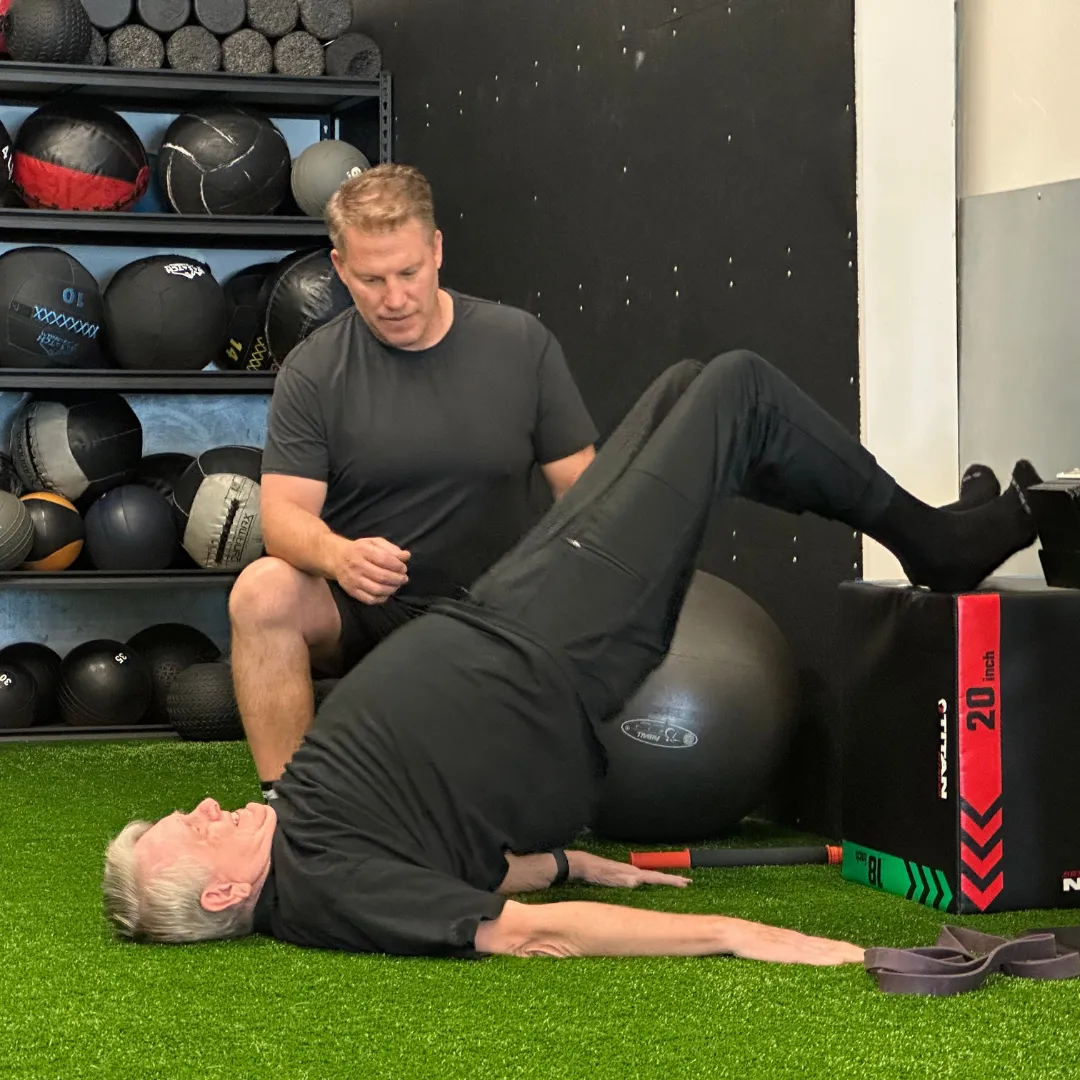
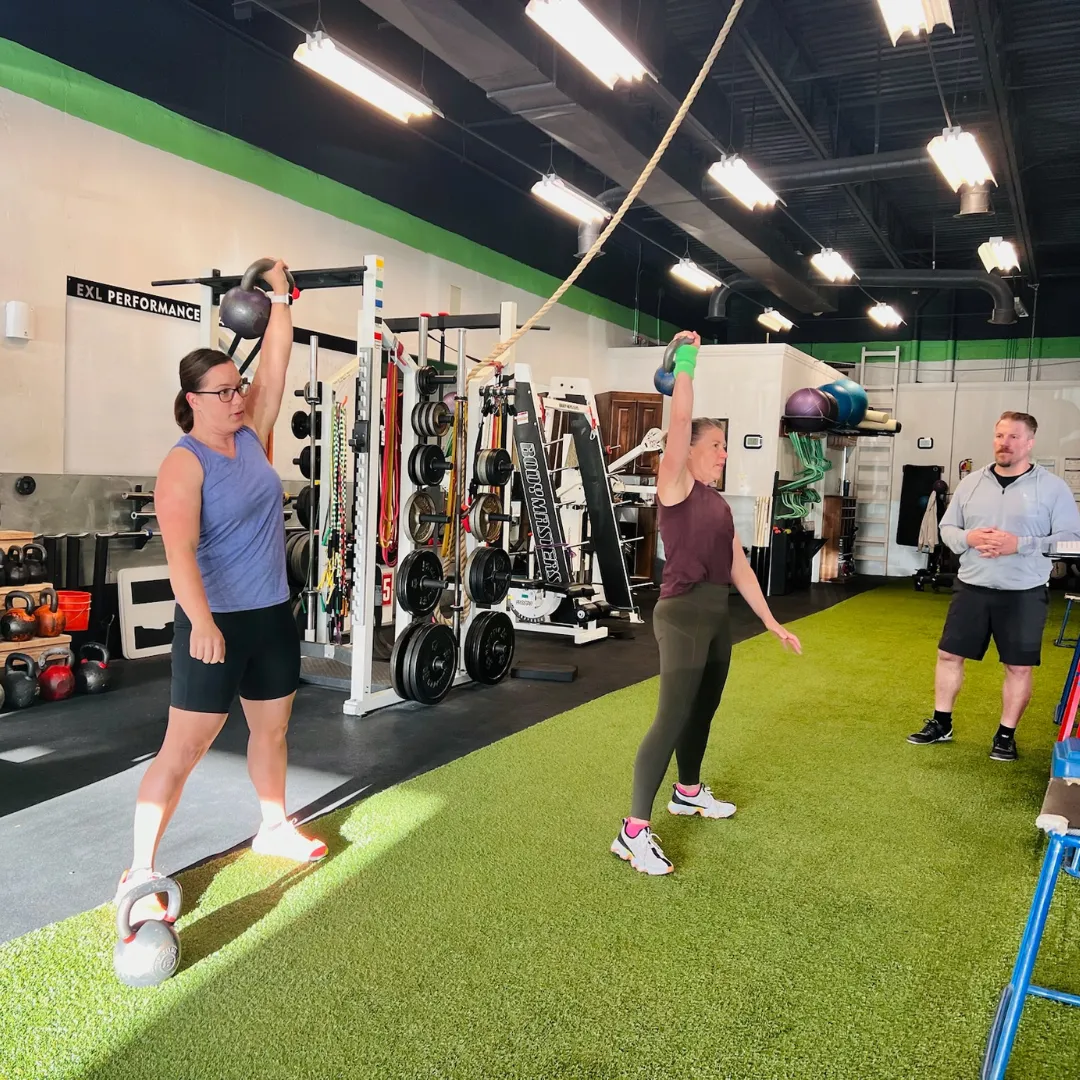
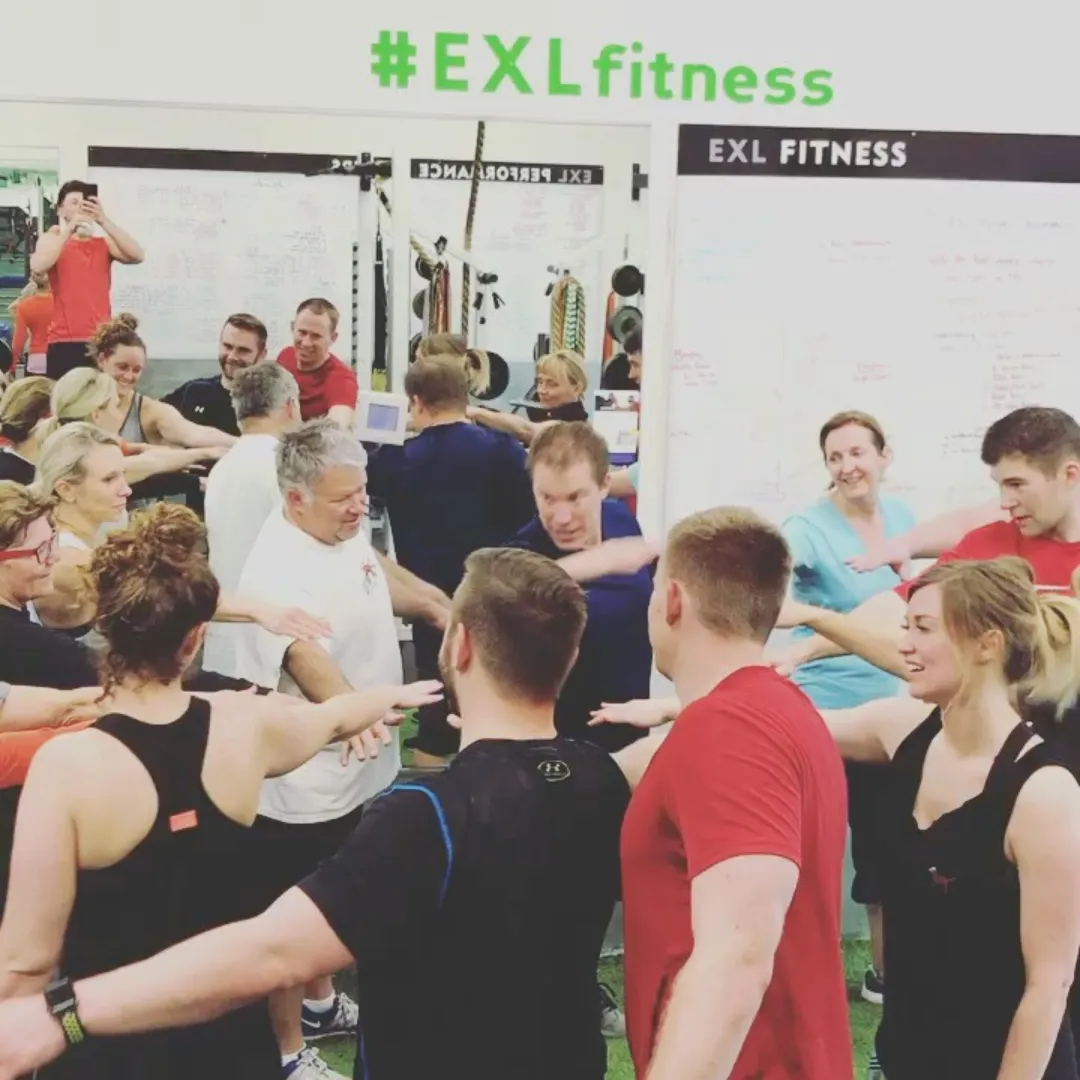
Below are a few of the warm-ups we utilize in our Orem EXL Fitness Boot Camp, as well as in our personal training settings. The big advantage to these routines is that they can literally be performed anywhere…no equipment and only with enough room to do a push-up.
Stay Fit,
Mat “the trainer”
Mat Gover BS, CSCS and Pam Gover CPT are Orem fitness boot camp instructors, personal trainers, and real world fat loss experts. They also own EXL Fitness & Performance, a personal and group training studio. To book Mat to speak at your Utah Valley company, club, or organization please contact him by email at matthetrainer@me.com or by phone at (801) 836.7185. For a free two-week trial to boot camp and experience the best personal training in Utah Valley please call Mat or drop by the gym (1623 N State St, Orem right next to Costa Vida).
NOTE: This is a newsletter emailed in January ’09, I’m posting it for archival purposes.
Hey, everyone, Mat the trainer again. In the last few emails we have been discussing the core. We have discussed some of the muscles that make up the core; some are obvious, some not so obvious. Let’s review the function of the core again. The core bolsters the spine and creates a stable platform from which muscles can contract to generate force (remember the battleship vs. canoe example). The core also transfers force from the lower body to the upper body, like in a golf swing. In the golf swing the muscles of the legs push against the ground to produce a force which then travels up the body through the core to the upper body and finally to the golf club. In essence the core links the upper and lower body. If the core is weak, energy is lost through the core as excess movement in the spine, hips and or shoulder girdle. To help clarify this, imagine your “core” as a bunch of rubber bands. As you torque your hips to swing the golf club, energy travels from your legs to your arms. Which kind of rubber bands would you like to have in your core connecting your legs to your arms? Thin, weak bands that don’t have a lot of snap? Or, thick, heavy bands with a lot of snap? Obviously the bands with a lot of snap. So the snappier (don’t even know if that’s a word) we get our core the less power we lose in our swing. This same example works with any movement pattern. The stronger the core the less energy is lost.So how do we strengthen it? Heck, how do we even contract our core?I’ll answer that question next time, and then we’ll get into the exercises.
The inaugural boot camp went off great. We still have some openings for those that have been procrastinating. Just ping me back or give me a call.
For most people Valentine’s Day is an excuse to blow their nutrition plan, eat a bunch of chocoloate and try to hook up with their significant other. Hey, sounds good to me.I’m all for enjoying a 10% meal and hooking up, but surely we can be more creative than that! Why not mix things up this V-Day with a fun workout you can do in the comfort of your home with your significant other?
Today I am going to demo the concept of partner training. Partner training is essentially a workout that involves performing exercises with at least one other person or more. There are a ton of benefits to partner training, including:
1.)Social Support and Accountability
2.)No Equipment Needed
3.)Provides a Ton of Variety
4.)Breeds Competition and Drives Better Results
5.)It’s FUN!
Partner training definitely spices things up. The inner freak seems to come out when you have someone you’re competing with and depending on within the workout itself.Whenever people workout with someone else- they are simply pushed to the limit and there is no better way to make their body change and break out of a frustrating training rut. My clients and I always joke that we hear the most ridiculous grunts and animal sounds during partner workouts, ha!
But, being that it’s the most important holiday of the year (yep, I was laying down some serious sarcastic undertones there), let’s make today’s partner training workout a little more intimate if you will.
So grab your luv-ah and try this bad boy out!
The Valentine’s Day Workout for Couples- Tabata Style Partner Training
This 20-minute total body partner workout will consist of all body weight-based exercises. For each exercise at each outlined station below you will alternate between 20 s of work and 10 s of rest. You will repeat this 30-second sequence eight times for four total minutes followed by a one-minute rest and transition before moving on to the next station listed:
Station#1- Partner Push-up-Row Combo
Partner Push-ups: Hold your partner’s feet from a standing position as they do as many push-ups as they can, then switch roles.An easier option A: while performing pushup bend your knees. Option B: while you partner is on all fours perform pushups with your feet on the floor and your hands on your partners back.
Partner Rows: Hold your partner’s hands from a standing position as they do as many body weight rows as they can, then switch roles.Another option is for both you and your partner stand in a quarter squat position facing each other and resist each other while doing rows.
Station #2- Partner Resisted Stationary Lunges- Static or Dynamic
Partner Lunges: Drop into a deep lunge position and hold as your partner applies downward force on your shoulders for you to fight against, then switch roles (can also be done with manual resistance in full range reps).Another option would be piggy back or fireman carry version.
Station #3- Partner Resisted Plank Circuit
Partner Plank: Get into a plank position and hold as your partner applies downward force with hands on your ribcage, then switch roles (alternate between front and L/R Side Planks).
Station #4- Partner Resisted Squats- Static or Dynamic
Partner Squats: Drop into a deep squat position and hold as your partner applies downward force on your shoulders for you to fight against, then switch roles (can also be done with manual resistance in full range reps). Another option would be piggy back or fireman carry version.
Now go ask someone to be your valentine and crank it! They say that sweat-driven pheromones are one of nature’s most powerful aphrodisiacs… you tell me .
Face it- we all want a flat, sexy midsection. But for many of us no amount of crunches or sit-ups seems to get the job done. I can’t tell you how many times people have asked me the following questions:
“I do hundreds of crunches and sit-ups a day and I still have a flabby midsection. What gives?”
Well, before I reveal your six-pack abs blueprint, let’s first debunk some very important myths about how to get six-pack abs:
Myth#1- Weight loss is the key to seeing your abs
WRONG!
The key to seeing your abs is FAT loss, not weight loss. Let me further explain: your body consists of fat mass and lean body mass (water, muscle, bone, organs, anything that is not fat). You want to minimize your fat mass and maximize your lean body mass to build a high metabolism: one that starves fat and builds muscle like clockwork. By improving body composition you will put yourself in the best position to rock that coveted six-pack.
So if you lose 17 lbs on the scale at the expense of losing some lean muscle mass in the process you will end up slowing your metabolism, decreasing performance, and losing that good looking muscle tone. But if you lose 17 lbs on the scale and you manage to keep or gain lean muscle mass you will increase performance, see more visible definition throughout your body, and lose primarily body fat.
The scale has far too many variables to account for that lead to frequent fluctuations such as hydration levels, sodium intake, and for women the menstrual cycle. I firmly believe one should NOT keep a scale at their home- it is such an anchor, particularly for women. Get off the scale.To accurately measure your progress get a body composition analysis performed every other week and make adjustments based on the trends established from consistent measurements. The true goal is fat loss, not weight loss. Focus on clothing size reduction, before and after pictures, and of course the mirror for the most accurate progress tracking.
Myth#2- Do lots of abs work to preferentially burn off stomach fat
WRONG!
Spot reduction doesn’t work. You can’t just work the muscles of a certain area of your body and expect to have the fat in that region go away. Think about it: millions of gym goers do crunches but proportionately very few people perform total body workouts. So, with all of these crunches, we’d expect to see nothing but people with flat tummies and fat everywhere else on their body (arms, legs, etc.). But think of how many people you see at the gym in the “ab section” doing crunches and sit ups but still have more than a few inches to lose in their midsection. See what I mean- spot reduction doesn’t work!
See, your body loses and gains fat in a genetically pre-determined way.You have no control where your body puts on body fat and vice versa you have no control of where it comes off.True fat loss is acquired when there is an appropriate caloric deficit AND hormonal environment created by proper eating and training. So your best bet is to focus on burning as many calories during your workouts as possible by engaging your whole body each and every training session (not just your abs). Compound, multi-joint movements like squats, push-ups, lunges, etc. (or better yet, total body exercises like squat to presses) burn a lot more calories than isolation movements like crunches and sit-ups. So be sure to focus on these movements first and then if you have time, you can do some extra core work to please the abs training Gods.
Myth#3- Crunches and Sit-ups are the best exercises for your abs
WRONG!
The scientific term for your six-pack muscles are your rectus abdominis. For years now, we have been conditioned to think that the best way to work your rectus abdominis is by doing endless crunches and sit-ups since these trunk flexion exercises make the muscles you want to see in the mirror “burn.” However, the true function of the rectus abdominis is to prevent hyperextension (swaying of the lower back), not to flex forward over and over again. Anytime you brace your abs (think kneel & reach) and pull your navel into your spine you effectively stabilize your spine into a safe, neutral position. And the moment you relax your abs and lose that braced abs position; your back will begin to hyperextend putting you at greater risk for injury.
So, we focus on stabilization exercises in all three planes of movement (saggital- front to back, frontal- side to side, and transverse- rotational) by using pillar exercise variations (also know as planks). Besides training the true “anti-extension” function of your superficial ab muscles, these bridging/stabilization exercises also activate the key transverse abdominus muscles, or your deep abdominal stabilizers, that wrap around your spine and support your internal organs. Strengthening these inner ab muscles is the key to optimal posture and performance in addition to injury prevention, yet another benefit to performing pillars over primitive crunches and sit-ups that often cause unwanted neck and back pain.
Myth#4- Do lots of long-duration cardio to burn the fat covering your abs
WRONG!
Both scientific research and real world case studies show that aerobic training for fat loss alone doesn’t work. Total body resistance training is the true foundation of any solid fat loss plan. In addition, interval training, where you alternate between bouts of maximum effort and active recovery, is scientifically proven to burn nine times more fat than ordinary exercise.
Without further adieu…
The Anti-Crunch Six-Pack Abs Blueprint:
Step#1- Lose the fat that is covering your abs so that you can see them
A.) The 10 Habits of Highly Lean Eaters (also good for optimum performance and overall good health)
1. Eat every 2-4 hrs, that means 5-6 meals a day
2. Eat lean protein with every meal about 20-30gr per meal
3. Eat veggies with every meal, and have a couple of servings of fruit every day
4. Eat other carbs (breads, pasta, rice) only within 1-2 hours of intense exercise
5. Don’t drink your calories, the exception being a workout shake, or a meal replacement shake that follows rules 2,3 and 6
6. Eat healthy fats throughout the day (everyone should supplement with fish oil)
7. Focus on whole foods
8. Plan out your nutrition and prepare your food
9. Plan on not following the rules 10% of the time (cheat meals)
10.Don’t eat the same thing everyday, have variety in your diet
B.) Train to lose fat and elevate metabolism
- Monday, Wednesday, and Friday- Perform Total Body Circuit Strength Training
Sample Total Body Circuit Strength Workout- 20 Minutes (not including five minute warm-up and cool-down)
50-10 Interval Five Exercise Total Body Circuit- You will alternate between 50 seconds of work and 10 s of rest for each exercise in the following five-exercise circuit. Perform this 5-minute circuit up to four times for a 20-minute total body workout:
Exercise#
Exercise Category
Exercise Variation
1
Double-Leg: Bilateral Hip-Dominant
Hip Extensions
2
Push: Horizontal Push
Push-up Variation
3
Single-Leg: Unilateral Knee-Dominant
Single-Leg Wall Sit
4
Pull: Horizontal Pull
Body Weight Rows
5
Core: Linear Stabilization or Trunk-Dominant
Upper Body Twist Variation
- Tuesday, Thursday, and Saturday- Perform Cardio Interval Training
Sample Cardio Interval Training Workout- 20 Minutes (not including five minute warm-up and cool-down)
30-30’s- You will alternate between 30 seconds of maximum effort and 30 s of active recovery. You will perform this 1-minute round up to 20x for 20 total minutes. You can perform this workout on your cardio machine of choice (airdyne or spin bike, running, etc.) or by alternating between the following body weight cardio exercises for the ultimate in-home workout:
Exercise#
Body Weight Cardio Variation
Body Weight Cardio Exercise
1
Linear
Locomotion Emphasis
Stationary Running
2
Lateral/Rotational
Locomotion Emphasis
Jumping Jacks Variation
Step#2- Train your abs based on their true function: STABILIZATION
Below is one of my boot camp client’s favorite (and most hated) core workouts. It involves no crunches or sit-ups by using all pillar stabilization exercises. Once you master these killer moves and follow everything else I previously listed above, you will have a sweet pair of rock hard abs to show for it… I guarantee it!
The 4 Point Core Workout- Tabata Style
This 20-minute total body core workout focuses entirely on pillar stabilization. The pillar collectively consists of your shoulders, hips, and core. It is your body’s powerhouse and is foundational to all movement.
For each exercise below you will alternate between 20 s of work and 10 s of rest. You will repeat this 30-second sequence eight times for four total minutes followed by a one minute rest and transition before moving on to the next exercise listed.
For maximum benefits, you must seek to maintain a tall, tight spinal position (remember kneel & reach) during all movements by actively pulling your navel to your spine, engaging your glutes, and maintaining a straight line from the heels through the shoulders. The following coaching cues work really well for our clients:
“Suck in your gut – tilt your belt buckle – be flat like a diving board.”
Exercise#1- Plank Variation (static or dynamic)
Exercise#2- Left Side Plank Variation (static or dynamic)
Exercise#3- Right Side Plank Variation (static or dynamic)
Exercise#4- Reverse Plank Variation (static or dynamic)
Today is the dawn of a new age in core training and it is my sincere hope that you take this killer information and run with it.
Next EXL Fitness Boot Camp Phase Begins Jan 4, 2012
Tired of spinning your wheels trying to get in shape on your own. Contact me now for a FREE Goal Assessment and Orientation. As always, boot camp comes with a complete nutrition program and a home cardio program. Face it...you need accountability and motivation. Contact me today!!!