The Best Lower Body Exercise Ever

28 07 2009

EXL_RGBAs a fitness trainer, I get a lot of questions like “What is the best exercise for ______” fill in the blank. I get asked as if there is one exercise that “rules them all” (to borrow a phrase from Lord of the Rings).  One of the most common areas of concerns is the lower body, specifically the butt and thighs. Today I’m going to share one of my personal favorite lower body exercises and all of its awesome variations. It’s called the Rear-Foot Elevated Split Squat  (a.k.a. Bulgarian Split Squat). This exercise is so effective that once you master it, your thighs and knees will be bullet proof!

Before we jump into this, one point I definitely don’t want to feed into is the idea of individual body part training and spot reduction.  Doing this killer leg exercise will NOT target fat loss in your legs.  I am a fervent believer in total body training, meaning that we train the upper body, lower body, and core during every single workout. By training the whole body at once we maximally stimulate lean muscle gain and metabolism and promote total body fat burning in order to effectively eliminate the body fat in all our favorite areas; yep the stubborn fat areas that prevent a good body from becoming a great body. Plus, a diet high in lean protein, fiber, and green veggies and low in unnatural fats and refined sugars and starches is of course a pre-requisite if you want to see your muscles pop in a good way.  It is also important to know that you lose fat in a genetically predetermined way.  You had no control where your body put on the body fat and likewise no control where it takes it off.  You can do all the crunches you want but without total body training, proper eating habits, and enough time to get to those stubborn fat areas you will never get rid of your gut, or your jiggly arms, or the junk in the trunk.

Massage away your trouble areas?   Are they for real???

Massage away your trouble areas? Are they for real???

Moving onto the main event: the world’s greatest lower body exercise. My favorite leg exercises are any sort of single leg exercise and their variations, which include split squats.  I prefer single leg exercise in lieu of their double leg counterparts for a myriad of reasons.  For people with back issues, single leg exercises allow them to safely perform lower body exercises without putting their lower lumbar spine in jeopardy of hyper flexion or excessive rounding that can cause back spasms in the short run and herniated discs in the long run.  Furthermore, I feel there’s often such a strength and/or mobility imbalance between one leg and the other that it’s critical to address one leg at a time to really shore up the weak links.  And life is performed assymetrically.  Meaning we rarely lift an object in a real life scenario with perfect double leg squat technique, most of the time we will be in a slightly staggered stance.  When we walk or run it is an example of single leg lunges.  So single leg exercises mimic life in a truly functional way.

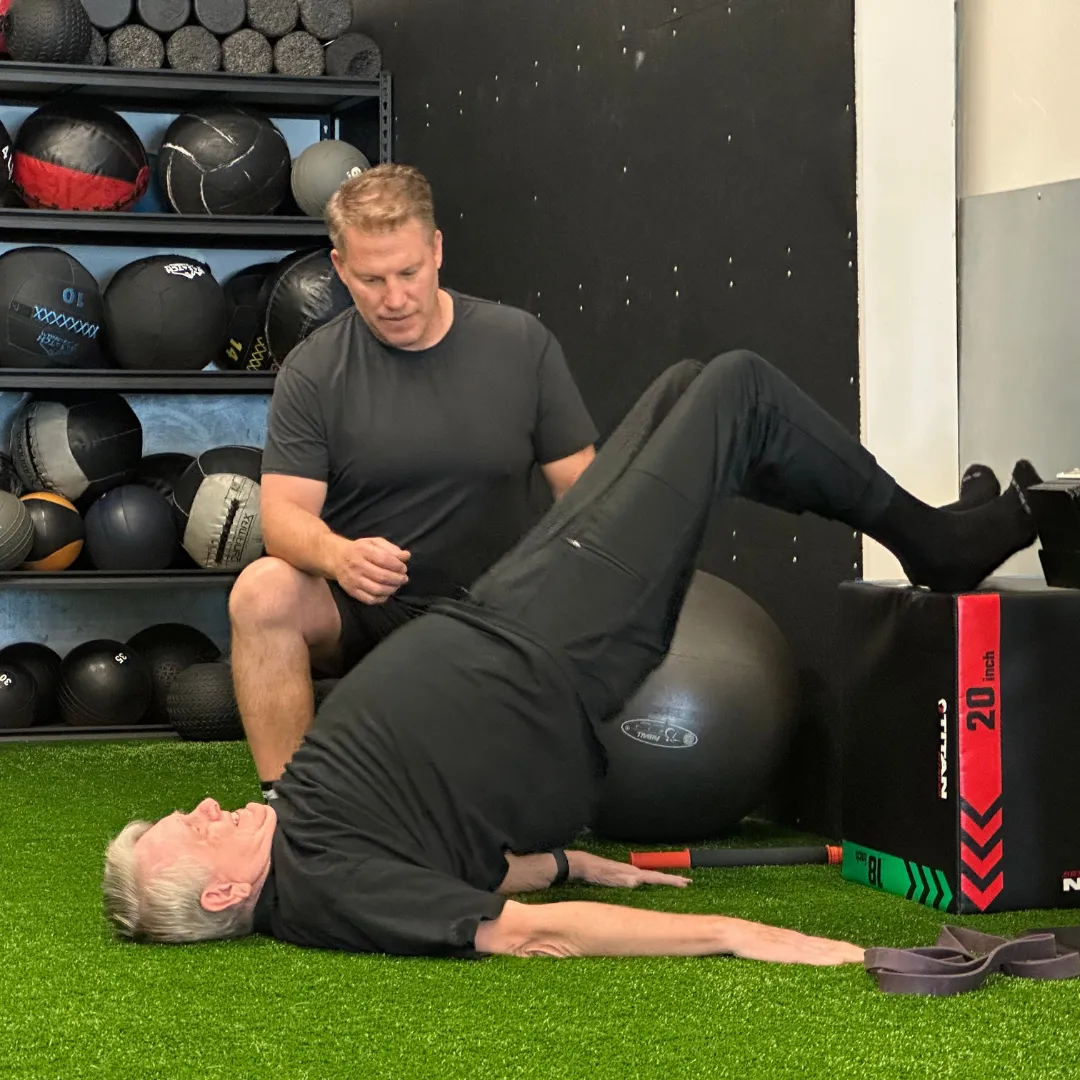
My favorite lunge variation is called the rear foot elevated split squat.  Regular split squats are basically stationary lunges.  Begin with one foot in front of the other in a long stride position.  A long stance position puts both knee at a 90 degree angle or slightly more when in the down position of the lunge.  Both feet stay planted toes straight ahead in the long stance and do not move.  The split squat is then performed keeping the front foot flat and dropping the back knee towards the floor.  This is the basic split squat, which I consider the basic of all single-leg, knee dominant exercises.  Once you have mastered the basic split squat you’re ready to move on to the rear foot elevated split squat.  Like the name infers, we’re going to elevate the back foot on a chair, bench, box, or any other sturdy foot support, usually about 12-18 inches high.  You’ll put your front leg well in front of you in order to make sure that your front knee and ankle are lined up, in other words your lower leg will be completely vertical when in the bottom of the lunge. In general, I tell people to exaggerate how far to put your front leg forward so that the front knee is almost slightly behind the ankle as this really helps reduce sheer forces on the knees. Initiate the exercise by loading the front heel (not the ball of your foot) and dropping your hips as low as you can in a pain-free range of motion while staying really tall up top with a proud chest and shoulders down and back. I use a stick to help maintain proper posture.  The back of your head, shoulder blades and tailbone should stay in contact with the stick throughout the entire range of motion.  Ideally I want to drop the back knee deep enough to ensure the front thigh gets down to horizontal.  To help with this I often put a 2-3″ pad under my knee so I have something to gauge my squat depth.  Finish the rep by explosively driving through your front heel to return to the top of the movement. You can start with body weight only in search of front thigh parallel to the floor or lower depth and then progress by adding speed of movement or by adding resistance. You can even incorporate some very cool combination movements with this lower body exercise like adding a curl to press at the top of the movement or even by raising dumbbells overhead to really challenge your core and single-leg balance and stability.

I have yet to find an exercise that hits the legs as hard as this baby does.  In particular, it really helps strengthen your vastus medialis, that inner quad muscle that looks like a teardrop, which is heavily responsible for tracking your patella and keeping your knee caps in line.  So if you have a history of overtraining injuries or patella-femoral issues this exercise is phenomenal for keeping your knees as bulletproof as possible, not to mention a dulcet set of thighs.

As an added bonus it provides a very good stretch for the hip flexor of your back leg, an area that is often very tight, especially for guys. Any exercise that allows you to simultaneously stretch and strengthen your body is a real keeper.  And because of the unstable nature of the exercise (balancing on one leg) it forces the stabalizers (inner and outer thigh muscles) to really fire.  So, don’t waste another moment with the useless abductor/adductor machine (a.k.a. thigh master 2000 ) and get off your butt and crank it with the world’s best lower body exercise today!

Stay Fit

Mat “the trainer”

PS- Feel free to post your comments on spot reduction or the rear foot elevated split squats or your opinion on the best lower body exercise..

PPS- as always feel free to share this blog post with anyone that is motivated by competition or  anyone looking to shed some fat, get stronger and feel more energy.

PPPS- word of the day: dulcet [duhl-sit] adjective: pleasant or agreeable to the eye or feelings; soothing.

To book Mat to speak at your Utah Valley company, club, or organizations please contact him by email at matgover@mac.com or by phone at (801) 836.7185. For a free one-week trial to his Orem boot camp to experience the best personal training in Utah Valley please call Mat or drop by the gym (1623 N State St, Orem right next to Costa Vida).


No Gym Equipment…No Problem

10 07 2009

EXL_RGB“It amazes me that most people spend more time planning out next summer’s vacation than  they do planning the rest of their lives.” Patricia Fripp, Professional Speaker

This can certainly be true for many people especially when it comes to planning their exercise and nutrition during these challenging summer months.  To combat this dilemma we are trying a couple of new things this summer.  First, we are taking our workouts outside.  The morning boot camps are actually outside at a near by park.  Second, we are having the  first ever EXL Fitness Skinny Jeans Lifestyle Transformation Contest.  It’s fun to mix it up a little bit and the weather couldn’t be better.  But more importantly, I wanted to show my campers the possibilities that they have when traveling for work or holiday this summer.  As well as help them stay accountable with a compliant dependent lifestyle transformation contest.

Summer is one of the hardest times to stay committed to an exercise and nutrition program.  The kids are out of school.  We have holidays, reunions, vacations, BBQ’s all sorts of events to pull us out of our routine.  Don’t get me wrong we should take breaks from both exercise and nutrition at certain times in the year, but only after we’ve been committed for extended periods of time.

For outdoor enthusiasts summer can be the easiest time to get in their exercise

For outdoor enthusiasts summer can be the easiest time to get in their exercise

As part of the skinny jeans contest I’m challenging my clients to perform exercise on a daily basis and to follow a nutrition plan.  Points are alloted for various forms of exercise and diet adherence.  Up for grabs are free training packages, massages, spa packages and a pair of designer jeans.  I would love to have a half a dozen winners tied with the most points, all with perfect scores.  But reality is, is that life happens.  Somethings are unavoidable, but there are many things we can do to schedule in our exercise, plan out our nutrition and get results.  Plus, I’m a firm believer in the 90% rule.  If you’re 90% compliant to your exercise and diet routine you will see results.  In fact, studies have shown almost immeasurable difference between 100% and 90% adherence (BTW, 90% adherence to 3 strength training workouts and 3 interval workouts a week in a 6 week phase means only missing 3 workouts.  90% adherence to 6 meals a week means out of 42 meals you only skip or eat something not on the meal plan 4 times a week). So plan on being completely fervid and faithful with an occasional mishap.  In the end you will see your goals to fruition.

To help with your exercise here is one of the outdoor boot camps we’re doing this week.  We just so happen to be doing this workout on a grass hill, but the workout is challenging even on flat ground.  There are 3 exercises in each circuit.  Each exercise is performed for the prescribed reps and then repeated continuously for 10 minutes with a 1 minute rest between circuits.  We actually perform a core specific circuit afterwards and then some energy system development (a sophisticated way of saying cardio).  This workout is definitely metabolic, the first few laps may seem a little easy, but it’ll catch up with you.

Circuit 1

1.  Bear Crawls up and down the hill: 1 rep up and down. The first time through the circuit face up the hill, the second time through face left, then faceright and then back to facing up hill.

2.  Partner Rows: 10 reps

3.  V rotations: 10 reps each side

Circuit 2

1.  Forward lunges up the hill, backward lunges down the hill: 1 rep up and down the hill

2.  Straight-leg sit ups: 10 reps

3.  Down Hill Skiers: 20 reps

Stay Fit

Mat “the trainer”

PS- Feel free to share your feelings and excitement about the Skinny Jeans Contest.  Or if you have any prizes you would be willing to throw into the competition let me know.

PPS- as always feel free to share this blog post with anyone that is motivated by competition or  anyone looking to shed some fat, get stronger and feel more energy.

PPPS- word of the day: fervid [fur-vid] heated or vehement in spirit, enthusiasm

To book Mat to speak at your Utah Valley company, club, or organizations please contact him by email at matgover@mac.com or by phone at (801) 836.7185. For a free one-week trial to his Orem boot camp to experience the best personal training in Utah Valley please call Mat or drop by the gym (1623 N State St, Orem right next to Costa Vida).


Hierarchy of Fat Loss (Factor #5)

27 03 2009

exl_rgb4The least effective tool in your fat loss arsenal is exercise that burns calories but does not do anything for increasing your metabolism or maintaining your lean muscle tissue.  Enter traditional, steady state “cardio” including hard cardio and low intensity cardio.  Both these have their benefits in the fat loss fight but should play only a small role.

What is “hard cardio”?  Technically it is cardio performed above your anaerobic threshold (AT).  This is the point at which your body burns only blood sugar or muscle glycogen for fuel (not fat).  This is typically around 75% of your maximum heart rate (MHR).  There are tests that require expensive lab equipment that can calculate your AT, but it is pointless unless you are training for an endurance event.  This is a fat loss post so knowing you AT is benign.  Just let it be know that when most people go out for a fun run or a ride and are exercising at a comfortable pace, they are most likely hitting around 80% of their MHR.  So anything at or above a comfortable pace is hard cardio.

images-31

Now you can burn some serious calories with hard cardio, but the down side is the time commitment and the fact that it doesn’t stimulate your metabolism to continue burning calories even after the workout.  Another problem is that on long bouts of steady state hard cardio, without appropriate workout nutrtion, your body will actually burn it’s own muscle tissue for fuel, sparing fat.

When I trained at a local commercial gym I saw it all the time.  People would come in hit the cardio deck for 45-60 minutes than come over and talk to me about how they’re following some 1200-calorie diet or some “cleanse”, and they’re wondering why they’re not losing weight.   Or if they are losing weight it’s the wrong kind…muscle.  I mentioned this in the first part of this article; they are headed down a road of future weight gain and sluggish metabolism.  Talk about counter productive.  So what about “low intensity cardio”?

Low intensity cardio is performed below the AT, and preferably around 50-60% MHR.  This is the intensity in which your body optimally uses fat for fuel.  Sounds great, huh?  You’re probably saying, “Mat, this is what I want…optimum fat loss…low intensity.  This is the Holy Grail of fat loss.  What gives?  Why is this the least most effective tool for fat loss?”  Now let me preface my response with a question, “Have any of you performed cardio at 50-60% MHR?”  If you have than you know it is embarrassingly slow.  I mean a brisk walk will take your heart rate to 50%images-22 MHR.  Do you know how many hours you would have to walk to burn any significant amount of calories?  A 175-lb man would burn about 250 calories/hour and a 130-pound woman would burn just over 200 calories/hour.  Because this is performed in the “ideal fat loss range” which means a larger percentage (75% at best) of the calories will most likely be fat that’s still very few calories.  Seventy-five percent of 250 and 200 are 188 and 150 respectively.  Good job!  You just burned off the caloric equivalent of a large apple, and you did nothing to stimulate your metabolism.  In a metabolically charged strength workout or a 20-30 minute HIIT you’ll easily burn that and then some, especially when you account for the “after burn” of an elevated metabolism.

Where does steady state cardio fit in?  It’s great to fit in after you’ve done the higher priority workouts…metabolically charged strength training and HIIT.  Either right after such a workout for 10-20 minutes or at other times in the week after you’ve completed your higher priority workouts and you have some free time.  A good example is HITT in the morning and steady state cardio at night.  You would choose steady state over another HIIT when you’re worried that you wouldn’t recover for the next day’s strength training workout.  Recovery from HIIT is a lot more challenging than from steady state cardio.  Even then you would have to be doing at least 5 hours a week of the strength training and HIIT before adding steady state cardio.

Isn’t it interesting that this flies in the face of what we traditionally think when planning on losing weight?  Most people think of hitting cardio first before committing to nutrition or even a strength training program.  Or my favorite excuse, “I’m going to hit cardio for a while…lose some weight, than I’ll come work out with you, Mat”.  In my mind, I think “Well, that’s worked for you in the past…not”.  Ninety-nine percent of the time they do a few cardio sessions, see minimal weight loss then stop exercising all together and stay in their fat limbo not exercising until they come to the harsh reality that their program isn’t working.

So how does this all fit into a schedule?  First of all learn about healthy nutrition and plan time to prepare your food.  Make healthy nutrition a priority first and foremost not an after thought.  If you’re wondering where to learn about healthy nutrition we offer a Precision Nutrition re-education course.  As far as exercise, the priority goes to metabolically intense strength training.  Perform three 45-60 minute sessions per week.  On the other days perform HIIT for 20–30 minutes.  Schedule 1 rest day per week, which can include low intensity cardio.  If you have more time or want to improve your results then add another HIIT workout on your cardio days (1 in the AM another in the PM).  If you’re worried about recovery, than replace the second HIIT workout with steady state cardio performed right after your remaining HIIT workout.  That’s approximately 6 hours of exercise a week.  If you have no life and have more than 6 hours a week to devote to exercise than you can start adding more steady state cardio, and most likely low intensity cardio to avoid impairing your recovery for your higher priority exercise.

There ya go the Fat Loss Hierarchy:

  1. Nutritionexercise-cartoon
  2. Nutrition
  3. Exercise that stimulates metabolism and promotes/maintains muscle tissue (metabolically charged strength training ie: boot camps, circuits, super sets, tri sets)
  4. Exercise that stimulates metabolism but doesn’t promote/maintain muscle tissue (HIIT, aerobic intervals)
  5. Exercise that burns calories, but doesn’t raise your metabolism or promote/maintain muscle tissue (traditional cardio high and low intensity)

So quite procrastinating, just go out and do it!

exercise-cartoon-1

Stay Fit

Mat “the trainer”

Mat Gover BS, CSCS and Pam Gover CPT are Orem fitness boot camp instructors, personal trainers, and real world fat loss experts. They also own EXL Fitness & Performance, a personal and group training studio.   To book Mat to speak at your Utah Valley company, club, or organization please contact him by email at matgover@mac.com or by phone at (801) 836.7185. For a free one-week trial to his Orem boot camp to experience the best personal training in Utah Valley please call Mat or drop by the gym (1623 N State St, Orem right next to Costa Vida).


Hierarchy of Fat Loss (Factor #3)

10 03 2009

exl_rgb1In the last post I introduced the 2 most important factors in fat loss…nutrition and nutrition.  In fact, nutrition is so important I don’t even bother measuring or testing a client’s body fat unless they have committed to a nutrition plan (preferably Precision Nutrition or The Carb Rotation Diet).  This week I’m continuing with the Fat Loss Hierarchy with #3…

#3   Activities that maintain or promote lean body mass (muscle) and elevate metabolism.  It goes to reason that you can burn more calories by increasing your total resting caloric expenditure i.e.: resting metabolic rate (RMR), than you can by just trying to raise your metabolism temporarily through exercise.  More muscle equals higher metabolism 24/7 not just during workouts.  This is one of the reasons men can lose fat faster than women.  Because of its metabolic impact strength training should be the foundation of your fat loss exercise plan.  This would include full body workouts that throw you’re metabolism for a spin.  Super sets, tri sets and circuit training that incorporate full body, multi-joint and multi-planar exercises that really “disturb the metabolism” and create an “after burn” that elevates your metabolism for several hours afterwards.

So how do you know if your workouts are “metabolically charged”?  Here are a few questions to ask:

    1. Do you perform exercises that incorporate multiple joints and large muscle groups?  If you find yourself standing in front of the mirror doing bicep curls, tricep pressdowns or shoulder presses then you’re most likely not impacting your metabolism as much as you could.  Try changing those exercises out for chin ups, dips and handstand push-ups/ handstands.  And do them in a super set or tri-set format with minimum rest between sets (30-90 seconds).  If that sounds like a lot of work, well…it is.  For this reason I recommend throwing in upper and lower body exercises in the same circuit, super set or tri-set.  Try doing 10-12 reps of a lunge variation super-setted with a pull up variation followed by a 60 second rest then repeat for 3-5 sets.  Or 3-5 sets of deadlift and pushups (or their variations) followed by a 60 second rest.  Perform 3-4 of these tri-sets in a workout and your metabolism will be cranking.
    2. Do you use machines?  Machines are crutches.  They do not allow your body to move in its natural movement patterns.  Machines designate the way your body moves.  In some programs (rehab, body building) machines have their place, but if you’re in the metabolism game choose exercises that require you to stabilize your body weight, free weights or a resistance band.  The more your body has to stabilize the more muscles are recruited.  The more muscles incorporated in an exercise as well as the higher the intensity the more you shake up your metabolism.  Machines don’t allow that to happen.
    3. Do you control your rest time?  Your rests between circuits, super-sets or tri-sets should be no longer than 90 seconds.  If you’re like most people you find yourself hanging out at the drinking fountain or making a phone call between sets.  Designate a workout time, where you can perform your entire workout without interruption. One of the formats we use in boot camp is “continuous work”.  We perform 3 exercises, an “upper body” exercise, a “lower body” exercise and a “cardio” or “core dependent” exercises in sequence for 10 minutes.  We do 10 reps on each exercise performing one exercise right after the next.  We repeat this tri-set for as many rotations as possible in 10 minutes, rest for a minute and then perform another 10 minute tri-set using alternate movement patterns.  Ask any of my campers, they’ll tell you how challenging ”continuous work” is.  Their muscles are burning and the cardio component is through the roof.  I would dare say that my boot campers get more done in one workout than most commercial gym members get done in a week.  A great example of this workout would be chin-ups, lunges and jumping jacks.  Try to do at least 5 rounds in 10 minutes performing 10 reps on each exercise.  This should really push your lactate threshold, if you you’re not struggling or feeling the burn then the intensity is not high enough and likewise, if you can do 10 or more rounds choose harder variations or add some resistance to the same exercises.

So there you have it, the third most important factor in fat loss, strength training.  But not just any strength training, “metabolically charged” strength training.  Workouts should challenge your strength, muscle endurance and will power.  If you still need some ideas on metabolically charging your workouts contact me for a free 1-week trial of boot camp.  And check back next week for The Hierarchy of Fat Loss, factor #4.

Stay Fit

Mat “the trainer”

Mat Gover BS, CSCS and Pam Gover CPT are Orem fitness boot camp instructors, personal trainers, and real world fat loss experts. They also own EXL Fitness & Performance, a personal and group training studio.   To book Mat to speak at your Utah Valley company, club, or organization please contact him by email at matgover@mac.com or by phone at (801) 836.7185. For a free one-week trial to his Orem boot camp to experience the best personal training in Utah Valley please call Mat or drop by the gym (1623 N State St, Orem right next to Costa Vida).


Follow

Get every new post delivered to your Inbox.