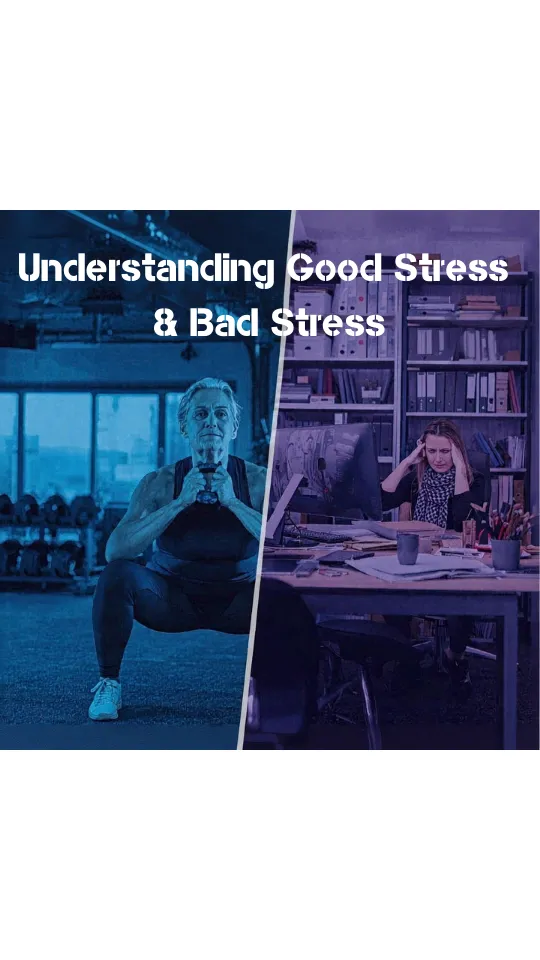
Good Stress vs. Bad Stress: Understanding Eustress and Distress for Better Health
Not all stress is created equal. In fact, some forms of stress are not only beneficial—they're essential for building the strength, resilience, and vitality you need for active aging and longevity.
At EXL Fitness in Orem, we help active adults ages 40-75 understand a crucial distinction: the difference between eustress (good stress that makes you stronger) and distress (bad stress that breaks you down). This knowledge transforms how you approach fitness, recovery, and overall wellness.
Understanding this difference isn't just academic—it's practical. When you know how to harness eustress and manage distress, you optimize your health outcomes, improve your training results, and extend your active years. You stop avoiding all stress and start strategically applying the right kinds while minimizing the harmful types.
Let's explore the science behind these two types of stress and how to leverage this knowledge to improve health, build stronger bodies, and live more vibrantly.
What Is Eustress? The Stress That Makes You Stronger
Eustress is positive stress that challenges your body or mind, leading to adaptation and growth. The term comes from the Greek prefix "eu" meaning "good" or "well." Think of eustress as a controlled challenge that temporarily disrupts your system, prompting it to adapt and become stronger.
Your body is incredibly adaptive. When you expose it to appropriate challenges—stressors that are significant but not overwhelming—it builds capacity to handle similar challenges more easily in the future. This is the fundamental principle behind all fitness training and many health interventions.
Eustress has several key characteristics:
It's temporary and controlled
It challenges you but doesn't overwhelm you
It leads to adaptation and improvement
It often feels accomplishing or energizing (even when difficult)
Your body recovers and becomes stronger afterward
For active adults committed to maintaining strength, bone density, and functional fitness, understanding and applying eustress is essential. Every effective training session applies eustress to your muscles, bones, cardiovascular system, and metabolism.
Eustress in Action: Strength Training
When you perform strength training at our gym in Orem, you're deliberately applying eustress to your muscles and bones. Here's what happens:
The Challenge: You lift weights that are heavy enough to challenge your muscles. This creates microscopic damage to muscle fibers and signals your bones to adapt.
The Stress Response: Your body perceives this as a challenge that needs to be addressed. Hormones are released. Inflammatory processes begin. Your nervous system adapts. You feel fatigued.
The Adaptation: With proper nutrition and recovery, your body repairs the muscle damage— but builds back slightly stronger. Your bones increase density in response to the load. Your nervous system becomes more efficient at recruiting muscle fibers.
The Result: You're stronger than you were before. You've increased muscle mass, improved bone density, and enhanced functional capacity. The temporary stress led to positive adaptation.
This is eustress at its finest. The workout temporarily stresses your system, but the result is improvement. For adults ages 40-75, this type of controlled stress is crucial for preventing age-related muscle loss (sarcopenia) and maintaining bone density to prevent osteoporosis.
Without the eustress of strength training, your body has no reason to maintain muscle and bone. The "use it or lose it" principle is really about applying appropriate eustress to signal to your body that strength still matters.
Eustress in Action: Cold Plunge Therapy
Another powerful example of eustress that's gained attention in recent years is cold-water immersion, or cold-plunge therapy. When you immerse yourself in cold water (typically 50-59°F) for 2-10 minutes, you're applying significant eustress to your body.
The Challenge: Cold water creates immediate physiological stress. Your heart rate increases. Blood vessels constrict. Your breathing quickens. Your body mobilizes resources to maintain core temperature.
The Stress Response: Your nervous system shifts into high alert. Stress hormones like norepinephrine spike. Your metabolism increases to generate heat. Inflammatory pathways are temporarily activated.
The Adaptation: With regular practice, your body becomes more efficient at managing cold stress. Your vagal tone improves (the ability to shift between stress and relaxation states). Your mitochondria (cellular energy producers) may increase in number and efficiency. Your resilience to other stressors improves.
The Result: Many people report improved mood, enhanced mental clarity, better stress management, reduced inflammation over time, and increased energy. The temporary discomfort leads to lasting benefits.
Cold plunge therapy exemplifies how controlled, temporary stress can lead to positive adaptations. The keyword is "controlled"—you choose when to enter and exit the cold water. You're applying eustress, not subjecting yourself to uncontrolled distress.
For active adults focused on longevity and functional fitness, cold exposure can complement strength training by supporting recovery, reducing chronic inflammation, and building stress resilience.
Other Examples of Eustress
Beyond workouts and cold plunges, eustress appears throughout life:
Intermittent Fasting: Temporary caloric restriction creates metabolic stress that can improve insulin sensitivity, promote cellular repair processes (autophagy), and potentially extend healthspan. The key is "intermittent"—it's controlled and temporary.
Sauna Use: Heat stress from sauna sessions (typically 15-20 minutes at 170-200°F) creates cardiovascular challenge, promotes heat shock proteins that protect cells, and may support longevity. Like cold exposure, it's controlled and time-limited.
Challenging Mental Tasks: Learning new skills, solving complex problems, or engaging in cognitively demanding activities creates mental eustress that builds cognitive reserve and may protect against age-related cognitive decline.
High-Intensity Interval Training (HIIT): Brief bursts of intense cardiovascular effort, followed by recovery, create metabolic and cardiovascular stress that improve fitness more efficiently than steady-state cardio alone.
Adequate Sun Exposure: Brief, regular sun exposure (without burning) creates mild stress that stimulates vitamin D production, supports circadian rhythm regulation, and may have other health benefits.
Notice the pattern: all these examples involve controlled, temporary challenges that prompt positive adaptations. They're manageable stresses applied intentionally to improve health and function.
What Is Distress? The Stress That Breaks You Down
Distress is negative stress that overwhelms your capacity to adapt. It's the stress we typically mean when we talk about "being stressed." Unlike eustress, distress doesn't lead to positive adaptation—it causes breakdown, dysfunction, and disease.
Distress has different characteristics from eustress:
It's often chronic or unpredictable
It exceeds your capacity to cope
It doesn't lead to positive adaptation
It feels overwhelming, draining, or anxiety-producing
Your body doesn't fully recover before the next stressor hits
For active adults trying to maintain health and fitness, distress is the enemy. It undermines your training results, impairs recovery, accelerates aging processes, and increases disease risk.
Examples of Distress
Chronic Work Stress: Ongoing pressure, deadlines, conflicts, or job insecurity that never resolves can cause a sustained elevation of stress hormones like cortisol. Unlike the temporary cortisol spike from a workout, chronic elevation impairs immune function, disrupts sleep, promotes fat storage (especially abdominal), and increases cardiovascular disease risk.
Relationship Conflict: Ongoing tension in meaningful relationships creates psychological and physiological stress, affecting health. Studies show that people in high-conflict relationships have impaired wound healing, higher inflammation markers, and increased disease risk.
Financial Worry: Persistent anxiety about money creates chronic stress that affects decision-making, sleep quality, and physical health. The stress isn't building capacity—it's simply draining resources.
Sleep Deprivation: Inadequate or poor-quality sleep is a form of chronic stress on your body. Unlike a challenging workout that temporarily stresses your body, sleep deprivation prevents recovery and adaptation. It's all breakdown, no build-up.
Overtraining: Yes, even exercise can become distressing. When you train too frequently, too intensely, or without adequate recovery, you cross the line from eustress to distress. Instead of getting stronger, you get weaker, injured, or ill.
Chronic Inflammation: While acute inflammation is part of healthy healing (like after a workout), chronic low-grade inflammation from poor diet, excess body fat, stress, or other factors damages tissues and accelerates aging.
Information Overload and Digital Stress: Constant connectivity, news consumption, social media engagement, and digital interruptions create persistent low-level stress that never allows full relaxation.
The defining characteristic of distress is that it doesn't lead anywhere positive. Your body can't adapt to make chronic worry or sleep deprivation less harmful. These stressors simply accumulate damage over time.
The Biological Difference: Why Eustress Helps and Distress Hurts
Both eustress and distress activate your body's stress response system—the hypothalamic-pituitary-adrenal (HPA) axis and sympathetic nervous system. Both release stress hormones, such as cortisol and adrenaline. So why do they have such different effects?
Duration and Recovery: Eustress is temporary with built-in recovery periods. Your cortisol spikes during your workout, then returns to baseline (or below) afterward. Distress keeps cortisol chronically elevated with insufficient recovery.
Predictability and Control: Eustress is typically predictable and controllable. You choose when to work out, how long to stay in the cold plunge, and when to end your fast. Distress often feels unpredictable and uncontrollable, which amplifies its harmful effects.
Intensity and Capacity: Eustress challenges you near your adaptive capacity but not beyond it. It's challenging but manageable. Distress exceeds your capacity to cope, overwhelming your systems.
Hormetic Response: Eustress activates beneficial cellular processes through hormesis—the principle that mild stressors activate protective mechanisms. Think of it as "what doesn't kill you makes you stronger," but only if the stress is brief and followed by recovery.
Psychological Perception: How you perceive stress matters biologically. Research shows that viewing a challenge as a "threat" versus an "opportunity" literally changes your physiological response. Eustress is typically framed positively; distress, negatively.
For active adults ages 40-75 focused on longevity, the goal isn't to eliminate all stress—it's to maximize beneficial eustress while minimizing harmful distress.
The Fitness Paradox: When Good Stress Becomes Bad
Here's where things get tricky: eustress can become distress if applied incorrectly. This is especially important for our clients at EXL Fitness who are committed to training consistently.
Overtraining happens when you apply training stress too frequently or intensely without adequate recovery. What starts as beneficial eustress becomes harmful distress. Signs include:
Persistent fatigue that doesn't improve with rest
Decreased performance despite continued training
Increased injuries or illness
Sleep disturbances
Mood changes (irritability, depression, anxiety)
Loss of motivation to train
For adults over 40, recovery capacity naturally decreases with age. The workout that provided perfect eustress at 30 might create distress at 50 or 60 without proper modification and recovery.
This is why at our personal training facility in Orem, we emphasize not just working hard, but recovering smart. We program rest days, adjust training intensity based on how you're recovering, and monitor signs that eustress might be tipping into distress.
The Goldilocks Principle: Your training needs to be "just right"—enough stress to stimulate adaptation, but not so much that you can't recover. Too little stress (undertraining) doesn't build strength. Too much stress (overtraining) breaks you down.
Science-Based Strategies to Manage Distress
While we want to maximize beneficial eustress, we need effective strategies to minimize and manage harmful distress. Here are evidence-based approaches:
1. Prioritize Sleep Quality and Quantity
Sleep is your primary recovery tool. It's when your body repairs damage from eustress and when you're most protected from distress.
The Science: Sleep deprivation increases cortisol, reduces growth hormone (essential for muscle building and repair), impairs glucose metabolism, increases inflammation, and reduces cognitive function.
Actionable Strategies:
Aim for 7-9 hours of sleep per night (individual needs vary)
Maintain consistent sleep and wake times, even on weekends
Create a dark, cool (65-68°F) sleeping environment
Limit screen exposure 1-2 hours before bed
Avoid caffeine after 2 PM
Consider magnesium supplementation (discuss with your doctor)
Use relaxation techniques before bed
For active adults over 40, sleep becomes even more critical as natural recovery capacity decreases. The hard workout that felt fine at 30 might require more sleep for adequate recovery at 50.
2. Practice Deep Breathing and Breathwork
Controlled breathing directly activates your parasympathetic nervous system (the "rest and digest" state), counteracting the stress response.
The Science: Slow, deep breathing (especially with extended exhales) stimulates the vagus nerve, which reduces heart rate, lowers blood pressure, and shifts your nervous system from stress to relaxation.
Actionable Strategies:
Box Breathing: Inhale for 4 counts, hold for 4, exhale for 4, hold for 4. Repeat for 5 minutes.
4-7-8 Breathing: Inhale for 4 counts, hold for 7, exhale for 8. This extended exhale is especially calming.
Diaphragmatic Breathing: Breathe deeply into your belly (not shallow chest breathing). Place your hand on your abdomen to feel it rise.
Practice 5-10 minutes daily, especially during stressful moments
This is one of the fastest-acting stress management tools available. It works within minutes and requires no equipment.
3. Engage in Regular Movement and Exercise (But Don't Overtrain)
Physical activity is paradoxically both a eustress and a distress management tool. The key is appropriate dosing.
The Science: Regular moderate exercise reduces chronic stress hormones, improves mood through endorphin and neurotransmitter production, enhances sleep quality, and improves stress resilience.
Actionable Strategies:
Engage in strength training 2-4 times per week (eustress for muscle and bone)
Include moderate cardiovascular activity (walking, hiking, cycling)
Don't train intensely every day—include lighter movement days
Take at least 1-2 complete rest days weekly
Listen to your body—if you're not recovering, reduce training stress
At EXL Fitness, we design programs that provide optimal training stress without tipping into overtraining. For adults 40-75, this balance is crucial.
4. Practice Mindfulness Meditation
Mindfulness—non-judgmental awareness of the present moment—has robust evidence supporting its role in stress reduction.
The Science: Regular meditation practice decreases activity in the amygdala (the brain's stress center), increases gray matter in brain regions associated with emotional regulation, reduces cortisol, and improves perceived stress and anxiety.
Actionable Strategies:
Start with just 5 minutes daily (consistency matters more than duration)
Use apps like Headspace, Calm, or Insight Timer for guidance
Focus on breath awareness or body scan techniques
Don't judge yourself for "doing it wrong"—noticing your mind wander and returning to focus IS the practice
Gradually increase to 10-20 minutes as it becomes comfortable
Research shows benefits appear within 8 weeks of regular practice, with effects increasing over time.
5. Maintain Strong Social Connections
Social support is one of the most powerful stress buffers identified in psychology research.
The Science: Strong social connections reduce cortisol response to stressors, improve immune function, increase longevity (as much as quitting smoking!), and provide practical and emotional resources during difficult times.
Actionable Strategies:
Prioritize time with friends and family who support your wellbeing
Join communities aligned with your values (like our gym community at EXL Fitness)
Reach out when you're struggling—connection reduces stress more than isolation
Offer support to others—helping reduces your own stress
Limit time with people who increase your stress (when possible)
The gym community we've built in Orem provides social support while also helping you achieve your fitness goals.
6. Spend Time in Nature
Nature exposure has measurable stress-reducing effects, beyond simply being outdoors.
The Science: Time in natural environments reduces cortisol, blood pressure, and heart rate. It decreases rumination (repetitive negative thinking), improves mood, and enhances cognitive function. Even brief nature exposure (15-20 minutes) shows benefits.
Actionable Strategies:
Take walks in parks, canyons, or natural areas (we have incredible access in Utah!)
Combine nature exposure with exercise (hiking, trail running)
Practice "forest bathing" (shinrin-yoku)—slow, mindful time in nature
Even views of nature through windows provide benefits
Aim for at least 120 minutes in nature per week (cumulative)
Living in Utah Valley gives us extraordinary access to stress-reducing natural environments—one of the reasons location gratitude matters for health.
7. Limit Caffeine and Alcohol
Both substances affect your stress response system, often in ways that worsen distress.
The Science: Caffeine increases cortisol and can amplify anxiety, especially when consumed in excess or late in the day. Alcohol disrupts sleep architecture, increases nighttime cortisol, and impairs recovery. Both can create dependency that adds stress.
Actionable Strategies:
Limit caffeine to 200-400mg daily (about 2-4 cups of coffee)
Avoid caffeine after 2 PM to protect sleep
Consider caffeine-free periods to reset tolerance
Limit alcohol to 1-2 drinks per occasion, not daily
Avoid using alcohol as a stress management tool
Stay well-hydrated with water
For active adults focused on recovery and stress management, moderation with these substances significantly impacts results.
8. Practice Progressive Muscle Relaxation (PMR)
This technique systematically tenses and relaxes muscle groups, reducing physical tension and stress.
The Science: PMR reduces muscle tension (which both causes and results from stress), lowers blood pressure and heart rate, and improves body awareness of tension patterns.
Actionable Strategies:
Starting with your feet, tense muscles for 5 seconds, then release for 30 seconds
Progress through legs, abdomen, chest, arms, neck, and face
Practice 10-15 minutes before bed or during stressful periods
Notice where you habitually hold tension (jaw, shoulders, etc.)
Regular practice improves your ability to recognize and release tension
This pairs well with the functional fitness work we do at our gym—you become more aware of how your body feels and responds to stress.
9. Maintain Blood Sugar Stability
Blood sugar fluctuations create physiological stress that compounds psychological stress.
The Science: Low blood sugar (hypoglycemia) triggers the release of stress hormones, including cortisol and adrenaline. High blood sugar and insulin spikes create inflammatory stress. Stable blood sugar supports a stable mood and energy.
Actionable Strategies:
Eat protein with every meal (25-40g for adults over 40)
Include healthy fats (avocado, nuts, olive oil, fatty fish)
Choose complex carbohydrates over refined sugars
Don't skip meals, especially breakfast
Avoid prolonged periods without food (unless practicing intentional fasting)
Limit sugary foods and drinks
This nutritional foundation supports both your training results and your stress management.
10. Set Boundaries and Manage Time
Much modern distress comes from overcommitment and lack of boundaries.
The Science: Perceived lack of control and time pressure increase stress hormones and reduce well-being. Boundary-setting improves sense of control and reduces stress.
Actionable Strategies:
Learn to say no to commitments that don't align with priorities
Schedule recovery time like you schedule workouts
Limit work emails/calls outside work hours
Batch similar tasks to reduce context-switching stress
Identify and eliminate time-wasting activities
Protect your sleep schedule as non-negotiable
For busy adults 40-75 juggling multiple responsibilities, boundaries become essential for sustainable health.
11. Consider Professional Support
Sometimes distress requires professional intervention, and that's not only okay—it's wise.
The Science: Therapy (especially cognitive-behavioral therapy) has strong evidence for reducing stress, anxiety, and depression. Medication can be appropriate for clinical conditions. Working with professionals prevents minor stress from becoming major health problems.
Actionable Strategies:
Consider therapy if stress feels overwhelming or persistent
Work with healthcare providers to address underlying health issues
Don't view seeking help as a weakness—it's strategic health management
Address hormone imbalances that might worsen stress response
Consider working with stress management coaches or psychologists
At EXL Fitness, we recognize that we're one part of your health team. Sometimes managing distress requires the involvement of other professionals, and we encourage clients to build comprehensive support systems.
The Balance: Applying Eustress While Managing Distress
The goal isn't to eliminate all stress—it's to optimize your stress profile. You want enough eustress to drive positive adaptations while minimizing distress that causes breakdown.
In Practice, This Looks Like:
Monday: Strength training session (eustress) + 10 minutes of meditation (distress management) + 8 hours of sleep (recovery)
Tuesday: Light walk in nature (mild eustress + distress management) + social time with friends (distress management)
Wednesday: Strength training (eustress) + cold plunge (eustress) + relaxation techniques (distress management)
Thursday: Rest day—gentle movement only + focus on stress management practices
Friday: Training session (eustress) + evening in nature (distress management)Weekend: Active recreation (hiking, biking—mild eustress) + quality sleep + social connection
Notice the pattern: controlled eustress through training, balanced with distress management practices and adequate recovery.
Age Considerations: Stress Management for Adults 40-75
As we age, our stress response systems change. Both eustress and distress management require adjustment:
Decreased Recovery Capacity: Adults over 40 need more recovery time between intense training sessions. The eustress that built strength at 30 might, without adequate rest, create distress at 50.
Hormonal Changes: Declining testosterone, growth hormone, and thyroid function affect both stress response and recovery. Working with healthcare providers to optimize hormones (as I do) can significantly impact how you handle stress.
Increased Stress Accumulation: Decades of life often mean accumulated responsibilities— career demands, family obligations, aging parents, and financial pressures. Distress management becomes more critical, not less.
Greater Stakes: Poor stress management at 50 or 60 has more immediate health consequences than at 25. Preventing disease and maintaining function requires a better balance of stress.
This is precisely why our approach at EXL Fitness in Orem and Pleasant Grove emphasizes recovery and stress management as much as training intensity. We're not training college athletes—we're helping adults 40-75 build sustainable strength and vitality for decades to come.
Practical Application: Your Weekly Stress Audit
To optimize your stress profile, conduct a weekly audit:
Eustress Assessment:
Am I training 2-4 times per week with adequate intensity?
Am I challenging myself with new skills or learning?
Am I applying controlled eustress (cold exposure, sauna, etc.) appropriately?
Am I recovering adequately between eustress applications?
Distress Assessment:
What are my main sources of chronic stress?
Which stressors can I eliminate or reduce?
Am I practicing daily distress management techniques?
Is my sleep adequate (7-9 hours)?
Are my relationships supportive or stress-inducing?
Recovery Assessment:
Am I getting 7-9 hours of quality sleep?
Am I taking at least 1-2 complete rest days from training?
Am I practicing active recovery (walking, stretching)?
Am I fueling recovery with adequate protein and nutrition?
This regular assessment helps you stay in the optimal zone—enough eustress for growth, managed distress for wellbeing, and adequate recovery for adaptation.
The EXL Fitness Approach: Optimizing Your Stress Profile
At our personal training facility in Orem and Pleasant Grove, we help clients optimize their stress profiles through:
Individualized Programming: We design training that provides optimal eustress for YOUR current capacity and recovery ability, not generic programs that might overtrain some people and undertrain others.
Recovery Integration: We program rest days, deload weeks, and recovery protocols as deliberately as we program training stress.
Education: We teach clients to recognize signs of overtraining and distress, empowering them to adjust their approach.
Community Support: Our gym community provides the social connection that buffers distress while supporting your commitment to health.
Holistic Perspective: We recognize that training is one part of your stress profile, and we encourage practices that manage distress outside the gym.
For active adults 40-75, this comprehensive approach is essential for building strength, maintaining bone density, and extending active years without burning out or breaking down.
Final Thoughts: Embracing the Right Stress
The message isn't "avoid all stress"—it's "embrace beneficial stress while managing harmful stress."
Your workout is stressful. Your cold plunge is stress. Challenging yourself to learn new skills is stressful. But these are all eustress—controlled challenges that make you stronger, more resilient, and more capable.
Chronic worry, sleep deprivation, overtraining, and persistent relationship conflict are distress —uncontrolled stresses that break you down without building you up.
The adults who thrive in their 40s, 50s, 60s, 70s, and beyond aren't those who avoid all stress. They're those who strategically apply beneficial stress, manage harmful stress effectively, and recover adequately between challenges.
At EXL Fitness, we're here to help you find that balance. We provide the eustress of effective training in a supportive environment. We encourage the recovery and distress management practices that make that training sustainable. We help you build a body and a life that can handle stress without being overwhelmed.
Because the goal isn't just to live longer—it's to live stronger, more capable, and more vibrant for all the years you're given.
At EXL Fitness in Orem and Pleasant Grove, we specialize in helping active adults ages 40- 75 optimize their stress profiles through personalized strength training, recovery protocols, and comprehensive wellness support. Our approach balances beneficial training stress with adequate recovery and distress management strategies. If you're ready to build strength and resilience while avoiding burnout and overtraining, contact us today to learn about our personal training programs designed specifically for sustainable, long-term health and vitality.


