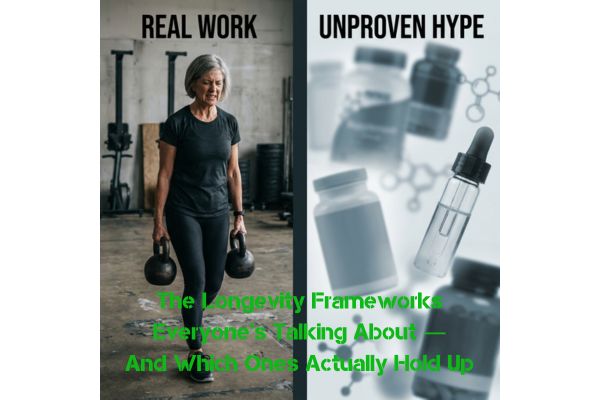
The Longevity Frameworks Everyone's Talking About — And Which Ones Actually Hold Up
Longevity is having a moment. Blue Zones documentaries, $2,000 "biological age" blood panels, guys drinking green juice on camera at 5 a.m. and calling it a protocol—it's everywhere, and much of it is marketing dressed up as science.
That matters to you, because you're not chasing a number on a dashboard. You're trying to stay strong enough to keep up with grandkids, hike Provo Canyon at 65, and not spend your 70s managing a joint replacement. So it's worth knowing which of these trendy longevity frameworks are backed by real evidence—and which are expensive theater.
Here's an honest rundown of six ideas you've probably heard, and what actually holds up under scrutiny.
Blue Zones: The Inspiring Story That Wasn't Backed by Real Data
Blue Zones — the idea that pockets of the world (Okinawa, Sardinia, Ikaria) produce unusual numbers of centenarians because of diet and lifestyle — became a bestselling book, a Netflix series, and a dietary movement. It's also, according to recent research, largely a data error.
Demographer Saul Newman (whose work won an Ig Nobel Prize in 2024) found that the regions with the highest reported rates of extreme old age also have the worst record-keeping, the least access to birth certificates, and the strongest financial incentive for pension fraud — not the healthiest lifestyles. In several cases, "supercentenarians" turned out to be dead people whose relatives kept collecting their pension checks. Newman also pointed out that Okinawa, held up as the vegetable-and-sweet-potato blue zone, actually has some of the lowest vegetable consumption in Japan.
None of this means "eat more plants and stay socially connected" is bad advice — it isn't. But the Blue Zones brand oversold a story that the underlying data doesn't support. Treat it as inspiration, not evidence.
Verdict: Mostly doesn't hold up. The lifestyle advice is generically reasonable; the claim that "these specific regions are longevity secrets" is not.
VO2 Max: The One That Keeps Checking Out
VO2 max — your body's maximum capacity to use oxygen — is one of the few longevity metrics with genuinely strong data behind it. A large study following roughly 122,000 people found a near straight-line relationship between fitness level and mortality risk: people in the lowest fitness category had dramatically higher death rates than everyone else, and moving from "low" to just "average" fitness cut ten-year mortality risk by around half. That's a bigger effect size than quitting smoking.
This is why we don't treat cardio as an afterthought at EXL. Zone 2 work builds the aerobic base; intervals push the ceiling. Both matter, and the payoff isn't hypothetical.
Verdict: Holds up. This is one of the best-supported ideas in the entire longevity conversation.
Grip Strength: A Surprisingly Powerful Predictor (Not the Point Itself)
Grip strength shows up constantly in longevity research, and for good reason — the PURE study, which tracked roughly 140,000 adults across 17 countries, found grip strength predicted all-cause and cardiovascular mortality more strongly than systolic blood pressure. Weak grip, worse odds. Strong grip, better odds.
Here's the nuance: nobody thinks your hands are secretly running the show. Grip strength is a proxy for overall muscle mass, neuromuscular function, and how much resistance training your body has been exposed to. It's a marker of what you've built, not a lever you pull on its own.
Verdict: Holds up as a marker — but train the whole body, not your grip in isolation. Deadlifts, carries, and rows will improve your grip strength as a side effect of doing the actual work.
NAD+ Boosters (NMN, Resveratrol): Expensive Hope, Thin Evidence
NAD+ boosting supplements are among the most heavily marketed longevity products, often citing decades of animal research showing lifespan extension in mice and yeast. The problem is the jump from mice to you. Human trials on NMN and resveratrol so far have been small, short, and inconsistent — some show modest improvements in specific biomarkers like insulin sensitivity or walking distance, others show nothing, and none have demonstrated that these supplements actually extend human lifespan, because that trial would take decades to run.
That's not a moral judgment on anyone taking them. It's just accurate to say the evidence right now doesn't support the price tag or the promises on the label.
Verdict: Doesn't hold up yet. Promising in petri dishes and mice; unproven in people.
Biological Age Tests: Real Science, Not Ready to Run Your Life
Epigenetic clocks — tests that estimate your "biological age" from a blood or saliva sample — are a legitimate and fast-moving area of aging research. The problem is what happens when that research gets sold directly to consumers. Multiple clocks trained on different data sets can give you meaningfully different results for the same sample, and researchers are increasingly cautious about using any single clock to guide an individual's personal decisions. These tools were built to measure aging trends across large populations, not to hand one person a definitive number.
Verdict: Interesting, not actionable yet. Fun to see; not something to build your training or supplement stack around.
Bryan Johnson-Style Biohacking: What Extreme Self-Experimentation Actually Proves
Bryan Johnson's "Blueprint" protocol — dozens of daily supplements, extreme caloric control, a team of physicians, a reported budget in the millions — gets a lot of attention because it's dramatic. But an N of 1, self-reported, uncontrolled experiment doesn't prove that any single piece of the protocol works, and several physicians have publicly pushed back on both his methods and his claims. It's a fascinating case study in obsession. It is not a template for a 55-year-old in Orem who wants to keep hiking with his kids.
Verdict: Doesn't hold up as a model. Entertaining, not instructive.
What to Actually Do
Lift, 2–3x a week. It's the one lever that moves grip strength, muscle mass, and functional independence all at once — no supplement or blood panel does that.
Build your aerobic base, then add intervals. Zone 2 work a few times a week, plus one or two harder efforts, is what actually moves VO2 max — the metric with the strongest longevity data of anything on this list.
Get your protein in deliberately. Most adults over 50 are running a deficit without realizing it; it won't show up on a biological age test, but it shows up in how much muscle you keep.
Skip the $2,000 panel for now. Biological age tests are a fun data point, not a decision-making tool — the individual-level reliability isn't there yet.
Be skeptical of anything sold as a shortcut. If a supplement, protocol, or test claims to replace training, sleep, and protein, that's the tell that it's marketing first and science second.
The Bottom Line
Strip away the branding and the supplement stacks, and the longevity science that consistently holds up looks almost boring: build and keep muscle through resistance training, build a strong aerobic engine through Zone 2 and intervals, eat enough protein, sleep like it's part of your program instead of an afterthought, and stay consistent for years, not weeks.
That's not a sexy documentary. It's just what works — and it's exactly what we build here every day. No $2,000 blood panel required.
References
Newman, S. (2024). Demographic analysis of Blue Zones centenarian data — record-keeping errors and pension fraud as predictors of extreme age claims. Coverage: UCL, "UCL demographer's work debunking 'Blue Zone' regions of exceptional lifespans wins Ig Nobel Prize" (2024).
Mandsager, K., et al. (2018). Association of Cardiorespiratory Fitness With Long-Term Mortality Among Adults Undergoing Exercise Treadmill Testing. JAMA Network Open.
Leong, D. P., et al. (2015). Prognostic value of grip strength: findings from the Prospective Urban Rural Epidemiology (PURE) study. The Lancet.
Poljsak, B., et al. (2024). Review of NMN/NAD+ precursor human clinical trials — mixed and preliminary findings. Frontiers in Pharmacology.
Medscape (2025). "Epigenetic Clocks: New Types, New Promises, New Skepticism."
American Council on Science and Health (2025). "Longevity or Marketing? Dissecting the Claims of the Blueprint Protocol."
→ Book a free intro session at EXL Fitness https://calendarapp.net/booking
Mat Gover, BS, CSCS, is the owner and head coach of EXL Fitness & Performance in Orem, Utah. With nearly 30 years of coaching experience and a specialization in strength and performance for adults over 40, Mat brings science-backed training and a no-fluff approach to every session. When he's not coaching, he's skiing the Wasatch, mountain biking the Uintas, or out in the red rock around the San Rafael Swell.


