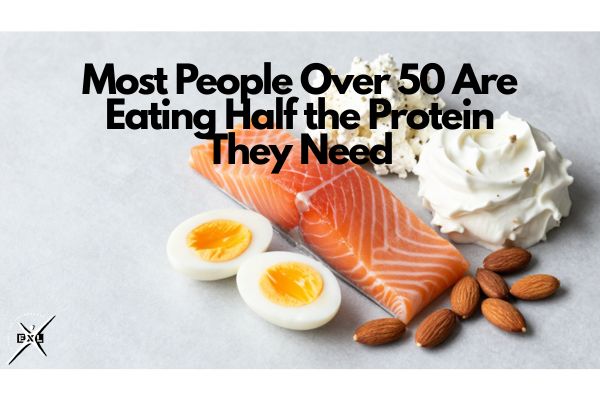
Most People Over 50 Are Eating Half the Protein They Need
You’re training, you’re showing up, you’re doing the work. But if your protein intake looks like most people’s, you’re running on fumes — and your muscles are paying the price.
Back from the Swell. Dirt was cleaned off the bike. Body rested and ready to go.
Every quarter, when we close EXL, I try to come back with the same energy I tell my clients to bring: fresh, clear, and locked in. This week I’m channeling that reset into something I’ve been wanting to write about for a while — because it’s one of the most consistent gaps I see among clients who are training hard but not getting the results they should.
Protein.
Specifically: not enough of it.
I’ve been coaching adults in Utah Valley for thirty years. I’ve worked with hundreds of people over 50, and I will tell you that the single most common nutritional mistake I see — across the board, regardless of fitness level or health goals — is chronically low protein intake. Not by a little. Often by half.
This post explains why that gap exists, what it costs you, and exactly what to do about it.
The Number Most People Think Is Enough
You’ve probably heard that the recommended daily allowance for protein is 0.36 grams per pound of body weight. For a 170-pound adult, that’s roughly 62 grams of protein per day. That’s two chicken breasts and a couple of eggs. Seems doable, right?
Here’s the problem: that number was designed to prevent deficiency, not to support an aging, active body that’s trying to maintain or build muscle. The RDA is the floor, not the target.[1]
And even that floor? Close to half of adults over 50 don’t reach it. A 2019 study in the Journal of Nutrition, Health & Aging found that nearly half of older adults consume less than the already-too-low RDA.[2]
If you’re training — especially if you’re doing any kind of resistance work — the target isn’t 0.36 g/lb. It’s closer to 0.55 to 0.73 g/lb per day, and for active adults working to build or preserve muscle, some research supports going up to 0.9 g/lb.
For that same 170-pound adult, that’s roughly 94 to 150+ grams of protein per day. For most people, that’s a significant jump from what they’re currently eating.[3]
What’s Actually Happening in Your Muscles After 50
To understand why protein requirements go up as you age, you need to understand something called anabolic resistance.
In younger adults, eating a moderate amount of protein — say 20 grams — triggers a robust muscle protein synthesis response. The body hears the signal and builds. In older adults, that same 20 grams produces a blunted response. Research published in PLOS ONE found that post-meal muscle protein synthesis rates were 16% lower in older subjects and that muscle was more than three times less responsive to dietary protein compared to younger adults.[4]
Translation: your muscles are getting harder to hear. They need you to speak up — louder, more often, and with higher-quality input.
This phenomenon — the muscle’s reduced ability to respond to protein and exercise — has been termed anabolic resistance, and it is now recognized as a key mechanism underlying sarcopenia: the progressive loss of muscle mass and strength that accelerates with age.[5]
Here’s the rate at which this loss happens if left unchecked: after age 50, muscle mass decreases at roughly 1–2% per year. Strength declines at 1.5% per year between ages 50 and 60, then accelerates to 3% per year thereafter.[6]
That’s not a small number over time. A decade of sedentary living and low protein intake can mean the difference between a person who’s strong, independent, and capable in their 70s — and one who isn’t.
Why Older Adults Are Especially Vulnerable
Anabolic resistance is only part of the story. There are several other age-related changes that conspire against protein utilization in adults over 50:
Reduced appetite. Older adults generally eat less, so total protein intake often declines along with total calories. Less food = less protein, regardless of how nutritious the diet is.
Digestive changes. Reduced stomach acid and slower gut motility can impair protein digestion and absorption, particularly from certain plant sources.
Hormonal shifts. Declining testosterone, estrogen, and IGF-1 all reduce the anabolic signaling environment. The machinery for building muscle is running at reduced capacity — which means the raw material inputs (protein) need to be higher to achieve the same output.
Increased splanchnic retention. Research has found that with aging, more of the amino acids consumed from protein get captured in the gut and liver, leaving less available for muscle uptake — a secondary mechanism of anabolic resistance.[7]
The end result: your body is working harder for a smaller return on every gram of protein you eat. The strategic response isn’t to give up — it’s to put in more, more consistently, and at better times.
Protein Timing and Distribution Matter
Most Americans eat the majority of their daily protein at dinner. I see this constantly — a light breakfast (maybe toast and coffee), a modest lunch, and then a big protein-heavy meal at 6 or 7pm.
The research is fairly consistent on this: that pattern is not ideal for muscle protein synthesis, especially as you age. The better approach is to distribute protein relatively evenly across meals, with an emphasis on getting a meaningful dose at breakfast and lunch — often the weakest points in most people’s intake.
Why? Because muscle protein synthesis operates in pulses. A single large protein load at dinner doesn’t store excess for the rest of the day. Your muscles are most responsive in the post-exercise and post-meal windows, and they need a consistent supply throughout the day to stay in a net anabolic (building) state.[8]
The PROT-AGE Study Group — an international panel of protein and aging researchers — recommends that older adults aim for 25–30 grams of high-quality protein per meal, spread across at least three meals per day.[9]
That’s not a huge amount at any one sitting — three eggs and some Greek yogurt at breakfast, a chicken and bean bowl at lunch, fish or lean meat at dinner — but it requires intentionality, most people aren’t exercising.
What Counts as High-Quality Protein
Not all protein sources are created equal when it comes to supporting muscle synthesis in older adults. The key factors are:
Leucine content. Leucine is the amino acid that acts as the primary trigger for muscle protein synthesis. Older adults require a higher leucine threshold to activate the same response as younger adults.[10]
Digestibility. Highly digestible proteins — whey, eggs, lean meats, fish, dairy — deliver amino acids to the bloodstream quickly and efficiently. Some plant proteins, while valuable, have lower digestibility and fewer essential amino acids, meaning you may need to eat more volume to hit the same target.
Completeness. Animal proteins contain all essential amino acids in adequate proportions. Plant proteins vary widely, though combinations of sources (legumes + grains, for example) can cover the essential amino acid spectrum effectively.
My top practical sources for clients over 50: eggs, Greek yogurt, cottage cheese, chicken, turkey, fish (especially salmon and tuna), beef, and — for those who need supplemental help hitting targets — whey protein. If you prefer plant-based options, a high-quality pea or soy protein powder can help bridge the gap.
How to Actually Hit Your Target
Knowing you need 0.55–0.73 g/lb of protein per day is useful. Knowing what that looks like on a plate is what actually changes behavior.
Let’s use a 165-pound person as our example. At 0.55 g/lb, the daily target is about 91 grams. At 0.73 g/lb, it’s about 120 grams. Here’s what hitting 110 grams looks like in a real day:
Breakfast: 3 eggs (18g) + 1 cup Greek yogurt (17g) = 35g
Lunch: 5 oz grilled chicken (43g) + ½ cup black beans (8g) = 51g
Snack: 1 oz almonds (6g) + 1 stick string cheese (6g) = 12g
Dinner: 4 oz salmon (28g) = 28g
Total: ~126g
That’s a completely normal day of eating. No protein shakes required (though they can be a useful tool). No extreme portions. Just intentional choices at every meal.
The single biggest shift most of my clients need to make is at breakfast. Most people eat almost no protein before noon, then try to make it up in the evening — which, as we covered, is not how muscle protein synthesis works. Front-loading protein in the first half of the day is one of the highest-leverage nutritional habits you can build after 50.
The Protein–Training Connection
Here’s the important caveat I want to close on: protein is not a magic pill. More protein with no training does very little for muscle preservation.
The research is unambiguous on this. Resistance training is the most potent stimulus for muscle protein synthesis at any age. Exercise sensitizes your muscles to protein — it essentially lowers the threshold of anabolic resistance, making the protein you eat more effective.[11]
The combination — consistent resistance training plus adequate protein intake — is significantly more effective than either alone. This is one of the core reasons EXL’s clients get results that surprise them: we’re not just programming workouts. We’re programming the conditions that make nutrition work.
If you’re already training, increasing your protein intake is probably the highest-return nutritional move you can make. And if you’re not training yet? That’s where to start — and then layer the protein strategy on top.
The Bottom Line
Most people over 50 are eating half the protein they actually need. The RDA was never designed with aging muscle in mind. Anabolic resistance means your muscles need more input to produce the same output, and the distribution of protein across meals matters almost as much as the total amount.
It’s not complicated to fix. It doesn’t require a supplement stack or a dramatic dietary overhaul. It requires knowing the target, knowing what foods get you there, and being intentional about protein at every meal — starting with breakfast.
Your muscles can hold on to what they’ve got. They can even build more, well into your 50s, 60s, and beyond. But they can’t do it on fumes.
Ready to dial in the nutrition side?
At EXL Fitness & Performance in Orem, we work with adults ages 40–75 who want coaching that accounts for how the body changes with age — including nutrition strategies built on what the research actually says, not what’s trending. Book a free consultation and let's build a plan that works with your biology, not against it.
Next week: Creatine for Older Adults — The Most Underused Supplement Out There
Tags: protein intake over 50, muscle loss, sarcopenia, anabolic resistance, protein for older adults, nutrition after 50, muscle protein synthesis, EXL Fitness Orem, Utah
References
8. Bauer JM, et al. Protein Requirements for Older Adults. Caring for the Ages. 2023.
10. Oppezzo M. Protein Needs for Adults 50+. Stanford Lifestyle Medicine. 2024.
11. Koopman R, van Loon LJ. Anabolic resistance of muscle protein synthesis with aging. PubMed. 2009.
About the Author
Mat Gover, BS, CSCS is the owner and head coach of EXL Fitness & Performance in Orem, Utah. With 30 years in the fitness industry and a background in exercise science, Mat founded EXL in 2008 with a simple conviction: adults over 40 deserve coaching that's science-driven, personally attentive, and built for the long game. EXL is a boutique, coach-led studio serving Orem, Pleasant Grove, and Utah Valley — not a big-box gym, and proudly not trying to be. Mat specializes in strength training, healthy aging, and the kind of no-fluff programming that helps people stay strong, mobile, and independent well into their later decades.


