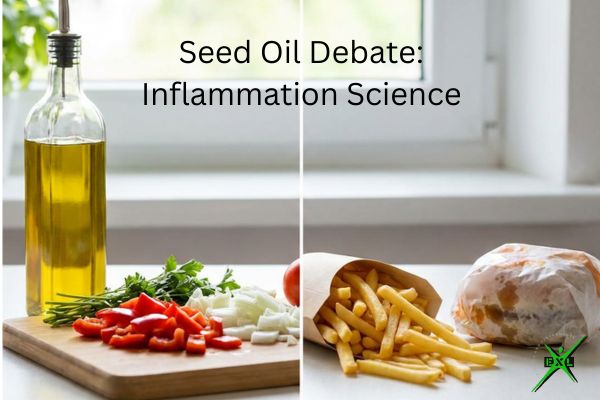
The Seed Oil Debate: What the Science Actually Says About Inflammation
Seed oils have become the internet's favorite villain — blamed for everything from inflammation to obesity to the decline of Western civilization. I'm not convinced. Here's what the actual research says, and why I think the real problem has been hiding in plain sight the whole time.
I get asked about seed oils more than almost anything else in nutrition right now. Clients bring me screenshots from Instagram. Someone's brother-in-law swapped to beef tallow fries and won't stop talking about it. It's everywhere — and unlike most nutrition trends that fade in a season, this one has staying power because it now has political backing, with Health Secretary RFK Jr. and the MAHA report naming seed oils as a driver of chronic disease.1
So let's actually dig into it. I'll tell you upfront where I land: I think the fear of seed oils is wildly overblown, and the real culprit is the processed food they're usually swimming in. But I didn't want to just assert that — I wanted to see if the data would talk me out of it. It didn't. Here's why.
How We Got Here
The seed oils under fire are usually the same eight: canola, corn, cottonseed, grapeseed, soybean, sunflower, safflower, and rice bran — sometimes called the “hateful eight.”2 The core claim is that these oils are chemically processed, high in omega-6 fatty acids, and that omega-6s drive chronic inflammation, which in turn drives heart disease, obesity, and a long list of other modern ailments.
Part of the appeal of this theory is that it lines up with a real trend: seed oil consumption rose sharply over the last 50 years, and so did rates of obesity and chronic disease.3 That correlation shows up in a lot of viral graphs. The problem, as you'll see below, is that many other things changed over the same 50 years, too.
What Seed Oils Actually Are
Seed oils are plant oils extracted from — you guessed it — seeds, usually using heat and chemical solvents like hexane rather than the simple mechanical pressing used for olive oil.4 That processing strips out some nutrients, which is a legitimate knock against them nutritionally. But a federal toxicology report published in 2025 found residual hexane levels in the finished oil to be “toxicologically insignificant,” and any trace amounts largely evaporate during cooking.4
The nutritional profile that actually matters here is the fatty acid makeup: seed oils are high in linoleic acid, an omega-6 polyunsaturated fat, and comparatively low in omega-3s. That imbalance — not toxic processing — is the real basis for the inflammation argument.
Does Linoleic Acid Actually Cause Inflammation?
This is the question that matters, and it's been studied more than almost anything else in nutrition.5 The theory sounds plausible: omega-3s convert into anti-inflammatory compounds, omega-6s can convert into pro-inflammatory ones, so more omega-6 should mean more inflammation. Nutrition scientist Sarah Berry of King's College London put it this way: “It doesn't play out in real life; it doesn't play out in the human body.”5
Randomized controlled trials — the gold standard for this kind of question — consistently show that increasing seed oil and linoleic acid intake does not raise inflammatory markers in human tissue.5 A 2025 study presented at the American Society for Nutrition's annual meeting analyzed blood biomarkers from nearly 1,900 people and found the opposite of what the seed oil critics predict: higher blood levels of linoleic acid were associated with lower levels of CRP, glycoprotein acetyls, and other inflammatory markers, along with better insulin sensitivity.6 A separate 2026 scoping review of the clinical and observational evidence concluded that concerns about seed oils are “without scientific foundation.”7
That's not a fringe result. It's consistent with large population studies — some covering over a million people — showing that higher linoleic acid intake tracks with lower rates of cardiovascular disease, not higher.8
What Layne Norton Says
If you follow evidence-based nutrition content, you know Layne Norton, PhD, doesn't pull punches, and he's spent a lot of time on this exact debate — including a full episode with Dr. Peter Attia dedicated to it.8 His argument is the one that convinced me to stop worrying about this, and it comes down to a comparison most people haven't made.
Norton points out that for every study used to indict seed oils, there's stronger evidence indicting saturated fat for the same outcomes.8 “If you say seed oils are uniquely deleterious to health,” he argues, “then you have to say saturated fat is uniquely deleterious to health — because for every level of evidence for seed oils, there's stronger evidence for saturated fat.”8 In other words, the seed oil panic applies a standard of evidence that, if applied consistently, would indict butter and beef tallow far more harshly — and almost nobody in that camp is calling for that.
He also makes a point I think gets lost in this whole debate: caloric overfeeding and rising obesity rates are, by a wide margin, the biggest drivers of the inflammatory markers people are worried about — not the fatty acid profile of your cooking oil.8 That tracks with everything else we know about inflammation and body composition.
The Real Culprit: What Seed Oils Are Usually Swimming In
Here's the part of the argument I find most convincing, and it's the same one I'd make if you asked me directly: seed oils are mostly consumed inside ultra-processed food, and that's a completely different problem from the oil itself.
Christopher Gardner, a nutrition scientist at Stanford, frames it about as plainly as it can be framed: “Is it the junk food that's causing these health issues, or is it the seed oils? I have always thought it's the junk foods.”3 Registered dietitian Julia Zumpano at Cleveland Clinic makes the same point from a different angle: “When people say they're cutting seed oils from their diet, what they really end up doing is cutting out many processed foods. I think that's why we often hear about seed oils as being so bad for your health. But the reality is that it's less about the seed oils themselves and more about the fact that they're so often found in ultra-processed foods.”4
Think about where seed oils actually show up in the American diet: deep-fried fast food, packaged snacks, frozen meals, sauces loaded with sugar and sodium.3 Those foods are also loaded with refined carbohydrates, added sugar, and excess sodium — all independently linked to the same chronic disease outcomes people are pinning on the oil. Pulling seed oil out of that equation and blaming it alone is a classic confounding-variable mistake. The oil isn't innocent by nutritional standards, but it's not the one doing the damage in a bag of chips or a deep fryer — the whole nutritional profile of the food is.
A note on the omega-6:omega-3 ratio — the fix isn't elimination.
Most Americans eat roughly 10 times as much omega-6 as omega-3, and researchers generally agree that's not an ideal ratio, even if the “perfect” number hasn't been nailed down.9 But the fix nutrition scientists actually recommend isn't cutting omega-6 to zero — it's adding more omega-3.
“Some of the influencers are talking about getting rid of all the omega-6 in the diet,” says fatty acid researcher Tom Brenna of UT Austin. “And that would be a terrible idea. Some omega-6 is absolutely required.”9
Practical fix: eat more fatty fish (salmon, mackerel, sardines), walnuts, flaxseed, and chia — and don't stress about the occasional stir-fry cooked in sesame or canola oil.
A Client Story
A client in his mid-50s came in a few months ago, convinced he needed to strip every trace of canola and soybean oil from his kitchen after a deep dive into seed oil content online. He'd started reading every label obsessively and was frustrated that half his usual grocery list was suddenly “off-limits.”
We didn't argue about the oil. We looked at what he was actually eating: a lot of frozen dinners, restaurant takeout a few nights a week, and protein bars with a dozen ingredients he couldn't pronounce. The seed oil was almost beside the point — the entire eating pattern was the issue. We shifted the focus to swapping convenience foods for simple home-cooked meals, whatever oil he used to cook them in. Within six weeks, his energy, digestion, and waistline had all improved — not because he'd eliminated linoleic acid, but because he'd eliminated the ultra-processed food it had been hiding inside.
What to Actually Do About It
1. Stop treating this as an all-or-nothing decision. You don't need to purge every bottle of canola oil from your pantry. The evidence doesn't support the claim that it's necessary for your health.
2. Prioritize whole foods over label-reading gymnastics. If your diet is built around vegetables, lean protein, fruit, legumes, and whole grains, the oil you occasionally use to cook them is a minor variable. If your diet is built around packaged and fried convenience foods, that's the problem to fix first — regardless of which oil is in them.
3. Add omega-3s rather than fearing omega-6s. Get fatty fish into your week twice a week, and keep walnuts, flaxseed, or chia on hand. This does more for your omega-6:omega-3 balance than avoiding seed oil ever will.
4. Skip the deep fryer, not the sauté pan. The legitimate concern with seed oils is repeated high-heat reuse — the kind restaurants and deep fryers use — which can produce inflammatory compounds.4 A weeknight stir-fry in canola or sesame oil isn't in the same category.
5. Use olive or avocado oil as your everyday default, and don't sweat it when you don't. Both have strong evidence behind them and work well for most home cooking. If a recipe calls for a neutral oil, a “high oleic” seed oil variant has a fatty acid profile closer to olive oil than to a typical vegetable oil blend.9
6. Spend your energy on the things that actually move the needle. Training consistently, sleeping well, eating enough protein, and cutting back on ultra-processed foods will do far more for your inflammation levels and long-term health than the oil in your pantry.
The Bottom Line
The evidence does not support the idea that seed oils are uniquely dangerous or that linoleic acid drives chronic inflammation — multiple randomized controlled trials, large population studies, and a 2025 biomarker study of nearly 1,900 people all point the other direction.5,6,7,8 What the evidence does support is that ultra-processed food, independent of which oil is in it, is genuinely worth cutting back on.
I went into this piece willing to be convinced that seed oils were a real problem. The data didn't take me there. What it did confirm is something I already believed walking in: the fear is aimed at the wrong target. Fix your overall diet, and the oil question mostly takes care of itself.
→ Book a free intro session at EXL Fitness
Next week: Do you really need 10,000 steps a day? What the research actually shows about the number everyone assumes is science — and isn't.
References
1. MAHA Report / RFK Jr. public statements on seed oils and vegetable oil consumption, 2024–2025; discussed in Godoy M. “Are seed oils actually bad for your health? Here's the science behind the controversy.” NPR, July 7, 2025.
2. Zumpano J, interviewed in “Seed Oils: Are They Actually Toxic?” Cleveland Clinic Health Essentials, March 3, 2025.
3. Gardner C, interviewed in Williamson L. “There's no reason to avoid seed oils and plenty of reasons to eat them.” American Heart Association News, August 20, 2024 (corrected March 27, 2025); and in Godoy M, NPR, July 7, 2025.
4. Decker E, interviewed in Godoy M. “Are seed oils actually bad for your health?” NPR, July 7, 2025; Zumpano J, Cleveland Clinic Health Essentials, March 3, 2025.
5. Berry S, interviewed in Godoy M. “Are seed oils actually bad for your health?” NPR, July 7, 2025.
6. Maki KC, et al. Presented at NUTRITION 2025, American Society for Nutrition annual meeting, Orlando, FL. Reported in “Myth-busting study shows controversial seed oils reduce inflammation.” ScienceDaily, June 21, 2025.
7. Concerns about the health effects of industrially produced seed oils are without scientific foundation: a scoping narrative review of the clinical and observational evidence. Critical Reviews in Food Science and Nutrition. 2026. doi:10.1080/10408398.2026.2657527.
8. Norton L. “The seed oil debate: are they uniquely harmful relative to other dietary fats?” The Peter Attia Drive, episode #380.
9. Brenna T, interviewed in Godoy M. “Are seed oils actually bad for your health?” NPR, July 7, 2025.
Mat Gover, BS, CSCS, is the owner and head coach of EXL Fitness & Performance in Orem, Utah. With nearly 30 years of coaching experience and a specialization in strength and performance for adults over 40, Mat brings science-backed training and a no-fluff approach to every session. When he's not coaching, he's skiing the Wasatch, riding in Moab, or climbing something steep in the Uintas.
Tags: seed oils inflammation health myths, seed oil debate, omega-6 omega-3 balance, ultra-processed food, nutrition myths, Layne Norton, linoleic acid


