The Real Reason Group Training Works (And It's Not the Workout)
Most fitness advice assumes a good workout is a good workout, whether you're doing it alone in your garage or shoulder-to-shoulder with nine other people. The programming is what matters. Who's in the room is just part of the atmosphere.
The research doesn't support that. Not even close.
We build our training programs around structured groups on purpose — the same people, the same coach, the same standing time on the schedule, week after week. That's not just a scheduling convenience or a marketing angle. It's built on something specific that the research keeps finding: the group isn't a nice-to-have feature tacked onto the training. For many people, it's the MOST meaningful part of what makes the training work.
The Study That Doesn't Add Up — Until You Look Closer
In 2017, researchers at the University of New England conducted a 12-week study of 69 medical students, splitting them into two groups: some exercised together in a class format, while others trained solo.¹ Every four weeks, everyone reported their stress levels and quality of life across physical, mental, and emotional health.
Here's the part that should stop you: the solo exercisers worked out for roughly twice as long per session as the group exercisers. More total volume, more total time under load. On paper, that's the group that should have come out ahead.
It didn't work out that way. The group exercisers improved across the board — mental health up 12.6%, physical health up 24.8%, emotional health up 26%, and perceived stress down 26.2%. The solo exercisers, despite putting in more raw work, moved the needle only on mental health, and even then, the gain was smaller. Physical and emotional health showed no significant change.
More time on the clock, less to show for it. Something other than sets and reps was doing the heavy lifting.
What's Actually Different in the Room
A 2016 review synthesized research on community-based group exercise programs for older adults, focusing on what kept people attending for six months or longer.² The average adherence rate across those programs was 69.1% — well above the roughly 50% dropout rate that's typical for exercise programs in general. One program in the review hit 93% attendance.
The researchers identified six things driving that, and the one that came up again and again in people's own words was social connectedness. One participant put it: "It's our exercise family." Not a metaphor for enjoying class — an actual description of what kept them coming back when motivation alone would have let them quit. Feeling physically and mentally better mattered too, and so did having a coach who did the job well. But belonging to the group was the thread running through nearly every account.
It's Not Just "Having People Around"
Here's where we're not going to oversimplify it, because the more recent research is more specific than "community is nice."
A 2026 systematic review examined 21 studies on what predicts whether someone continues to attend group fitness classes.³ The strongest predictor wasn't the social side at all — it was self-efficacy, meaning whether someone believed they were capable of doing the work in front of them. Belief you can do it beats almost everything else.
But the social piece wasn't nothing — it just wasn't generic. Vague "social support" (having people around, in general) was a weak predictor. What actually moved the needle was specific: feeling drawn to this group, identifying with these people, feeling like you belonged in this room. Generic camaraderie doesn't do much. Belonging to a particular group you've chosen and keep choosing does.
That distinction is why we've built our programs the way we have. A rotating cast of strangers on a gym floor gives you people to be around. A standing group that trains together week after week, that notices when you're missing, that's mostly the same faces for months at a time — that gives you a group you actually belong to. Research shows that the difference predicts whether you'll still be showing up in six months.
Why We Built It This Way
This is the part that's less about a study and more about what we've built the whole model around. We run three formats here: private one-on-one training, small groups of 3–5, and large groups of 6–12. Some people genuinely need the one-on-one — an injury, a physical limitation, a goal specific enough that group programming can't address it well. That's a real, valid reason to train privately, and the research above doesn't argue against it.
But across all three formats, the common thread is the same. Clients receive personalized attention regardless of group size, genuine accountability, and a coach who truly knows them — not just their name, but their kids’ names, their history, their limitations, and what a bad day looks like for them. That's hard to fake in a group of 30.
Coming out of a rough stretch — a layoff, a health scare, just years of stopping and starting — showing up to an empty gym floor and figuring it out alone is a much bigger ask than showing up to people and a coach who already know your name and expect you at 6 a.m. Tuesday.
Self-efficacy — that belief you're capable of the work — isn't something people show up with. It gets built session by session, faster when you're not doing it in isolation, and even faster when the person coaching you actually knows what you're capable of. Somebody in your group hit a milestone you're six weeks from. Somebody else is further behind than you and still shows up. Both of those things reinforce your belief that you can do this — and so does a coach who remembers what you couldn't do three months ago.
In the Spirit of Full Transparency
A few honest caveats. The 2017 study is a real, peer-reviewed finding — but it's 69 people at one school, a small sample that warrants larger studies before anyone calls it settled science. And the 2026 review is a useful check on the easy version of this story: it's not that being around people magically makes exercise work better. Generic social support was one of the weaker predictors in that review. What predicts adherence is believing you can do the work, plus belonging to a specific group — not just having company.
Group training also isn't the right fit for everyone. Some people need private training — due to an injury, a physical limitation, or a goal that group programming doesn't serve well. Others prefer it and have the means to choose it, for reasons that are nobody's business but theirs — some of them emotional, some of them just a preference for privacy over a room full of people. All of that is a real, standing option here, not a consolation prize. The point isn't "everyone must train in a group." It's that if you've tried training completely on your own and it hasn't stuck, the research gives a specific, credible reason why — and it's not a lack of willpower.
What the Research Actually Suggests You Need
A specific group, not just a crowd. Generic "people around you" doesn't move adherence much. A group you identify with and keep choosing does.
Belief that you're capable, built through repetition. Self-efficacy was the strongest predictor of adherence in the 2026 review — and it's built by showing up, not by feeling ready first.
Consistency in who you train with. The adherence research points to the same faces, same schedule, same coach — not a different class every time.
Realistic expectations. This isn't a claim that group training beats solo training on every physical outcome. For most people, it's a stronger bet to actually stick with it — and sticking with it is what produces results.
What Changed My Mind About Group Training
Before I opened EXL, I trained clients exclusively one-on-one. It worked. My clients got real results, and I fully believed in it.
When I started EXL, I moved toward group training mostly for practical reasons — it gave my clients and me more leverage in terms of time and cost. I wasn't chasing some theory about belonging. I just needed a model that worked for more people. It wasn't until I was actually running those groups that I saw what I hadn't been able to give anyone training alone in a room with just me: a team.
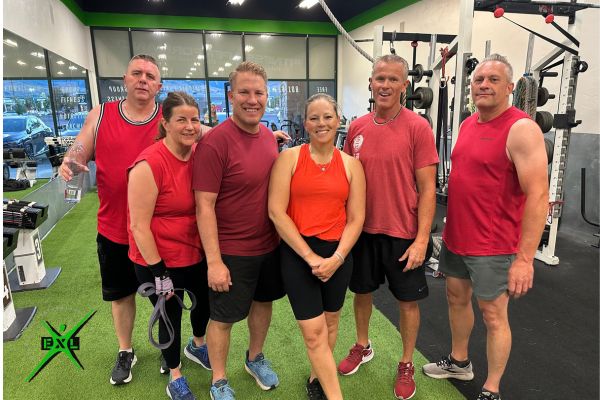
Clients show up for their teammates in a way they don't show up for a workout. I've watched people text each other when someone misses a session, simply to check in. I've watched real friendships form at this gym — the kind that outlast the training phase, that show up to each other's kids' games, that check in on hard weeks that have nothing to do with squats. There's an old line I've always liked: a high tide raises all ships. Put people with similar goals in the same room, working hard, week after week, and something happens that no individual program design can manufacture on its own — they start pushing each other, not just under the bar, but outside the gym too. They encourage each other to get better sleep, better food, and better follow-through, because now somebody besides me is watching, and somebody besides me genuinely cares if they slip.
The quantifiable stats back it up too. Compared to when I trained everyone privately, my group clients attend more consistently, bring more energy and positivity to sessions, and have stronger personal records (PRs). Some of that is just contagious effort in a room. But what still gets me, years into this, is watching someone recalibrate what they believe is possible for themselves, in real time.
I've had a client half-convinced that a lift wasn't in the cards for them — "I'm too old for that." Then they watch another 72-year-old client in that same room hit the exact same benchmark. Something clicks. It isn’t a pep talk from me. It's proof, standing three feet away, that age wasn't the ceiling they'd already decided it was. That client works harder the next set — not because I said a word, but because Jane just did it.
I still believe in one-on-one training — some of my best client results have come from it, and it's the right call for plenty of people. But group training taught me something private training never could: the work is only part of what changes people. The team is the other part.
The Bottom Line
The evidence doesn't say your workout doesn't matter — it says who you do it with might matter more than most people assume — and not for the reason you'd guess. It's not "exercise is more fun in a group." It's that a specific group you belong to builds the self-belief that gets you back in the door on the days you don't feel like it, and that's the variable that actually predicts whether training works over the long run. That's the whole case for how we've built this place.
Next week, we're taking that same idea outside — literally. We'll dig into why getting outside is part of the program here, not a break from it.
References
Yorks, D. M., Frothingham, C. A., & Schuenke, M. D. (2017). Effects of Group Fitness Classes on Stress and Quality of Life of Medical Students. Journal of Osteopathic Medicine, 117(11), e17–e25.
Farrance, C., Tsofliou, F., & Clark, C. (2016). Adherence to community-based group exercise interventions for older people: A mixed-methods systematic review. Preventive Medicine, 87, 155–166.
Gao, X., Song, Y.-G., Shu, Y., Silva, A. F., & Greco, G. (2026). Perceived Capability, Social Belonging, and Behavioral Adherence in Adult Group Fitness Classes: A Systematic Review of Psychosocial Predictors. Behavioral Sciences, 16(6), 882.
→ Book a free intro session at EXL Fitness: https://calendarapp.net/booking
Mat Gover, BS, CSCS, is the owner and head coach of EXL Fitness & Performance in Orem, Utah. With nearly 30 years of coaching experience and a specialization in strength and performance for adults over 40, Mat brings science-backed training and a no-fluff approach to every session. When he's not coaching, he's skiing the Wasatch, mountain biking the Uintas, or out in the red rock around the San Rafael Swell.


