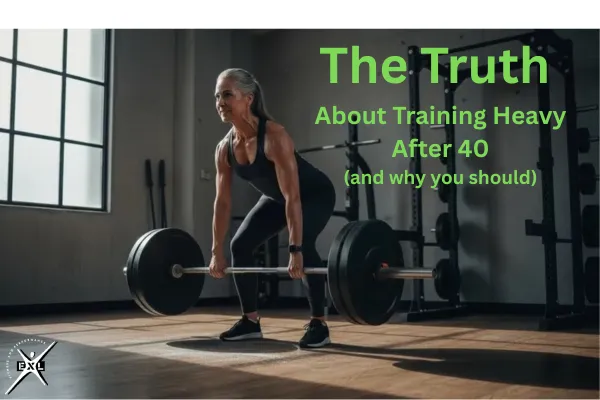
The Truth About Training Heavy After 40 (And Why You Should)
There's a lie that gets told to people the moment they hit their forties.
It sounds reasonable. It comes from well-meaning doctors, cautious trainers, and worried family members. It sounds like this:
"You should take it easy now. Your body can't handle what it used to."
And the result? Millions of men and women over 40 swap the barbell for the elliptical, drop their weights in half, and start training like they're made of glass.
Here's the truth: that approach doesn't protect you. It accelerates the exact decline you're trying to prevent.
Heavy training — real, progressive, challenging resistance training — is not something to shy away from as you age. For most people over 40, it's the single most important thing you can do for your health, your body, and your quality of life.
Let's talk about why.
What Actually Happens to Your Body After 40
Starting in your late thirties and accelerating through your forties, a process called sarcopenia begins. This is the gradual loss of muscle mass and strength that comes with aging — and left unchecked, it's relentless.
The numbers are sobering: without intervention, you can lose 3–8% of your muscle mass per decade after 30. The rate picks up after 60.[1] The downstream effects touch everything:
Slower metabolism and increasing body fat
Reduced bone density and higher fracture risk
Decreased joint stability and mobility
Lower energy and worse sleep
Diminished balance and coordination
Higher risk of type 2 diabetes, cardiovascular disease, and cognitive decline
Here's what the research is unambiguous about: the most effective way to counter sarcopenia is progressive resistance training.[1] And "progressive" means the load has to keep challenging you — not staying comfortable.
Why "Light Weights, High Reps" Isn't Enough
There's a well-intentioned but misguided belief that once you're over 40, you should switch to lighter weights and higher repetitions to protect your joints.
The problem? Muscle is only built and preserved when it's meaningfully challenged. Research comparing heavy and light loads in older adults consistently finds that higher intensities produce superior strength gains — and that training with insufficient load is one of the primary drivers of continued muscle loss.[2]
Light weights do have a role. They're appropriate for warm-ups, technique work, rehabilitation, and accessory movements. But they shouldn't be your primary training stimulus if your goal is to build or preserve muscle and strength.
Your muscles don't know your age. They respond to mechanical tension, metabolic stress, and muscular damage — regardless of whether you're 25 or 55. The stimulus has to be sufficient.
"Progressive overload — gradually increasing the demands on your musculoskeletal system — is not optional for real results. It's the mechanism."
What the Research Actually Says
The science on resistance training for adults over 40 is not ambiguous. Here's what we know:
Strength training improves bone density. Free-weight exercises performed with high loads (>70% of one-rep max) have been shown to improve bone mineral density at the spine and hip by up to 3.8%, which is considered clinically relevant.[3]
Higher loads produce greater strength gains. A meta-analysis of 15 studies in adults averaging 68 years old found that training with heavier loads consistently produced greater strength gains than training with light-to-moderate loads.[2]
Heavy resistance training is safe and effective for older adults. A PMC review found that heavy-to-very-heavy strength training is documented to be excellent and safe for healthy older adults and numerous patient populations, producing meaningful gains in force production.[4]
Hormonal response is stimulated. Resistance exercise has been shown to provoke significant acute growth hormone release in older adults — including an approximately 18-fold increase in GH following a single heavy training session in men aged 55–70.[5]
Cognitive function improves. A 2025 systematic review and meta-analysis found that resistance training significantly improved overall cognitive function, working memory, and verbal learning in older adults, and a network meta-analysis found resistance training to have the greatest impact on overall cognitive improvement among all exercise modalities tested.[6][7]
The evidence is clear. The question isn't whether to train heavy. It's how to do it intelligently.
Training Heavy After 40: What Changes (And What Doesn't)
Here's where nuance matters. Training heavy after 40 is not the same as training heavy at 22. The goal is the same — progressive overload — but the approach has to be smarter.
Recovery takes longer.
Your nervous system and connective tissue need more time between intense sessions. Training 4–5 days a week, hitting every muscle group with maximum intensity, isn't smart at any age — and it's counterproductive over 40. Two to three heavy sessions per week, with intelligent programming and adequate recovery, outperforms more frequent grinding every time.
Technique matters more.
At higher loads, movement quality becomes non-negotiable. An imperfect squat at 95 lbs is inefficient. An imperfect squat at 275 lbs is an injury. Invest in your technique — with a coach if needed — before chasing numbers.
Warm-up is non-negotiable.
Cold connective tissue doesn't absorb force as well as warm tissue. Your warm-up should prepare your joints, prime your nervous system, and progressively build to working weight — not just a few arm circles and a light set.
Intensity doesn't mean recklessness.
"Heavy" is relative to you, not some absolute number. Training at 75–85% of your current capacity — where the last 2–3 reps of a set are genuinely challenging — is heavy training. You don't need to max out. You need to train with intent.
The Lifts That Matter Most
If you want to build real strength and muscle after 40, your programming should be built around compound, multi-joint movements:
Squats (back, front, goblet, or box squat variations)
Hip hinges (deadlifts, Romanian deadlifts, trap bar deadlifts)
Pressing (bench press, overhead press, push-up progressions)
Pulling (rows, pull-ups, lat pulldowns)
Carries (farmer carries, suitcase carries — underrated for full-body strength and stability)
These movements recruit the most muscle, provide the greatest hormonal stimulus, and translate directly to real-world function. Isolation work (curls, extensions, lateral raises) has its place, but it supplements these movements — it doesn't replace them.
What About Injuries — Don't Heavy Weights Cause Them?
This is the concern that stops most people over 40 from lifting seriously. It deserves a direct answer.
Most injuries in the gym don't come from lifting too heavy. They come from lifting heavy with poor technique, lifting without adequate preparation, or progressing too quickly without first building the foundation.
The PMC review on heavy strength training in older adults specifically notes that heavy-to-very-heavy training has a "relatively low risk" profile — and is appropriate even for frail individuals and those with chronic conditions when properly programmed.[4]
Strong people don't get hurt doing everyday things. Deconditioned people do.
Getting Started: A Practical Framework
If you've been avoiding heavy training — or haven't trained seriously in years — here's how to approach it:
1. Start with a movement assessment.
Before adding load, understand where your movement limitations are. A good coach or trainer can identify restrictions in your hips, shoulders, or thoracic spine to inform your exercise selection and help you train without compensatory patterns that lead to injury.
2. Build your base.
Spend 4–6 weeks working on technique with moderate loads. Learn the movement patterns, build the mind-muscle connection, and let your connective tissue adapt.
3. Apply progressive overload consistently.
Once your technique is solid, start adding load systematically. Small, regular increases — even 5 lbs at a time — compound significantly over months and years. Consistency beats dramatic jumps every time.
4. Prioritize recovery.
Sleep, protein intake, and stress management are not optional add-ons. They're integral to whether your training produces results. Training is the stimulus; recovery is where adaptation happens.
5. Track and adjust.
Keep a training log. Know what you lifted last week. Make decisions based on data, not how you feel on a given day. Adjust when something consistently causes pain (not soreness).
The Bottom Line
Your body after 40 is not a liability. It's a different environment — one that requires smarter training, better recovery, and a longer view.
But it absolutely responds to hard work. It builds muscle. It gets stronger. It adapts.
The people who train into their fifties, sixties, and beyond with strength, energy, and capability didn't get lucky with genetics. They made a decision — probably around your age — that they weren't going to accept decline as inevitable.
Spring is here. The gym is open. The barbell is waiting.
Time to get to work.
Ready to train with purpose?
At EXL, we specialize in strength training for adults over 40 who are done with generic gym programs and ready for something that actually works. Book a consultation and let's build a plan around your body, your goals, and your life.
References
[1] Volpi E, Nazemi R, Fujita S. Muscle tissue changes with aging. Current Opinion in Clinical Nutrition and Metabolic Care. 2004;7(4):405–410. PMC: https://pmc.ncbi.nlm.nih.gov/articles/PMC2804956/ | Also: Harvard Health Publishing. Preserve your muscle mass. https://www.health.harvard.edu/staying-healthy/preserve-your-muscle-mass
[2] Steib S, Schoene D, Pfeifer K. Effects of resistance training with moderate vs. heavy loads on muscle mass and strength in the elderly: A meta-analysis. Scandinavian Journal of Medicine & Science in Sports. 2010. PubMed: https://pubmed.ncbi.nlm.nih.gov/26302881/
[3] Massini DA, et al. The Effect of Resistance Training on Bone Mineral Density in Older Adults: A Systematic Review and Meta-Analysis. Healthcare (Basel). 2022;10(6):1129. PMC: https://pmc.ncbi.nlm.nih.gov/articles/PMC9222380/
[4] Unhjem R, et al. Heavy Strength Training in Older Adults: Implications for Health, Disease and Physical Performance. PMC. 2025. https://pmc.ncbi.nlm.nih.gov/articles/PMC12003923/
[5] Nicklas BJ, et al. Testosterone, growth hormone and IGF-I responses to acute and chronic resistive exercise in men aged 55–70 years. PubMed. 1995. https://pubmed.ncbi.nlm.nih.gov/8550252/
[6] Systematic review and meta-analysis: Resistance exercise exerts selective benefits on cognitive domains in older adults, particularly enhancing overall cognition, working memory, verbal learning, and spatial memory. Frontiers in Psychiatry. 2025. https://www.frontiersin.org/journals/psychiatry/articles/10.3389/fpsyt.2025.1708244/full
[7] Network meta-analysis (37 RCTs, n=2585): Resistance training was found to have the greatest impact on overall cognitive improvement and inhibitory control among all exercise modalities tested. ScienceDirect. 2025. https://www.sciencedirect.com/science/article/pii/S053155652500097X


