Why Accountability Matters More Than Motivation (And How to Get It Right)
We're in the final week of January.
By now, you know if your fitness goals are on track or off the rails. You know whether you've maintained consistency or whether excuses have taken over. You know if you're part of the 8% who'll achieve their goals or the 92% who won't.
Here's what determines which group you're in:
Not your motivation levels.
Not your genetics.
Not your schedule.
It's whether you have proper accountability.
After 30 years training adults ages 40-75 at EXL Fitness in Orem and Pleasant Grove, I can predict with stunning accuracy who will succeed long-term based on one factor: the quality and consistency of their accountability system.
People with strong accountability achieve their goals. People without it almost never do.
Today, I'm going to explain why accountability matters more than motivation, show you the six levels of accountability (ranked by effectiveness), and help you identify which level you need to succeed.
This might be the most important article you read this year about achieving fitness goals.
The Accountability vs. Motivation Paradox
Let me start with a truth that most people don't want to hear:
Relying on motivation to achieve fitness goals is like relying on the weather to get to work.
Some days it's perfect—sunny, clear, easy. Other days it's terrible—stormy, cold, miserable. But your job doesn't care about the weather. You show up regardless.
That's how accountability works. It makes showing up non-negotiable, regardless of how you feel.
The Motivation Problem:
Motivation is:
Internal (depends on how you feel)
Fluctuating (high some days, low others)
Emotion-driven (affected by stress, sleep, life events)
Unreliable (disappears when you need it most)
You can't control motivation. You can't summon it on demand. You can't make it last.
The Accountability Solution:
Accountability is:
External (independent of your feelings)
Consistent (works the same regardless of your mood)
Structure-driven (built into systems and commitments)
Reliable (functions when motivation fails)
This is why accountability predicts success, and motivation doesn't.
The Research: Why Accountability Works
The data on accountability and goal achievement is overwhelming:
Study 1: American Society of Training and Development research found:
10% success rate when people simply have an idea or a goal
25% success rate when they consciously decide to commit
40% success rate when they decide when to commit
50% success rate when they plan how to commit
65% success rate when they commit to someone else
95% success rate when they have a specific accountability appointment
From 10% to 95% success based solely on accountability level.
Study 2: Dominican University research on goal-setting showed:
People who wrote goals and sent progress reports to friends achieved 76% of their goals
People who only wrote goals achieved 43%
People who only thought about goals achieved 33%
External accountability more than doubled success rates.
Study 3: Personal training research consistently shows:
People working with trainers achieve 50-70% better results than solo
People with weekly check-ins are 2-3x more likely to maintain behaviors
People in supportive communities maintain habits 4-5x longer
The pattern is clear: accountability dramatically increases success rates.
Why Accountability Works When Motivation Doesn't
Understanding the psychology helps explain why accountability is so powerful:
1. Loss Aversion
Humans are hardwired to avoid loss more strongly than we seek gains.
Without accountability:
Missing a workout costs you nothing immediately
The "loss" is abstract and future (maybe you won't reach your goal months from now)
Easy to skip
With accountability:
Missing means disappointing someone (immediate social cost)
Missing means wasting money (if you paid for an appointment)
Missing means breaking a commitment (identity cost—you're not someone who keeps their word)
Harder to skip
The immediate cost of skipping makes follow-through more likely.
2. Social Commitment
When you commit to someone else, you engage social motivation:
You don't want to let them down
You don't want to appear unreliable
You want to maintain your reputation
You value the relationship
This social pressure persists even when personal motivation is zero.
3. External Structure
Accountability creates structure independent of your feelings:
Scheduled appointments happen regardless of motivation
Check-ins occur whether you feel like it or not
Reviews happen on schedule, not when convenient
Structure removes the need for constant decision-making and willpower.
4. Immediate Consequences
Without accountability:
Skip today, no immediate consequence
Easy to rationalize ("I'll go tomorrow")
The pattern of skipping develops slowly
With accountability:
Skip today, someone knows immediately
Rationalization doesn't work (you committed to someone)
Pattern caught early before it becomes a habit
Immediate feedback prevents small misses from becoming patterns.
5. Expert Guidance
Quality accountability often includes expertise:
Someone corrects your mistakes before they become habits
Someone adjusts when you plateau
Someone provides perspective during difficulties
This prevents wasted months of effort on ineffective approaches.
The Six Levels of Accountability (Ranked by Effectiveness)
Not all accountability is created equal. Here are the six levels, ranked from least to most effective:
Level 1: Self-Accountability (Lowest Effectiveness: ~20%)
What it looks like:
You track your own behaviors
You hold yourself accountable
You self-monitor and self-correct
No external oversight
When it works:
If you're exceptionally self-disciplined
If you have years of successful behavior maintenance
If you're maintaining existing habits, not building new ones
Why it usually fails:
You're both the accountant and the one being held accountable
Easy to rationalize, excuse, or postpone
No consequences for missing
Works only as long as motivation lasts
For adults 40-75: Self-accountability rarely works for building new fitness habits. You've likely tried this before—how did it go?
Level 2: Public Commitment (Low-Moderate Effectiveness: ~30-40%)
What it looks like:
Tell friends/family your goals
Post on social media about commitments
Make your intentions known publicly
When it works:
Creates mild social pressure
Some people care about public perception enough that this helps
Works better for people who are highly social
Why it often fails:
No one is actually checking
Easy to go quiet if you're not following through
No structured follow-up
Consequences are vague and avoidable
Better than nothing, but not sufficient for most people.
Level 3: Accountability Partner/Workout Buddy (Moderate Effectiveness: ~50-60%)
What it looks like:
Find a friend or partner with similar goals
Commit to working out together
Check in with each other regularly
Mutual support and encouragement
When it works:
Both people are equally committed
Schedules align consistently
You genuinely don't want to let each other down
You have similar goals and fitness levels
Why it can fail:
If your partner quits, you're likely to quit too
If schedules conflict, both will miss workouts
Neither person has the expertise to guide the other
Can become a social time more than effective training
Peer pressure isn't as strong as professional accountability
Good supplement to other accountability, less effective as a sole source.
Level 4: Group Fitness Classes at a Big Box Gym or Rec Center (Moderate-High Effectiveness: ~60-70%)
What it looks like:
Scheduled classes at specific times
Instructor leads and motivates
Classmates create community
You pay for a class package or a membership
When it works:
A schedule creates a routine
Instructor provides structure and motivation
Community creates belonging
Prepayment creates financial motivation
Why it can fail:
Not personalized to your specific needs or goals
Miss a class, no one really notices or reaches out
Can't adjust for injuries, limitations, or goals
If you stop showing up, no follow-up accountability
Effective for people who thrive in group settings, less so for those who need individual attention.
Level 5: Personal Training and Group Classes at EXL Fitness (High Effectiveness: ~75-85%)
What it looks like:
Regular appointments with a trainer
Ideal client-to-trainer ratio in EXL's group classes
One-on-one attention and instruction
Personalized programming
Financial investment in sessions
When it works:
Scheduled appointments you're unlikely to skip
The trainer notices if you don't show up
Expert guidance prevents wasted effort
Personalized to your body, goals, and limitations
Adjustments made as you progress
Why it's highly effective:
Strong external accountability (trainer expecting you)
Financial motivation (you paid for this)
Professional expertise (not just moral support)
A consistent schedule creates a routine
Difficult to rationalize skipping
Limitations:
Only accountable during scheduled sessions
Between sessions, you're on your own
No daily oversight of nutrition, recovery, and lifestyle factors
This is where results start to become predictable rather than hopeful.
At EXL Fitness, this is our foundation—but we go further with Level 6.
Level 6: Comprehensive Multi-Layer Accountability with Our Premium Accountability and Nutrition Coaching Program (Highest Effectiveness: ~90-95%)
What it looks like:
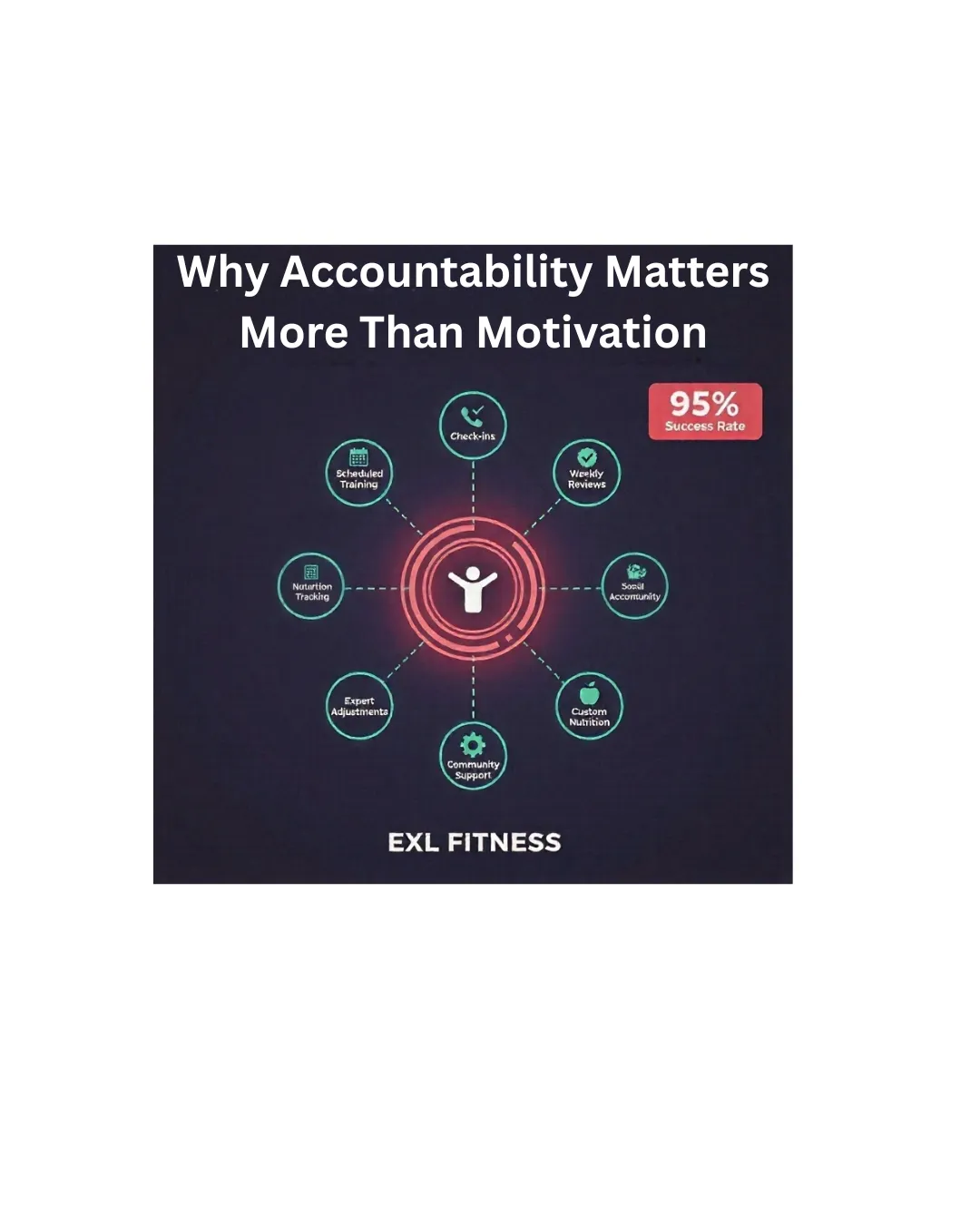
This is the gold standard—multiple overlapping accountability systems that create nearly inevitable consistency:
Layer 1: Scheduled Personal Training or Group Sessions
Regular appointments with an expert trainer
Can't skip without immediate consequence
Professional instruction and programming
Layer 2: Daily Check-Ins and Tracking
Report behaviors every single day via our custom fitness tracking app
Trainer reviews daily (not just at sessions)
Immediate feedback and course correction
No "I'll catch up next week"—every day counts
Layer 3: Weekly Progress Reviews
Dedicated accountability sessions beyond training
Review tracking data
Problem-solve obstacles
Plan next week's focus
Adjust the program as needed
Layer 4: Custom Nutrition Plan with Daily Targets
Specific daily goals (not generic advice)
Track and report nutrition
Accountability for what happens between workouts
Layer 5: Community Support
Train alongside others with similar goals
Normalize struggles and celebrate wins
Accountability through belonging
Notice when someone's absent
Layer 6: Expert Adjustments
When you plateau, expertise guides changes
When life disrupts routine, backup plans are created
When motivation tanks, systems sustain you
Why this works at the highest level:
Multiple Touchpoints: You're not just accountable at training sessions. You're accountable daily and weekly in multiple ways.
No Gaps: Between personal sessions, daily check-ins keep you on track. Between weeks, progress reviews ensure consistency. The accountability is continuous, not episodic.
Professional Expertise: Not just moral support—expert guidance that prevents wasted effort and navigates obstacles.
Personalization: Everything is designed for YOUR goals, body, schedule, and challenges. Not generic.
Sustainable Long-Term: Because it's comprehensive, it addresses all aspects of behavior change. Not just workouts, but nutrition, recovery, lifestyle, and mindset.
This is the system we've built at EXL Fitness because we've learned:
Single-layer accountability works for some people. Multi-layer accountability works for almost everyone.
How to Choose Your Accountability Level
Ask yourself these questions:
1. Have I successfully maintained fitness habits long-term before?
If yes: You might succeed with Levels 2-4
If no: You likely need Levels 5-6
2. How is my current approach working?
If you're consistent: Current level is sufficient
If you're struggling: You need a higher level
3. How important are these goals to me?
Moderately important: Levels 2-4 might work
Very important: Invest in Levels 5-6
4. Do I have a history of starting and stopping?
If yes: You definitely need Level 5-6
If no: Levels 3-4 might work
5. Am I trying to build new habits or maintain existing ones?
Building new: Need stronger accountability (Levels 5-6)
Maintaining existing: Lower levels might suffice
For most adults 40-75 who are:
Building new fitness habits
Haven't succeeded long-term with previous attempts
Serious about lasting results
Willing to invest in their health
Levels 5-6 are necessary, not optional.
Real-World Examples: Different Accountability Levels in Action
Let me show you real examples of how different accountability levels played out:
Mark, 58 - Started with Level 1 (Self-Accountability)
Approach: Bought gym membership, created own workout plan, tracked in notebook.
Result: Consistent for 3 weeks. Motivation faded. Started skipping. Gym membership unused by March.
Why it failed: No external accountability. Easy to rationalize skipping.
Tom, 61 - Started with Level 3 (Workout Partner)
Approach: Found a friend to train with 3x/week.
Result: Worked well for 2 months. The partner got injured and quit. Tom continued alone for 2 weeks, then stopped.
Why it failed: When the partner quit, accountability disappeared.
Linda, 54 - Level 4 (Group Classes)
Approach: Joined group fitness classes 3x/week.
Result: Maintained for 8 months. Made some progress. Classes weren't specific to her goals (strength and bone density). Eventually plateaued and felt bored.
Why it was limited: Not personalized. No adjustments for her specific needs. When she stopped showing up, no one reached out.
Karen, 57 - Level 5 (Personal Training)
Approach: Started training with a personal trainer 2x/week.
Result: Consistent attendance at sessions. Made good progress. But struggled between sessions—poor nutrition choices, inconsistent on non-training days, didn't follow through on trainer's recommendations outside the gym.
Why it was incomplete: Strong accountability during sessions, zero accountability between them.
David, 65 - Level 6 (Comprehensive Multi-Layer)
Approach: Started at EXL Fitness with a full program:
Training 3x/week with a trainer
Daily check-ins via app
Weekly accountability sessions
Custom nutrition plan with daily targets
Community support
Result: 18 months later, David has:
Lost 32 pounds
Increased deadlift from 85 to 185 pounds
Maintained 85%+ consistency the entire time
Never had a week where he completely fell off track
Built sustainable habits that are now automatic
Why it worked: Multiple overlapping accountability systems. When motivation was low, daily check-ins kept him on track. When he hit obstacles, weekly reviews provided solutions. When he plateaued, expert adjustments broke through. Community normalized the journey.
David didn't have more discipline than Mark, Tom, Linda, or Karen.
He had better accountability systems.
The Cost-Benefit Analysis of Comprehensive Accountability
Common objection: "Level 6 accountability sounds expensive. I can't afford personal training + daily check-ins + all that support."
Let's look at the real numbers:
Option 1: Minimal Investment, Minimal Accountability
Gym membership: $30-50/month
Self-accountability only
Cost over 12 months: $360-600
Success rate: ~20%
Likely result: Sporadic effort, minimal progress, abandoned by Month 3
Actual cost per successful outcome: Very high (since most attempts fail)
Option 2: Moderate Investment, Moderate Accountability
Group classes or basic training: $100-200/month
Some accountability, not comprehensive
Cost over 12 months: $1,200-2,400
Success rate: ~60%
Likely result: Some progress, some maintenance, some plateaus, inconsistent long-term
Option 3: Significant Investment, Comprehensive Accountability
Personal training + daily accountability + custom programming: $300-500/month
Multi-layer comprehensive system
Cost over 12 months: $3,600-6,000
Success rate: ~90%
Likely result: Consistent progress, sustained habits, lasting results
Now consider:
What's the cost of NOT achieving your goals?
Continued decline in strength, mobility, and independence
Increased health risks (diabetes, heart disease, bone fractures)
Reduced quality of life
Medical costs from preventable conditions
Years of frustration from repeated failure
What's the value of SUCCESS?
Decades of maintained independence
Ability to do activities you love without limitation
Confidence and self-efficacy
Setting an example for family
Preventing costly health problems
Years of vitality instead of decline
When you factor in success rates and long-term value, comprehensive accountability isn't expensive—it's the most cost-effective option.
Spending $3,600-6,000 to actually achieve lasting health is dramatically cheaper than:
Spending $360/year for 10 years on gym memberships you don't use ($3,600 with no results)
Medical costs from preventable conditions ($thousands to $tens of thousands)
Reduced quality of life from declining health (priceless)
Invest in what actually works, or keep paying for what doesn't.
How to Implement Comprehensive Accountability (Even Without a Trainer)
What if you can't afford or access Level 6 accountability right now?
You can build a DIY version that's better than lower levels:
Create Multiple Accountability Layers:
Layer 1: Scheduled Commitments
Join a gym with a class schedule or find a reliable training partner
Put workouts on the calendar as non-negotiable appointments
Financial commitment (prepay for classes/sessions)
Layer 2: Daily Tracking with External Reporting
Use a tracking app
Report daily to a friend, spouse, or online accountability group
Share your tracking publicly (Instagram, Facebook group, etc.)
Layer 3: Weekly Check-Ins
Schedule weekly calls with an accountability partner or coach
Review the previous week's tracking
Problem-solve obstacles
Plan next week
Layer 4: Specific Targets
Set clear behavioral goals (not just "work out more")
Create nutrition targets (e.g., protein per meal).
Track specific metrics
Layer 5: Community
Join online fitness communities
Find local workout groups
Connect with others working toward similar goals
This won't be as effective as professional Level 6 accountability, but it's far better than trying alone.
The EXL Fitness Comprehensive Accountability System
At EXL Fitness in Orem, we've spent years perfecting our multi-layer accountability system for adults 40-75.
Here's exactly what our clients get:
Scheduled Personal Training Sessions:
2-4 sessions per week (based on your goals and schedule)
Expert trainers with decades of experience
Personalized programming for your body and limitations
Appointments you won't skip
Custom Nutrition Plan:
Designed for YOUR goals, preferences, metabolism
Specific daily targets (protein, meals, timing)
Not generic—personalized for adults 40-75
Adjustable as you progress
Daily Check-Ins via Custom App:
Log workouts automatically
Track nutrition daily
Report how you're feeling
Your trainer reviews EVERY SINGLE DAY
Immediate feedback when issues arise
Weekly Private Accountability Sessions:
Beyond training sessions
Review tracking data together
Identify patterns and obstacles
Adjust plan as needed
Problem-solve challenges
Plan next week's focus
Progress Tracking:
Photos, measurements, strength metrics
See changes over time
Celebrate wins
Adjust when plateaus occur
Community Support:
Train alongside others 40-75 with similar goals
Supportive environment
Normalized struggles
Celebrated victories
Friendships formed
Expert Adjustments:
When you plateau, we adjust programming
When life interferes, we create backup plans
When questions arise, you have immediate access to expertise
This is why our clients maintain 85-90% consistency and achieve results that last for years, not weeks.
It's not because they're more motivated or disciplined than you.
It's because they have a system that makes consistency almost inevitable.
Your Next Step: Getting Proper Accountability in Place
We're at the end of January. February starts in days.
You've seen the data: 92% of New Year's resolutions fail. Most have already failed by now.
You know why: Insufficient accountability.
You have a choice:
Option 1: Continue with your current accountability level (or lack thereof) and hope for different results.
Option 2: Upgrade your accountability system to a level that actually predicts success.
If you're serious about Option 2:
At EXL Fitness, we specialize in comprehensive accountability for adults 40-75.
We offer:
✓ Personalized training with expert coaches
✓ Custom nutrition planning
✓ Daily accountability via app
✓ Weekly progress reviews
✓ Community support
✓ Expert adjustments
This is Level 6 accountability—the kind that produces 90%+ success rates.
Ready to stop trying alone and start with comprehensive support?
[Schedule your free consultation]
In this consultation, we'll:
Assess which accountability level you need
Discuss your specific goals and obstacles
Show you exactly how our system works
Determine if our program is right for you (no pressure, honest conversation)
Or call/text: 801.623.6717
Special February Offer:
Start in February and receive:
Free body composition analysis
Free nutrition consultation
Offer expires January 31st.
This is your chance to make February—and the rest of 2026—different.
Final Thoughts: Accountability Isn't a Crutch, It's a Smart Strategy
Some people think needing accountability means they're weak or lack discipline.
That's completely wrong.
Accountability isn't a crutch for weak people. It's a strategy used by successful people.
Professional athletes have coaches, trainers, nutritionists, and support staff. They don't do it alone.
CEOs have advisors, accountability partners, and coaches. They don't do it alone.
Successful people in every field understand:
External accountability produces better results than self-accountability
Multiple accountability layers work better than single layers
Professional expertise prevents wasted effort
Systems beat motivation every time
Using accountability isn't a weakness. Going it alone when better options exist—that's the real mistake.
The question isn't whether you need accountability.
The question is: What level of accountability do you need to achieve the results you want?
For most adults 40-75 trying to build lasting fitness habits, the answer is: comprehensive, multi-layer, professional accountability.
That's what we provide at EXL Fitness.
Let us help you make 2026 the year you finally achieve goals that last.
At EXL Fitness in Orem and Pleasant Grove, we've built the most comprehensive accountability system in Utah County for adults ages 40-75. Our multi-layer approach—scheduled training, daily check-ins, weekly reviews, custom programming, and community support—produces 90%+ success rates because it works when motivation doesn't. Stop trying alone. Contact us today for a free consultation. 801.623.6717 | exlfitness.com


