Why Willpower Isn't the Problem: The Habit Systems That Actually Stick
If you only work out when you feel motivated, you won't work out much.
I say some version of that to new clients all the time, and every fall it becomes true for half of Utah Valley at once. The kids are back in school, the schedule resets, and everybody wants to "get back on track" — which usually means waiting to feel ready before starting. That's backward, and it's not a discipline problem. It's a strategy problem.
Here's what nobody tells you: willpower is like a muscle. That part's true. But most people misunderstand what that means, and the misunderstanding is exactly what derails them every September. Let's look at what the research actually says, and what we do at EXL instead of waiting for motivation to show up.
Willpower Is a Muscle — Just Not the Way You Think
The "willpower is a muscle" idea comes from real research — psychologists call it the strength model of self-control, and it's held up reasonably well over nearly three decades of study.¹ Two parts of that model matter here, and they point in different directions.
Part one: willpower can be built over time, like strength. In one of the better-designed studies on this, sedentary adults who started a 2-month exercise program didn't just get fitter — they started smoking less, drinking less, spending less impulsively, eating better, and even doing their dishes more consistently. None of that had anything to do with exercise directly. Training their self-control in one area of life — showing up to the gym — carried over into areas that had nothing to do with fitness.² That's the "muscle" part of the metaphor working exactly like you'd hope: exercise the capacity, and it gets stronger everywhere.
Part two is where it gets more honest. The original theory also claimed willpower gets used up in the short term — that resisting a donut in the break room would leave you with less self-control an hour later at the gym, the same way your biceps fatigue mid-set. That specific claim hasn't held up well. When 24 research labs worldwide ran the same depletion experiment on over 2,100 people in 2016, they couldn't reproduce the effect.³ The field has walked that part back considerably.
So here's the honest version: willpower doesn't run out minute-to-minute the way people assume, but it does grow with consistent use over weeks and months — closer to how training adaptations actually work than how a single set does. The problem is that "closer to how training adaptations work" also means it takes time, which is exactly why you can't wait to feel motivated first. You have to survive the gap before the muscle is built. That's what the rest of this post is about.
Why Habits Beat Motivation While You're Still Building the Muscle
Motivation is a feeling. Feelings are unreliable by design — they respond to sleep, stress, weather, how your week's going. Building a training habit lets you skip needing the feeling altogether.
The most detailed look at how long that actually takes came from a study that had people repeat a new daily behavior — in the same context, at the same time — for 84 days straight, then tracked how automatic it became.⁴ The average landed around 66 days to reach the point where the behavior felt close to automatic. The range, though, was wide — 18 days for some people, 254 for others — and exercise habits specifically took longer to lock in than simpler ones like drinking a glass of water, averaging closer to 90 days.
Two things from that study matter for how we coach at EXL. First: two to three months, not three weeks, is the honest number — anyone telling you 21 days is selling you a nicer story than the data supports. Second, and more useful: missing a single day didn't meaningfully set people back. The habit-forming process turned out to be more forgiving of one missed session than people assume — it's the repeated pattern of skipping that resets you, not the occasional bad week.
That's the whole case for accountability. You need something holding the pattern together for two to three months while the automatic version is still under construction. That something isn't more willpower. It's structure.
The Three-Tier Accountability System
This is how I actually think about it, and how we build it into EXL: accountability isn't one thing; it's three, stacked on top of each other.
1. Personal accountability
This is the baseline — the commitment you make to yourself, and whether you keep it when nobody's watching. It's real, and it matters, but it's also the layer people lean on most, and it's the least reliable early on because it competes directly with how you happen to feel that day. Personal accountability is what you're building toward. It's rarely what gets you through week three.
2. Social accountability
This is where the research gets genuinely striking. A meta-analysis pooling 44 studies and over 4,500 participants compared different exercise program formats —true cohesive groups, standard exercise classes, home programs with some phone support, and home programs with none.⁵ Structured group programs with real cohesion beat standard classes by a wide margin on adherence, and both beat home-based programs, with or without check-in calls. The researchers' conclusion: contact with other people doing the same hard thing isn't a nice-to-have. It's one of the biggest levers.
That's a big part of why EXL runs cohorts instead of just handing out programs. The people next to you on a Tuesday morning are doing more for your consistency than they probably realize, and so are you for theirs.
3. Professional accountability
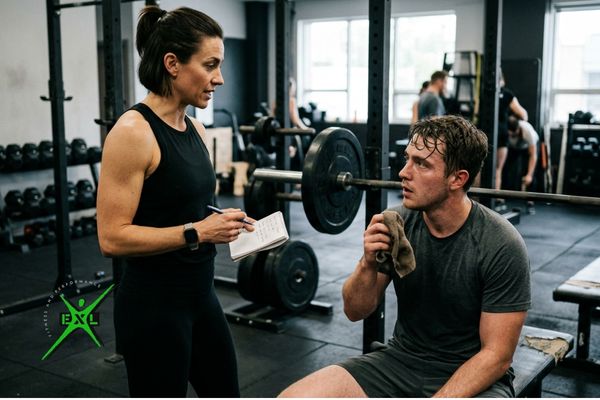
This is the layer a coach provides, and it does two different jobs. On the technical side, a 2022 review of supervised versus unsupervised resistance training found a real, measurable strength advantage for supervised training.⁶ On the human side — separate from the numbers — a coach is a standing appointment that exists independent of how you feel walking in the door. Someone notices if you don't show up. Someone corrects the form before it becomes an injury, not after. That's not a luxury add-on to training. It's a big part of the mechanism.
Stack all three, and you've got a system that doesn't depend on any single layer holding by itself on a bad week. That's the actual answer to "how do I stay consistent" — not more discipline, but a better structure.
What to Actually Do
Stop waiting to feel ready. If motivation were reliable, gyms wouldn't empty out every February. Build the system first; let the feeling catch up later, because it will.
Give it two to three months, not three weeks. That's the honest timeline for a new habit to start running on its own. Plan for it instead of getting discouraged at week two.
Don't let one missed day become the story. The research says a single skip barely moves the needle. It's the second and third skip in a row that actually unravels things — treat the first miss as a non-event and get back on the calendar.
Don't rely on personal accountability alone, especially early. Add a layer — a training partner, a standing class, a coach — that holds the line on the days your own motivation doesn't show up.
If you train alone, build in contact anyway. Even a check-in call moved the needle in the research above. A coach or a group does more, but something beats nothing.
A Client Story
I had a client I'll call Ted — mid-40s, came in wanting to lean up. On paper it should have been straightforward, because the thing you'd expect to be the problem wasn't. His training was already dialed in; he showed up and did the work, every week, no exceptions. The problem was everywhere else. He ate out with clients almost daily, and once there was anything sweet in the room, he had essentially no ability to leave it alone. His sleep was inconsistent and poor quality, which made everything else harder to hold together.
We didn't try to fix that with more discipline — Ted had plenty of discipline, or his training wouldn't have been consistent in the first place. We picked specific, weekly habit-focused goals instead, and he tracked them daily. Every week we sat down, looked at what actually happened against what he'd committed to, and coached from there. Not lectures — just "here's what worked, here's what didn't, here's the adjustment for next week."
A year in, he'd hit the physique goal he originally walked in the door for. But that's not what he brings up now when it comes up. What actually changed was his relationship with food — the near-daily eating out, the sugar he used to have zero control over. Those weren't willpower failures he finally muscled through. They were patterns rebuilt one tracked week at a time, with someone reviewing the data with him every week. That's personal accountability — the daily log — and professional accountability — the weekly review — doing work that willpower alone never had a shot at.
The Bottom Line
Willpower is real and trainable — but it's built slowly through consistent use, not summoned on command the morning you don't feel like showing up. While it's still under construction, what keeps people consistent is structure: personal commitment backed by social accountability and, underneath both, a coach who's watching whether you show up. That's not a workaround for weak discipline. It's how discipline actually gets built.
References
Baumeister, R. F., Tice, D. M., & Vohs, K. D. (2018). The Strength Model of Self-Regulation: Conclusions From the Second Decade of Willpower Research. Perspectives on Psychological Science, 13(2), 141–145.
Oaten, M., & Cheng, K. (2006). Longitudinal Gains in Self-Regulation from Regular Physical Exercise. British Journal of Health Psychology, 11(4), 717–733.
Hagger, M. S., Chatzisarantis, N. L. D., et al. (2016). A Multilab Preregistered Replication of the Ego-Depletion Effect. Perspectives on Psychological Science, 11(4), 546–573.
Lally, P., van Jaarsveld, C. H. M., Potts, H. W. W., & Wardle, J. (2010). How Are Habits Formed: Modelling Habit Formation in the Real World. European Journal of Social Psychology, 40(6), 998–1009.
Burke, S. M., Carron, A. V., Eys, M. A., Ntoumanis, N., & Estabrooks, P. A. (2006). Group versus Individual Approach? A Meta-Analysis of the Effectiveness of Interventions to Promote Physical Activity. Sport & Exercise Psychology Review, 2(1), 19–35.
Systematic review and meta-analysis on supervised vs. unsupervised resistance training (2022) — supervised training showed a small-to-moderate positive effect on strength outcomes versus unsupervised training.
→ Book a free intro session at EXL Fitness https://calendarapp.net/booking
Mat Gover, BS, CSCS, is the owner and head coach of EXL Fitness & Performance in Orem, Utah. With nearly 30 years of coaching experience and a specialization in strength and performance for adults over 40, Mat brings science-backed training and a no-fluff approach to every session. When he's not coaching, he's skiing the Wasatch, mountain biking the Uintas, or out in the red rock around the San Rafael Swell.


