Why Getting Outside Is Part of the Program, Not a Break From It
The research on time in nature is more specific than "fresh air is good for you," and it comes with a dose.
Most people treat time outside as the thing they do instead of training. A hike is a day off. A drive up the canyon to see the leaves is a nice break from the real work.
I see it differently, and the research backs me up more than you'd expect. Time outside isn't a reward you earn after the program. It's one of the most reliable recovery tools you have, and it's been sitting in our backyard this whole time.
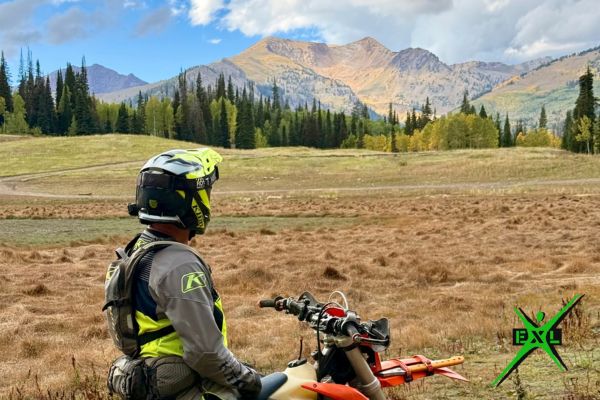
That's why a big part of our quarterly closures here is the challenge of getting outside and re-creating. And with the Alpine Loop and American Fork Canyon about to hit peak color, there's no better week to make the case.
There's an Actual Dose
In 2019, researchers looked at nearly 20,000 adults in England and asked a simple question: how much time in nature does it take before people start reporting better health and well-being?¹
The answer was about 120 minutes a week. Below that, not much changed. At 120 minutes and up, people were significantly more likely to report good health and high well-being. The benefit kept climbing until somewhere between 200 and 300 minutes, then flattened out.
Three details make this useful for our crowd:
It held for adults over 65 and for people living with chronic illness or disability. It wasn't just the already fit people who got outside more.
It didn't matter how you split it up. One long Saturday hike counted the same as four 30-minute walks.
Two hours a week is about the same time commitment as the Zone 2 cardio we already program.
Fair warning: this was an observational study. It shows a strong association, not proof that nature caused the better health. But it gives us something most outdoor advice never provides: a target.
Nature Turns Down the Noise in Your Head
If you've ever come off a trail and realized you stopped replaying that argument somewhere around mile two, there's a brain-level explanation for it.
A Stanford team sent people on a 90-minute walk, either through natural grassland with oaks or along a busy four-lane road.² Afterward, the nature walkers reported less rumination, the repetitive, stuck-on-a-loop negative thinking that feeds stress and low mood. Brain scans showed reduced activity in the subgenual prefrontal cortex, a region tied to that exact pattern. The urban walkers got the same exercise and none of that change.
Same walk. Same effort. Different setting, different result. That's the "part of the program" argument in one study. If you read our post on completing the stress cycle, this is one of the most effective ways to do it.
The Awe Effect
This is my favorite study on the subject, and it was done with older adults.
Researchers at UCSF had healthy older adults take one 15-minute walk a week for eight weeks.³ Half were simply told to walk. The other half were coached to look for awe, to notice the vast and the beautiful and approach it with fresh eyes.
The awe walkers reported less daily distress and more gratitude and compassion over the eight weeks. Here's the kicker: the control group walked more often and didn't get the same benefit. The researchers also had everyone take selfies on their walks. Over time, the awe walkers appeared smaller in their own photos, with more of the landscape in frame, and their smiles grew measurably bigger.
The researchers call it the "small self" effect. A healthy sense of proportion between you and the bigger picture. You don't need a lab to get it. You need a ridgeline and 15 minutes of paying attention.
It Works Better With Your People
Last week we talked about why group training works: belonging to a specific group matters more than just having people around. The outdoors follows the same rule.
A large study of nearly 2,000 people in England's Walking for Health program found that group nature walks were linked to lower depression, less perceived stress, and better overall well-being.⁴ The people who benefited most were those who had recently been through something hard: a serious illness, the death of someone close, a separation, a job loss.
The people who need it most get the most out of it, especially when they're not out there alone.
What About Forest Bathing?
I love the Japanese idea of shinrin-yoku, or "forest bathing." Slow down, put the phone away, and take in the forest with all your senses. No summit, no pace, no goal.
But I owe you straight talk here. A 2026 meta-analysis of 11 studies found that forest bathing lowered heart rate by about 4 beats per minute and produced small improvements in tension, anxiety, and low mood.⁵ Blood pressure didn't change significantly. The researchers rated the overall quality of the evidence as very low, meaning the studies were small and inconsistent. Their conclusion: it's a helpful complement, not a treatment.
I don't think that makes it less worth doing. It means we call it what it is. Forest bathing isn't medicine. It's a skill: the practice of slowing down on purpose and paying attention. For a lot of us who are wired to push, that's the harder workout.
Utah Has an Unfair Advantage
Most of this research was done in forests and green parks. Utah Valley isn't exactly lush. We have granite peaks, sagebrush, red rock, and desert.
Here's the encouraging part. A 2022 study had people in El Paso, Texas, go through a stressful task, then spend 10 minutes in a virtual desert, a virtual green landscape, or a virtual office.⁶ The desert group had lower cortisol and blood pressure than the office group, and green didn't beat desert. The researchers think familiarity matters: the landscape you know and love may work as well as the "classic" forest.
It's one small study, so I won't oversell it. But if the San Rafael Swell or the backside of Timp is what resets you, the science doesn't say you're doing it wrong.
One more for the list: a pooled analysis of 10 studies found mood and self-esteem got the biggest boost in the first five minutes of outdoor activity, and settings with water gave an extra lift.⁷ A stroll along the Utah Lake Shoreline Trail counts.
Why This Is Personal
I've made getting outside a priority for decades, including in college when it would've been easy to justify skipping it. It's how I decompress. It's how I reset when life stacks up. And some of the best friendships of my life were built on a trail, in a canyon, or on a ridgeline.
Early on, it was about the adventure and the risk, and seeing how far I could push. That's changed. These days I'd rather take someone somewhere beautiful for the first time and watch it hit them. The mountains and the desert are still what pull me. What I want out of them is different now.
That's the story I care about most: you don't have to be an adventurer to get this. You just have to go.
A Morning on the Backside of Timp
Every winter, we run an EXL snowshoe trip. Most of our clients have hiked around Utah, but snowshoeing is a different animal. We head up above Sundance to the backside of Mount Timpanogos. It's beautiful in summer, but under a thick blanket of snow, Timp turns into another world.
We snowshoe back to a quiet ridgeline overlooking the Primrose Cirque. When people crest that ridge, it gets quiet. The word I hear most is "magical."
It's also a training session. We get solid Zone 2 work in on the way up, with a few short, hard pushes to build VO2 max. So everything in this post happens at once: the dose, the rumination break, the awe, and the people. Nobody on that ridge is thinking about it as "a break from training." They're thinking about how lucky we are to live here.
We're hoping for a big snow year so we can get back up there this winter. With a strong El Niño in the forecast, send your snow prayers our way.
What to Actually Do
Aim for 120 minutes outside per week. Split it however you want. Two hours is the threshold at which the research starts to show up.
Stack it with your cardio. A brisk canyon walk or easy hike is Zone 2 with a view. Same time commitment, more return.
Take one awe walk a week. Fifteen minutes. Leave the phone in your pocket and deliberately look for something vast or beautiful.
Bring someone. A spouse, a friend, someone from your group. Especially if you've had a rough stretch.
Go where you love. Mountains, desert, the reservoir, your own neighborhood trail. Familiar counts.
Respect the conditions. Know your limits and the weather. In winter, don't go into avalanche terrain without training, gear, and a current forecast from the Utah Avalanche Center.
The Bottom Line
Getting outside isn't a break from your program. It's one of the few recovery tools that works on your stress, your mood, and your cardio at the same time. The research gives us a target (about two hours a week), a mechanism (less rumination, more awe), and a multiplier (the people you go with).
So here's the challenge: this week, while the leaves are at their peak, get outside for two hours. Drive the Alpine Loop, hike up to Battle Creek Falls, and take a jaunt along the Provo Parkway Trail. Look up, check out the colots. Bring somebody. Then tell us where you went.
Next week: [TBD — Oct 6 topic not yet set]
References
White, M. P., Alcock, I., Grellier, J., et al. (2019). Spending at least 120 minutes a week in nature is associated with good health and wellbeing. Scientific Reports, 9, 7730.
Bratman, G. N., Hamilton, J. P., Hahn, K. S., Daily, G. C., & Gross, J. J. (2015). Nature experience reduces rumination and subgenual prefrontal cortex activation. Proceedings of the National Academy of Sciences, 112(28), 8567–8572.
Sturm, V. E., Datta, S., Roy, A. R. K., et al. (2020). Big smile, small self: Awe walks promote prosocial positive emotions in older adults. Emotion, 22(5), 1044–1058.
Marselle, M. R., Irvine, K. N., & Warber, S. L. (2014). Examining group walks in nature and multiple aspects of well-being: A large-scale study. Ecopsychology, 6(3), 134–147.
Short-term cardiovascular and mental health responses to Shinrin-Yoku (forest bathing): a systematic review and meta-analysis (2026). PubMed ID 41756503. [Confirm full author list and journal before publishing.]
Yin, J., Bratman, G. N., Browning, M. H. E. M., Spengler, J. D., & Olvera-Alvarez, H. A. (2022). Stress recovery from virtual exposure to a brown (desert) environment versus a green environment. Journal of Environmental Psychology, 81, 101775.
Barton, J., & Pretty, J. (2010). What is the best dose of nature and green exercise for improving mental health? A multi-study analysis. Environmental Science & Technology, 44(10), 3947–3955.
→ Book a free intro session at EXL Fitness. If you want a training plan that counts your time outside as part of the work, not a break from it, that's exactly what we build in a free intro session. Book yours here.
Mat Gover, BS, CSCS, is the owner and head coach of EXL Fitness & Performance in Orem, Utah. With nearly 30 years of coaching experience and a specialization in strength and performance for adults over 40, Mat brings science-backed training and a no-fluff approach to every session. When he's not coaching, he's skiing the Wasatch, mountain biking the Uintas, or out in the red rock around the San Rafael Swell.
Tags: Recovery, Re-Create, Nature, Stress, Zone 2, Mental Health, Healthy Aging, Utah Valley


