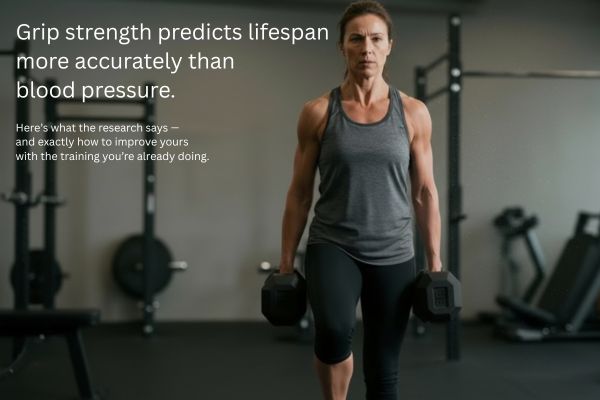
Grip Strength Predicts Lifespan — Here’s How to Improve Yours
Last week, we talked about reframing the story you tell yourself about aging. This week, we’re getting into the biology — specifically, one marker that quietly predicts how long and how well you’re going to live.
I’ve been coaching for nearly 30 years, and if there’s one measurement I wish more people paid attention to, it’s this one. Not your bodyweight. Not your mile time. Not your blood pressure, though that matters too.
Your grip strength.
I know. Sounds underwhelming. But hear me out, because the research on this is some of the most striking I’ve come across in a long time. Grip strength has emerged as one of the most reliable biomarkers for aging, disease risk, and all-cause mortality in the scientific literature. And unlike many health markers that require bloodwork or expensive equipment to track, this one you can measure with a device that costs less than a gym bag.
Here’s what the science says, what it actually means for you, and exactly what to do about it.
Why Grip Strength Is a Window Into Your Entire Body
Grip strength measures the force your hand and forearm muscles can generate against resistance. That part is simple. What’s not simple is what it represents beneath the surface.
Researchers increasingly describe handgrip strength as a “functional vital sign” — a quick, low-cost snapshot of how multiple systems in the body are aging simultaneously.1 What your hand can squeeze tells clinicians something about your overall muscle mass, neuromuscular function, metabolic health, cardiovascular fitness, and systemic inflammation. It’s not magic; it’s the fact that grip reflects whole-body strength and the health of the neuromuscular system responsible for generating it.
Here’s the landmark study that put this on the map: The Prospective Urban-Rural Epidemiology (PURE) study followed nearly 140,000 adults across 17 countries and found that lower grip strength was a stronger predictor of cardiovascular death than systolic blood pressure.2 Think about that for a second. The same measure your doctor takes at every appointment — the one considered the gold standard for cardiovascular risk — was outperformed by a simple hand squeeze.
Every 5 kg decline in grip strength was associated with a 16% increase in all-cause mortality and a 17% higher risk of cardiovascular death, independent of age, smoking, physical activity, and other risk factors.2 A separate meta-analysis of 42 studies found that people with low grip strength had a 67% higher risk of early death from all causes compared to those with high grip strength.3
This isn’t a peripheral health marker. It’s a central one.
Grip Strength Declines — and the Rate Accelerates After 50
Here’s the trajectory. Grip strength peaks somewhere in your late 20s to mid-30s, holds fairly steady through midlife, and then begins a meaningful decline.4 The rate of loss is relatively low per decade in your 40s — roughly 2.8 kg per decade for men and 1.4 kg for women — but it accelerates with age, hitting a moderate-to-steep decline in your 60s, 70s, and beyond.5
By age 80, roughly 23% of men and 27% of women have grip strength levels more than 2.5 standard deviations below their gender-specific peak.4 That’s clinical weakness territory — the kind that’s associated with frailty, loss of independence, and dramatically elevated mortality risk.
Low grip strength in older adults predicts disability risk more accurately than age alone.3 When researchers from the Newcastle 85+ Study tracked very old adults over nearly 10 years, they found that not only did baseline grip strength predict survival, but the rate of decline mattered just as much: people whose grip strength was declining had a significantly higher mortality risk, while those whose grip strength increased over time had a 31% lower mortality risk.6
That last part is the one I want you to hold onto. This isn’t just about where you are now. It’s about the direction you’re heading.
What Grip Strength Reflects — and What It Doesn’t
A question I get a lot: “Does that mean I should just buy a hand gripper and squeeze it every day?”
Short answer: Squeezing a gripper alone isn’t the point.
Grip strength isn’t primarily a training target — it’s a proxy. It reflects overall muscle mass, neuromuscular function, and systemic health. The best way to improve it is to build the underlying system: lean muscle through structured resistance training. The deadlift, the row, the farmer carry, the pull-up — these are grip strength training, because they develop the full kinetic chain that grip depends on.
Research supports this directly. A network meta-analysis of 42 randomized controlled trials found resistance training to be the most effective intervention for improving handgrip strength in older adults, with a mean improvement of 2.69 kg.7 A 2025 systematic review and meta-analysis found that strength-focused hand training produced even larger effects in older adults (Hedges’ g = 0.97) than in younger adults (g = 0.18), suggesting that the aging body responds strongly to this stimulus.8
Older adults actually respond more robustly to targeted grip training than younger people do. That’s a pattern we’ve seen consistently across different strength outcomes. The starting point may be lower, but the capacity for improvement is real.
What This Looks Like at EXL
When I look at what we do at EXL through the lens of grip strength, I see it built into almost everything.
Every pull variation — cable row, lat pulldown, dumbbell row — requires sustained grip under load. Our trap bar deadlifts and Romanian deadlifts are essentially loaded isometric holds for the hands and forearms. Farmer carries, which we cycle in regularly, are about as direct a grip stimulus as you can get. And the fact that we program heavier loads progressively over time means the demand on grip keeps increasing as clients get stronger.
I’ll be straightforward about something here. I don’t use straps with most of my clients. Straps have their place, but if someone’s grip is the limiting factor on a lift, that’s usually information worth having. Training around a weak grip all the time keeps it weak. We want to develop it.
I also want to be honest about what you can do to reinforce this outside the gym. Anything that requires sustained grip in real life — mountain biking, rock climbing, skiing hard through variable snow, hauling gear into the backcountry — is building functional grip capacity. For those of us who use Utah as the adult playground it is, a lot of our outdoor pursuits are quietly contributing to this biomarker. That’s not an excuse to skip the gym, but it’s a reminder that the whole picture matters.
How to Directly Train It
Beyond compound pulling movements, here are the specific methods worth adding if grip is a priority for you:
Farmer carries: Load up a pair of heavy dumbbells or a trap bar and walk. This is the most functional grip exercise that exists and one of the best total-body strength tools, period. 3–4 sets of 30–60 seconds of walking is a good starting point.
Dead hangs: Hang from a pull-up bar for as long as you can. Start with 3 sets at whatever duration your grip allows and build over time. This develops crush grip and shoulder health simultaneously.
Plate pinches: Pinch two weight plates together between your fingers and thumb and hold for time. This builds the pinch strength that carries over to real-world tasks better than most grip exercises.
Towel rows or bar rowing without straps: Simply pulling without mechanical assistance develops grip strength as a byproduct. If you’ve been using straps as a crutch, back them off on your lighter sets.
Consistent resistance training overall: the big one. Every compound movement you do with a barbell, dumbbell, or cable is grip training. The total volume of your training drives grip strength more than any single drill.
Progressive overload applies here the same way it does to any other strength quality. What you can grip and hold today should be harder than what you could hold a year ago. If it’s not, something in your programming needs to change.
A Simple Way to Track It
If you want an objective baseline, a handheld dynamometer is the gold-standard measurement tool. They’re widely available and affordable. Stand with your arm at your side, squeeze as hard as you can for 3–5 seconds, take the best of 2–3 attempts, and record both hands.
General reference ranges for adults: men with grip strength below about 57 lbs and women below about 35 lbs fall into the low range associated with sarcopenia risk.9 These are diagnostic thresholds, not performance targets — if you’re in the 40–60 range and training regularly, the goal is to keep building, not just to stay out of the danger zone.
What you’re looking for over time is the trend. Grip strength that’s holding steady or increasing tells you one story. Grip strength that’s declining tells you another — and gives you a clear target to address before it becomes a problem.
The Bottom Line
Grip strength is not a party trick or a gym novelty. It is one of the most well-validated biomarkers of healthy aging in the scientific literature, with strong associations to cardiovascular health, all-cause mortality, independence, and longevity. The research is consistent across decades, populations, and study designs.
The good news: it’s trainable. Not through hand grippers alone, but through the same structured resistance training we’ve been talking about in this series for months. The deadlifts and rows and carries and pulls you’re already doing at EXL are building this marker, whether you’ve thought of it that way or not.
Track it. Build it. And pay attention to which direction it’s moving.
~Mat Gover BS, CSCS
Ready to build the kind of strength that actually shows up in your healthspan?
Book a session at EXL: calendarapp.net/booking
Next week: How to build VO2 max as you age — what it is, why it drops, and what to do about it.
Tags: grip strength longevity, grip strength over 50, how to improve grip strength, functional fitness adults, sarcopenia prevention, strength training over 40
About the Author
Mat Gover is the founder of EXL Fitness & Performance in Utah Valley. He studied athletic training at BYU and gained experience in physical therapy clinics before discovering his true calling in personal training. Since 2008, he’s specialized in the “gray area” of fitness — helping clients navigate injuries that don’t require formal PT and guiding others from post-rehab back to peak performance. Mat believes true success is measured in vitality: doing what you love with the people you love.
References
1. Bohannon RW. Hand grip strength: an indispensable biomarker for older adults. Clin Interv Aging. 2019;14:1681–1691.
2. Leong DP, Teo KK, Rangarajan S, et al. Prognostic value of grip strength: findings from the Prospective Urban Rural Epidemiology (PURE) study. Lancet. 2015;386(9990):266–273.
3. Rijk JM, Roos PR, Deckx L, van den Akker M, Buntinx F. Prognostic value of handgrip strength in people aged 60 years and older: a systematic review and meta-analysis. Geriatr Gerontol Int. 2016;16(1):5–20.
4. Dodds RM, Sayer AA, Jagger C, et al. Grip strength across the life course: normative data from twelve British studies. PLoS One. 2014;9(12):e113637.
5. Stijntjes M, et al. International norms for adult handgrip strength: a systematic review of data on 2.4 million adults aged 20 to 100+ years from 69 countries. J Sport Health Sci. 2024.
6. Syddall H, Westbury L, Dodds R, Dennison E, Cooper C, Aihie Sayer A. Initial level and rate of change in grip strength predict all-cause mortality in very old adults. Age Ageing. 2017;46(6):970–976.
7. Li Y, et al. Optimal dose of resistance training to improve handgrip strength in older adults with sarcopenia: a systematic review and Bayesian network meta-analysis. Front Med (Lausanne). 2025.
8. Rodgers SJ, et al. Hand-focused strength and proprioceptive training for improving grip strength and manual dexterity in healthy adults: a systematic review and meta-analysis. PMC. 2025.
9. Cruz-Jentoft AJ, et al. Sarcopenia: revised European consensus on definition and diagnosis. Age Ageing. 2019;48(1):16–31.


