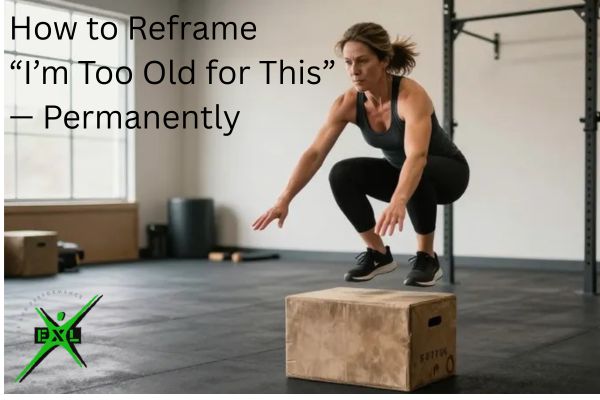
How to Reframe “I’m Too Old for This” — Permanently
The story you’re telling yourself about aging might be doing more damage than the years themselves.
A few months ago, I was wrapping up a training session with one of my longtime clients — a guy in his late 50s who is genuinely one of the strongest people I work with. We’d just finished a set of heavy trap bar deadlifts. He nailed every rep with solid form. And his first comment was, “I can’t believe I’m still doing this at my age.”
I hear some version of that sentence almost every week. Sometimes it’s said with pride. Sometimes with genuine disbelief. And sometimes — too often, honestly — it’s said before someone even tries something, as a reason to hold back. “I’m probably too old for that.” “I don’t want to get hurt at this age.” “Maybe a few years ago, but not now.”
Here’s what I want you to understand: that inner voice isn’t wisdom. It’s not your body talking. It’s a story — one that was handed to you by a culture that has been getting aging wrong for a long time. And the science is now very clear that the story you tell yourself about getting older has a measurable, documented, physiological effect on your health, your performance, and your lifespan.
So let’s dig into what’s actually going on — and how to permanently change the narrative.
Your Beliefs About Aging Are Literally Changing Your Biology
This is the part that surprised me the most when I first came across it. I’d always understood that mindset matters in training — confidence affects performance, negativity drains energy, all of that. But I wasn’t prepared for how deep it actually goes.
Researchers at Yale followed 660 adults aged 50 and older for 23 years and found that people with more positive self-perceptions of aging lived an average of 7.5 years longer than those with negative ones.¹ Not months. Years. And that survival advantage held even after controlling for age, gender, income, loneliness, and baseline health.
Seven and a half years. That’s more lifespan benefit than not smoking. More than maintaining a healthy body weight. More than regular exercise.²
Let that sit for a second.
The lead researcher, Dr. Becca Levy of Yale School of Public Health, has spent decades building on this work. Her studies show that negative age stereotypes — the ones we absorb from culture and eventually turn on ourselves — are linked to slower recovery from disability, worse cardiovascular outcomes, higher risk of dementia, and compromised physical function.³ She calls this “stereotype embodiment”: the idea that cultural messages about aging get internalized over a lifetime and then, once they become self-relevant, start shaping biology through behavioral, psychological, and physiological pathways.
In plain English: the story you believe about what aging means for you is actually changing what aging does to you.
The “I’m Too Old” Script Gets Installed Young
Here’s something worth understanding about how this happens. Age stereotypes don’t get installed in your 50s or 60s. They start accumulating when you’re a child — from TV, from offhand comments, from birthday cards that make getting older a punchline. By the time those messages become personally relevant, they’ve had decades to become background noise.´ You don’t even notice them anymore. They just feel like the truth.
That’s exactly what makes them powerful. And exactly what makes them worth dismantling.
Research published in the journal Psychology and Aging found that negative views of aging are strongly associated with reduced physical activity among older adults — not because their bodies can’t do more, but because they’ve accepted a story that says they shouldn’t.⁵ People with negative aging expectations consistently underestimate their physical capacity and adopt unnecessarily inactive lifestyles.
I see this firsthand. I’ve had clients walk through EXL’s door already half-convinced that they’re broken, that their best years are behind them, that training is something for younger people. And the hardest part of working with them in the early weeks isn’t the programming. It’s walking them back from a story that’s been reinforced for 20 or 30 years.
What Your Body Can Actually Do (That Nobody Told You)
Let me give you some data to replace the old story with.
A study published in Frontiers in Physiology compared strength-training adaptations in elderly participants (average age 82) with those in young adults and found that muscle strength improved by 78% in the elderly group, to a similar extent as in young participants.⁶ The capacity for adaptation was not impaired by age.
Other research has demonstrated strength increases of 9 to 37% after resistance training in people aged 65 to 81, accompanied by meaningful improvements in neural drive and muscle structure.⁷ These aren’t marginal gains. These are the kinds of numbers that change how you move through your day.
And here’s the part I find myself telling clients over and over: older adults who show up with higher exercise self-efficacy — meaning a genuine belief in their ability to train and improve — are consistently more active, more consistent, and see better long-term outcomes than those who don’t.⁸ The belief comes first. The adaptation follows.
I think about a client I’ve been training for several years — a woman who came in at 62 after decades away from any structured training. She was convinced she was too far gone to build real strength. Within a year, she was deadlifting more than her bodyweight. Not because I’m some kind of miracle worker. Because we killed the story that was holding her back and replaced it with evidence that her body could still do remarkable things.
Utah Doesn’t Let You Get Away With That Story
I’ll be honest: living in Utah makes it harder to coast on aging excuses, and I think that’s a gift.
I’m out in the Wasatch most weekends in the winter on skis, grinding up trails in the Uintas in summer, riding dirt bikes in the San Rafael Swell when EXL closes for quarterly reset. Every time I’m out there, I’m surrounded by people in their 50s, 60s, and 70s doing hard, physical things. Not carefully. Not gingerly. With real effort and real intensity.
Utah is an adult playground, and nobody out on those trails is telling themselves they’re too old. They’ve opted into a different story. One where getting older means becoming more intentional about how you take care of your body so you can keep doing what you love — not using age as an excuse to do less.
That’s the story I want for you.
How to Actually Reframe It — Practically
Telling someone to “think positively” isn’t a strategy. Here’s what actually works.
1. Audit the language you use about your body and your age.
Not to force fake positivity, but to notice when you’re casually reinforcing a ceiling. “I used to be able to do that” and “I’m not as young as I was” are true statements that can function as permission slips to stop trying. Replace them with questions: “What would it take for me to do that now?”
2. Collect counter-evidence relentlessly.
Every time you lift something heavier than last month, move with less pain, recover faster, hike a trail you weren’t sure you could manage — that’s data. Write it down if you have to. The brain updates beliefs through evidence, not through willpower. Give it better evidence.
3. Surround yourself with people who aren’t buying the story either.
Research on self-efficacy consistently shows that watching people like you succeed at something is one of the most powerful belief-changers.⁸ This is part of why training in a community matters. When you watch your peers — people your age, with your history — doing hard things, your brain adjusts what it thinks is possible for you.
4. Start before you feel ready.
Confidence doesn’t come first and action second. It works the other way. You do the thing, the thing goes reasonably well, and your confidence in doing it again goes up. The research on exercise self-efficacy is clear: beliefs developed through actual training experience are the ones that stick.⁹ You can’t think your way into a new story. You have to train your way there.
The Bottom Line
You’re going to age. That’s non-negotiable. But the meaning you attach to that process — what you believe it limits, what you decide it permits — is one of the most powerful levers you have over your own health.
The science isn’t subtle here. Positive age beliefs don’t just make you feel better. They are independently associated with longer life, better function, faster recovery, and lower disease risk. And negative ones do the opposite — not through some abstract mechanism, but through documented physiological changes.
So the next time you catch yourself thinking “I’m too old for this,” stop. Ask yourself: Is that actually true? Or is it just the story you’ve been told long enough that it feels true?
Then come in and lift something heavy. That’s usually the fastest way to get a new answer.
Ready to rewrite the story?
If you’re in Utah Valley and want to see what your body is actually capable of, let’s find out together. Book a session at EXL and let’s get to work.
Next week: Grip strength predicts lifespan — seriously. We’ll get into the research and exactly how to improve yours.
References
1. Levy BR, Slade MD, Kunkel SR, Kasl SV. Longevity increased by positive self-perceptions of aging. J Pers Soc Psychol. 2002;83(2):261–270.
2. Yale School of Public Health. Thinking positively about aging extends life more than exercise and not smoking. Yale News. July 29, 2002.
3. Levy BR. Stereotype embodiment: a psychosocial approach to aging. Curr Dir Psychol Sci. 2009;18(6):332–336.
4. Levy BR, Banaji MR. Implicit ageism. In: Nelson T, ed. Ageism: Stereotypes and prejudice against older persons. MIT Press; 2002:49–75.
5. O’Brien Cousins S. “Abs” olutely not! Reframing resistance to physical activity among older women. Can J Aging. 2000;19(3):382–399.
6. Kjær M, et al. Preserved capacity for adaptations in strength and muscle regulatory factors in elderly in response to resistance exercise training and deconditioning. Front Physiol. 2020;11:845.
7. Morse CI, et al. Musculoskeletal adaptations to resistance training in old age. Scand J Med Sci Sports. 2006;16(Suppl 1):1–8.
8. McAuley E, Blissmer B. Self-efficacy: implications for physical activity, function, and functional limitations in older adults. Am J Prev Med. 2000;25(3 Suppl 2):82–89.
9. Neupert SD, Lachman ME, Whitbourne SB. Exercise self-efficacy and control beliefs: effects on exercise behavior after an exercise intervention for older adults. J Aging Phys Act. 2009;17(1):1–16.
Author Bio
Mat Gover, BS, CSCS, is the owner and head coach of EXL Fitness & Performance in Orem, Utah. With nearly 30 years of coaching experience and a specialty in training adults 40–75, he’s helped hundreds of clients discover that their best physical years aren’t behind them. When he’s not coaching, he’s skiing the Wasatch, riding trails in the Uintas, or finding new reasons to never slow down.


