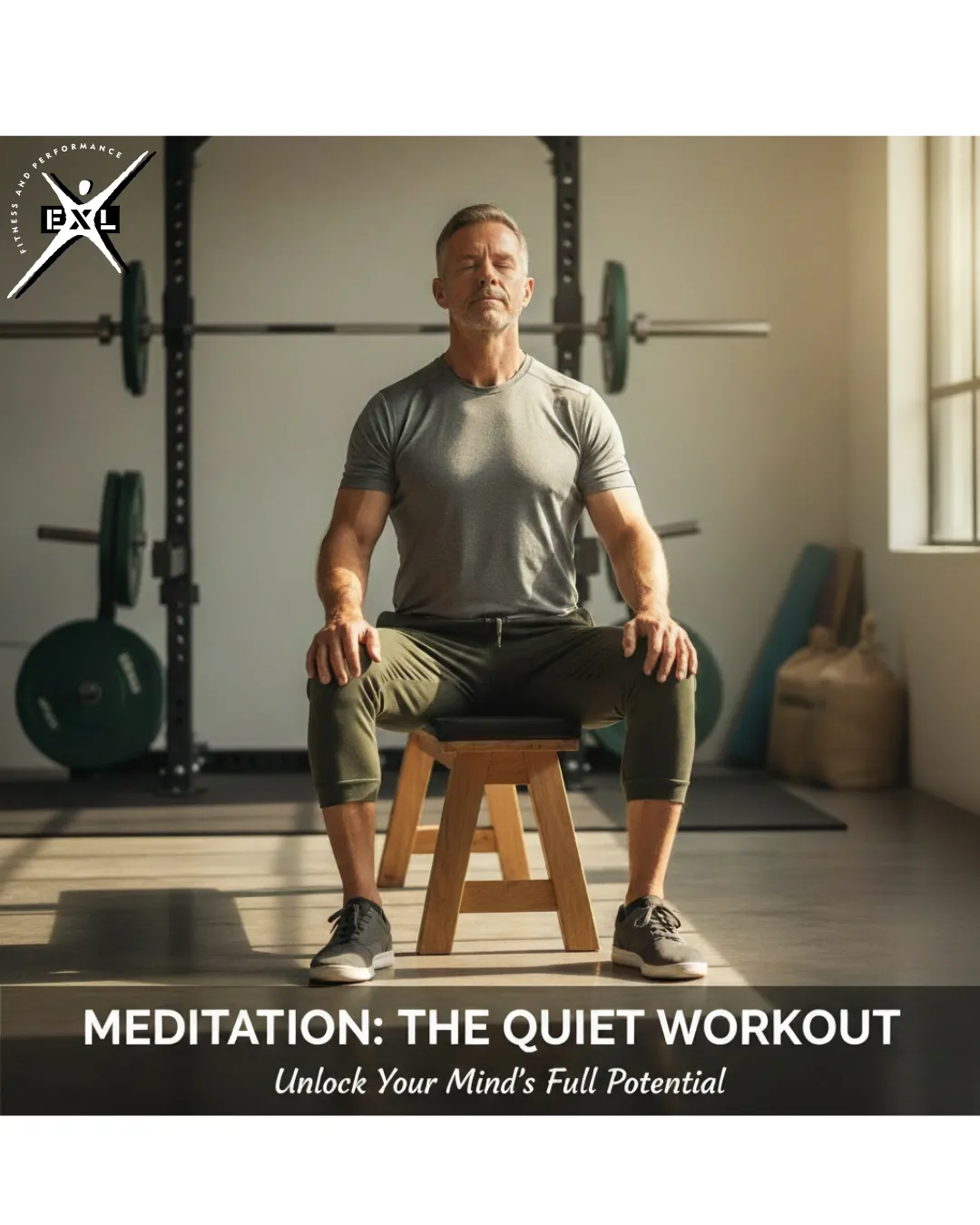
The Quiet Workout: A Complete Guide to Meditation for Adults 40–75
You train your body. You eat with intention. You track your sleep. But are you training the one organ that controls everything else — your brain?
Meditation is no longer a fringe practice reserved for monks and yoga studios. It's backed by decades of neuroscience research, recommended by cardiologists, and increasingly adopted by high performers across every field. And for adults in their 40s, 50s, 60s, and beyond, it may be one of the most impactful things you can add to a fitness routine.
This guide covers what meditation actually is, the types that work best for our demographic, the science-backed benefits, and a simple, realistic approach to building a sustainable practice.
What Is Meditation, Really?
Meditation is the deliberate practice of focusing and regulating your attention. That's it. The goal isn't to empty your mind — that's a common misconception that stops many people before they even start. The goal is to notice where your mind goes, and gently redirect it.
Think of it like this: if strength training is a workout for your muscles, meditation is a workout for your prefrontal cortex — the part of your brain responsible for decision-making, emotional regulation, and stress response.
Over time, that "workout" creates measurable structural changes in the brain — a process called neuroplasticity. The more you practice, the more resilient and responsive your brain becomes.
Types of Meditation — And Which Are Best for Active Adults
Not all meditation is the same. Here are the most well-researched styles, with notes on what makes each one well-suited for the 40–75 age range.
1. Mindfulness Meditation
This is the most widely studied form of meditation in the West. You sit quietly, focus on your breath, and observe thoughts without judgment as they arise. When your mind wanders (and it will), you return your focus to the breath without criticism.
Best for: Stress reduction, anxiety management, sleep improvement, and developing emotional resilience. This is the foundation most beginners should start with.
2. Body Scan Meditation
You systematically bring attention to different areas of the body — from toes to the top of your head — noticing sensations without trying to change them. It's done lying down or seated.
Best for: Active adults dealing with chronic pain, joint issues, post-workout recovery awareness, and those who struggle to quiet racing thoughts. It's a particularly powerful tool for improving the mind-body connection that supports better movement and posture.
3. Focused Attention (Concentration) Meditation
Rather than observing the broad field of experience, you lock attention on a single point — a candle flame, a word, a mantra, or a sound. Each time the mind drifts, you bring it back.
Best for: Cognitive sharpness and mental focus. Research shows regular focused attention practice helps preserve working memory and executive function — areas that naturally decline with age.
4. Loving-Kindness Meditation (Metta)
You silently repeat phrases of goodwill — toward yourself first, then progressively to loved ones, neutral people, and eventually all beings. It sounds simple, and it is, but the neurological impact is significant.
Best for: Reducing self-criticism, improving mood, and building emotional reserves. Studies show consistent metta practice can reduce symptoms of depression and loneliness — both of which become more common in older adults.
5. Movement-Based Meditation (Yoga Nidra, Tai Chi, Qigong, Walking)
For those who struggle to sit still, these practices integrate meditative awareness with gentle movement or guided body relaxation.
Best for: Anyone with mobility challenges, those in high-stress occupations, or those who simply prefer an active entry point into mindfulness. These practices also carry significant benefits for balance, flexibility, and fall prevention.
6. Breathwork / Pranayama
Structured breathing practices — like box breathing (4-4-4-4) or diaphragmatic breathing — directly activate the parasympathetic nervous system, dropping heart rate and cortisol quickly.
Best for: Acute stress relief, blood pressure management, and recovery between workouts. It's one of the fastest evidence-based tools available for shifting your nervous system state.
The Science-Backed Benefits — Especially After 40
Meditation isn't just about feeling calmer. For adults over 40, the physiological benefits align powerfully with the goals most of our clients already have.
Cardiovascular Health
Multiple large-scale studies — including research published in the American Heart Association's journal — have linked regular meditation to reduced blood pressure, lower resting heart rate, and lower levels of markers of systemic inflammation. These are significant factors for longevity and heart disease prevention.
Cortisol Reduction and Hormonal Balance
Chronic stress drives elevated cortisol, which directly interferes with muscle building, fat loss, sleep quality, immune function, and testosterone levels. Meditation is one of the most effective non-pharmacological tools for reducing chronic cortisol, which means it actually supports your strength-training goals, not just your mental health.
Brain Health and Cognitive Preservation
Longitudinal studies show that long-term meditators have significantly less age-related cortical thinning — meaning their brain tissue stays denser longer. Regular practice has also been associated with reduced risk of dementia, improved memory recall, and greater mental processing speed.
Key finding: A Harvard study found that 8 weeks of mindfulness meditation produced measurable increases in gray matter density in the hippocampus — the brain's memory center.
Sleep Quality
Meditation — particularly body scan and mindfulness — has been shown to be as effective as pharmacological interventions for improving sleep quality in older adults, without the side effects. Better sleep means better recovery, better hormonal balance, and better performance in the gym.
Pain Perception and Management
Regular meditators report significantly lower perceived pain intensity, and brain scans confirm that meditation changes how the brain processes pain signals. For adults managing arthritis, back pain, or post-injury discomfort, this is a meaningful quality-of-life improvement.
Emotional Resilience
Life after 40 often brings its share of significant transitions — career shifts, health challenges, loss, retirement, and changing family dynamics. Meditation builds the capacity for emotional regulation to navigate these with greater steadiness and less reactivity.
How to Start a Meditation Practice — Without the Overwhelm
Here's the honest truth about starting a meditation practice: it's uncomfortable at first. Your mind will race. You'll feel like you're doing it wrong. You'll wonder if anything is happening.
That discomfort is actually the practice working. Sitting with it — and coming back anyway — is exactly what trains the brain.
Step 1: Start Absurdly Small
Five minutes. Not twenty. Not an hour. Five minutes, every day, for two weeks. Consistency beats duration every time. Research on habit formation is clear: the threshold for daily execution needs to be low enough that you never talk yourself out of it.
Step 2: Pick a Time and Anchor It
Meditation works best when it's attached to an existing behavior — what habit researchers call a "keystone habit." Common anchors for our clients include right after morning coffee, immediately after a workout, or just before bed. The exact time matters less than the consistency.
Step 3: Choose One Method and Stay With It
Dabbling in five different styles simultaneously is one of the fastest ways to abandon the practice. Pick one — we recommend starting with simple breath-focused mindfulness — and commit to it for 30 days before experimenting with others.
Step 4: Use a Guided App (At Least Initially)
Apps like Calm, Headspace, and Insight Timer offer structured beginner programs that take the guesswork out of the process. A human voice guiding you through the practice dramatically reduces the friction of starting. Think of it like hiring a coach for a new skill — the structure accelerates learning.
Step 5: Measure Progress the Right Way
You won't feel zen after your first session. Or your tenth. The benefits of meditation — like those of strength training — accumulate over weeks and months, often showing up first in how you respond to stress outside of practice. Notice those moments. They're the proof of progress.
EXL Tip: Try pairing a 5-minute breathwork session with your post-workout cooldown. It accelerates nervous system recovery, supports heart rate normalization, and creates a natural daily anchor for the habit.
Common Objections — Answered
"I can't stop thinking."
Correct — and you're not supposed to. The goal is not a quiet mind. The goal is to notice when your mind wanders and return your focus. Every return is a rep. Every rep builds the muscle.
"I don't have time."
Five minutes. You have five minutes. We're not asking for an ashram retreat. We're asking for the equivalent of one commercial break.
"I've tried, and it doesn't work for me."
You likely haven't tried consistently for long enough, or you were measuring the wrong outcomes. Expecting to feel instantly relaxed after a few sessions is like expecting to feel strong after two weeks in the gym. Return to Step 1.
"Isn't it a religious thing?"
Meditation has roots in multiple spiritual traditions, but the evidence-based practices we're describing here are secular and clinical. They are as "religious" as physical therapy.
Putting It Together
You've spent years building physical strength, functional capacity, and healthy habits. Meditation is the next layer — the practice that optimizes how your nervous system, brain, and cardiovascular system perform in the long game.
Start with five minutes of breath-focused mindfulness tomorrow morning. Anchor it to your coffee. Use an app if it helps. Come back to it the day after, even if yesterday felt like a failure.
That's it. That's the practice.
The research is clear, the tools are accessible, and the return — in terms of longevity, mental sharpness, stress resilience, and quality of life — is one of the most significant investments you can make in yourself after 40.
About EXL Fitness
EXL Fitness is a private personal training studio in Orem, Utah, specializing in strength training, functional fitness, and healthy aging for adults 40–75. Our evidence-based approach helps clients build the strength, mobility, and resilience to live actively on their terms.
Questions about meditation, recovery, or your training program? Reach out — we'd love to talk.


