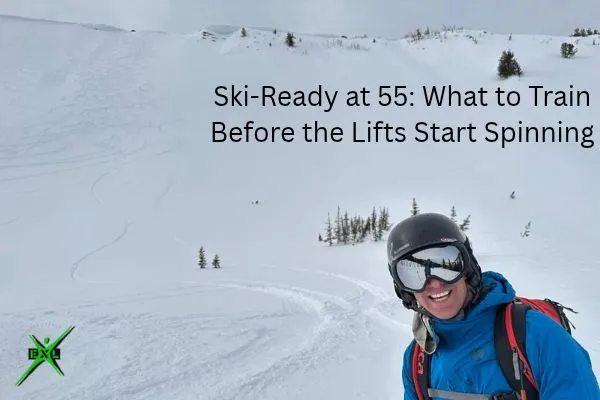
Ski-Ready at 55: What to Train Before the Lifts Start Spinning
I went looking for the science on whether preseason training prevents ski injuries. Here's what I found, and the four-week plan I'd use anyway.
The first Utah lifts at Brian Head are scheduled to open November 6. Alta, Park City, and Solitude are aiming for November 20, and Snowbasin and Snowbird for November 27.¹ Dates move with the snow, but if you're reading this the week it posts, the big resorts are three to five weeks out.
Before I wrote this, I looked for research on whether getting fit before ski season keeps you from getting hurt. I didn't find it. What I did find is a pattern worth acting on, and a clear picture of what a day on the hill asks of your body.
What I Went Looking For
A 2013 review pulled together 30 articles on injury prevention in recreational skiing and snowboarding. It found no recommendations built around fitness, exercise, or training. Almost everything focused on equipment or other people on the hill.² The authors still argued that strength, endurance, and conditioning matter for meeting the demands of the sport, and they called for research. I didn't find a trial since then showing that a preseason program lowers injury rates in recreational skiers.
What has changed is the gear. Skiing has gotten safer over the past several decades, and researchers credit shorter carving skis, stiffer boots, helmets, and better-groomed slopes.³ Those same researchers point to the part you control: your own fitness and how you behave on the hill.
The Pattern Worth Acting On
The closest link I found between fitness and a good ski season comes from a study of 117 recreational skiers. Before the season, researchers tested their agility, balance, and leg endurance, then followed them through the winter. The skiers with slower agility times and lower balance scores were more likely to get hurt.⁴
That's a correlation, not proof that training agility and balance changes your risk, and it's a small group over a single season. But the two qualities that lined up with injuries are both trainable.
In the seasons I'm prepared for, I get more turns. In the seasons I'm not, it's a buzzkill to stop halfway down a powder slope because my legs are smoked. The snow is the same either way. What changes is how much of it I get to ski.
Why Your Legs Are the Place to Start
Skiing is a long day of leg work, and the legs tire early. In a study of 38 women over 40 who skied a full day with thigh sensors, muscle fatigue in the quadriceps and hamstrings was already significant by lunch, and a 45-minute break didn't reverse it.⁵ The study didn't measure injuries, so it can't tell us tired legs cause them. It does show how quickly the legs get taxed.
Most skiers worry about the knee. In a clinic series of 282 recreational skiers with MRI-confirmed knee injuries, the average age was 44. Every one involved the ACL, and about two-thirds also had damage to other structures, most often the MCL or the medial meniscus.⁶ These were people who ended up in a specialty clinic, so the series shows what serious ski knee injuries look like, not how common they are.
Your Heart and Lungs Count Too
A review of skiing in older adults notes that skiing works as both aerobic and isometric exercise and can improve cardiovascular risk factors. The main concerns are a sudden jump in the heart's oxygen demand, especially in sedentary people, and the effects of hypoxia in untrained people.⁷ The authors conclude that skiing may safely be recommended to older adults when precautions are taken.
Utah's resorts sit at elevation, so this applies here. If you've been sedentary, or you have heart disease or risk factors for it, check with your doctor before you ramp up. If you're healthy and already training, an aerobic base is part of getting ready.
What I See Every Season
Every year, clients tell me they started skiing again now that they're fit. I've also had clients tell me that being fit has let them ski more and enjoy it more, because their fitness isn't holding them back.
These are stories, not data. But they're the reason I'd build the plan below even without a trial behind it.
What to Actually Do
This plan comes from the research above and my coaching, and it's built around what the evidence points to: strong, fatigue-resistant legs; good balance and agility; and an aerobic base.
Train your legs twice a week, on non-consecutive days. Use slow, controlled lowering, because skiing asks your quads to control a descent. If you’re already training at EXL twice a week, then you’re covered…we train multiple leg exercises every workout.
Weeks 1 and 2: goblet squat, 3 sets of 8 with a three-second lowering phase; split squat, 3 sets of 8 per leg; kettlebell Romanian deadlift, 3 sets of 10.
Weeks 3 and 4: heavier squat, 4 sets of 6 (barbell if you've progressed to it); slow step-downs from a low box, 3 sets of 8 per leg; Straight-leg deadlift, 3 sets of 8. Finish with a wall sit: 2 to 3 holds of 30 to 60 seconds, because fatigue is the problem that day.
Add 10 minutes of balance and agility, 2 or 3 times a week. Do single-leg reaches forward, to the side, and behind you: 2 sets of 5 per direction on each leg, then lateral skater steps (Skaters): 2 sets of 8 per side. In weeks 3 and 4, add lateral hops and quick direction changes once the steps feel steady. Balance and agility are the two qualities that stood out in the injury study.⁴
Build the aerobic base. Do two or three 30- to 45-minute sessions a week at a pace where you can still talk. Hill walking, cycling, or the incline treadmill all work. Add one harder interval session only if you're already comfortable with hard efforts and your doctor is on board.
Test yourself in week one and again in week four. Do two simple tests. For leg endurance, count how many bodyweight squats you can do in 60 seconds, going to the same depth every time (a chair or box makes that easy). For balance, stand on one leg and reach the other foot as far forward, to the side, and behind you as you can without losing your balance or putting it down. Do it on both legs and note the distances. These are home versions of tests used in the injury study.⁴ Compare yourself to yourself, and your left leg to your right.
On the hill, warm up before the first run. Do a dynamic warm-up before you click in. (Spiderman stretch, sumo squats, toy soldiers, jump tucks.) The first chairlift ride doesn't count as a warm-up.
Plan for tired legs. Fatigue is already significant by lunch, and a break doesn't fully reset it.⁵ Take a real break, stay fed and hydrated, and call it when your legs are done rather than when the lifts close.
If you ski tour, that's a different sport. Touring requires different training than resort skiing, and avalanche safety is its own subject.
The Bottom Line
I went looking for proof that preseason training prevents ski injuries, and I didn't find it. What I found is that skiing is hard on your legs and heart, that fatigue shows up early in the day, and that in one study the skiers with weaker agility and balance got hurt more. Those are all things you can train. Four weeks won't make you injury-proof, but it will put you on the lift with stronger, steadier legs and the engine to use them. Keep the helmet on and the boots well fitted, too. Gear is where skiing's biggest safety gains have come from.
Next week: what the dementia-risk research says about lifting and your brain.
References
"Utah ski resorts' opening dates, new terrain, upgraded chairlifts for the 2026-27 season." Deseret News, October 7, 2026. https://www.deseret.com/lifestyle/2026/10/07/utah-ski-resorts-opening-dates-new-terrain-upgraded-chairlifts/ [Opening dates are planned dates, weather permitting. Re-check the day this publishes. Confirm the article's exact headline.]
Hébert-Losier, K., & Holmberg, H.-C. (2013). What are the exercise-based injury prevention recommendations for recreational alpine skiing and snowboarding? A systematic review. Sports Medicine, 43, 355–366. https://doi.org/10.1007/s40279-013-0032-2
Burtscher, M., & Ruedl, G. (2015). Favourable changes of the risk-benefit ratio in alpine skiing. International Journal of Environmental Research and Public Health, 12(6), 6092–6097.
Wang, Z., Cai, Y., Wu, J., Xie, S., & Jiao, W. (2022). Relationship between lower extremity fitness levels and injury risk among recreational alpine skiers: a prospective cohort study. International Journal of Environmental Research and Public Health, 19(16), 10430.
Hermann, A., Christl, V., Hastreiter, V., Carqueville, P., Ellenberger, L., & Senner, V. (2023). Muscular fatigue and quadriceps-to-hamstring ratio in alpine skiing in women over 40 years. International Journal of Environmental Research and Public Health, 20(8), 5486.
Posch, M., Schranz, A., Lener, M., Tecklenburg, K., Burtscher, M., & Ruedl, G. (2021). In recreational alpine skiing, the ACL is predominantly injured in all knee injuries needing hospitalisation. Knee Surgery, Sports Traumatology, Arthroscopy, 29, 1790–1796. https://doi.org/10.1007/s00167-020-06221-z
Rossi, V. A., Schmied, C., Niebauer, J., & Niederseer, D. (2019). Cardiovascular effects and risks of recreational alpine skiing in the elderly. Journal of Science and Medicine in Sport, 22(Suppl. 1), S27–S33.
→ Book a free intro session at EXL Fitness
If you want a plan that gets you ready for the season and fits your schedule, not just a list of exercises, that's exactly what we build in a free intro session. Book yours here.
Mat Gover, BS, CSCS, is the owner and head coach of EXL Fitness & Performance in Orem, Utah. With nearly 30 years of coaching experience and a specialization in strength and performance for adults over 40, Mat brings science-backed training and a no-fluff approach to every session. When he's not coaching, he's skiing the Wasatch, mountain biking the Uintas, or out in the red rock around the San Rafael Swell.
Tags: Ski Conditioning, Strength Training, Balance, Injury Prevention, Healthy Aging, Utah Valley


