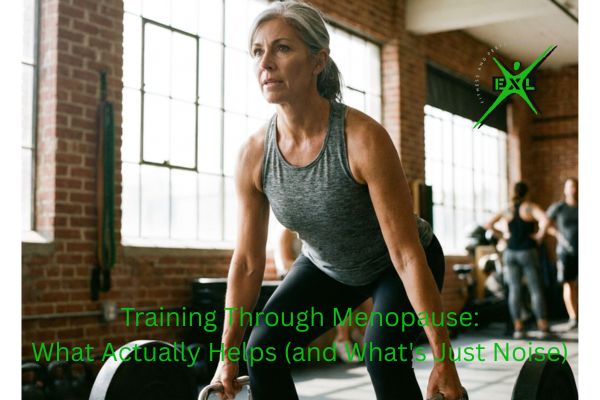
Training Through Menopause: What Actually Helps (and What's Just Noise)
Menopause changes the rules for building and keeping muscle. Here's what the research actually supports — and what's just noise from your feed.
I get some version of this question from nearly every female client in her late 40s through 60s: "Is this actually my fault, or is it just menopause?" The honest answer is usually both less complicated and more real than what she's been told online. The hormonal shift is legitimate, and it does change how your body responds to training. But it doesn't mean you're stuck, and it doesn't mean you need to overhaul your entire life around whatever a wellness account is selling this month. Here's what almost 30 years of coaching and the current research actually say — and where I think the noise has gotten ahead of the evidence.
What's Actually Happening in Your Body
Estrogen isn't just a reproductive hormone. It has receptors throughout your muscle, bone, cartilage, tendons, and ligaments.1 When estrogen declines through perimenopause and menopause, several things shift at once: muscle protein synthesis becomes less efficient, bone remodeling tips toward more breakdown than rebuild, and your baseline inflammation rises.1 None of that is a character flaw or a sign you've let something slip. It's physiology — and it's exactly why the advice that used to work for you ("just eat a little less, move a little more") stops delivering the same results in your late 40s and beyond.
The Muscle Loss Is Real — And Resistance Training Is the Strongest Countermeasure We Have
Left unaddressed, postmenopausal women lose muscle mass at a rate of roughly 0.6% per year.2 That adds up fast over a decade. But this is where I want you to actually feel some relief: a 2025 University of Exeter study found that resistance training builds lean muscle in women regardless of whether they're pre-, peri-, or postmenopausal, with measurable strength gains showing up in as little as four weeks.3 Your hormones set the terrain. Training still moves the needle — at any stage.
I had a client, Karen, 54, come to me a year into perimenopause convinced her body had simply stopped responding to exercise the way it used to. Twelve weeks of structured resistance training later, she'd added weight to every major lift and dropped two clothing sizes without changing her diet dramatically. Nothing about her biology reversed. What changed was that the training stimulus was finally matched to what her body actually needed.
Your Bones Need the Same Prescription
Bone loss accelerates sharply after menopause — women can lose 1.5% to 2.5% of bone mass per year in the first decade after their final period. Moderate-intensity resistance training performed three days a week has the strongest evidence behind it for improving bone mineral density in postmenopausal women.4 This isn't about babying your joints with light bands forever. Bone responds to real mechanical load — squats, deadlift patterns, loaded carries, step-ups — the same movements that build muscle also build bone. A pilot trial currently underway in Canada (STOP-EM) is specifically testing structured strength training as osteoporosis prevention in early menopause, which tells you where the research is heading: earlier and heavier, not later and lighter.5
The Joint Pain Isn't Just "Getting Older"
If you've noticed new joint stiffness or achiness that seems to have shown up out of nowhere in your late 40s or 50s, you're not imagining it and it's not simply age catching up with you. Estrogen has anti-inflammatory properties, and its withdrawal is linked to a rise in inflammatory markers that lower your threshold for joint pain and stiffness.1 Researchers have started calling this cluster of symptoms — joint pain, new stiffness, and increased injury risk showing up together during the menopause transition — the musculoskeletal syndrome of menopause. I'll be straight with you: it's a fairly new clinical framework, and the exact terminology is still being debated in the research community. But the underlying biology — estrogen's role in joint and connective tissue health — is well established.1 Practically, this means progressive, well-programmed loading matters more during this window, not less.
What About Hormone Therapy?
I'm not a physician, and this is a conversation to have with your doctor, not with your trainer. But there's real news here worth knowing going in: on November 10, 2025, the FDA announced it is removing the "black box" warning — its strongest safety label — from estrogen-containing hormone replacement therapy products.8 That warning had been in place since 2003, based on a Women's Health Initiative study where the average participant was 63 years old — over a decade past the typical age of menopause onset — using a hormone formulation that isn't commonly prescribed anymore. The FDA's updated labeling will instead recommend starting HRT within 10 years of menopause onset or before age 60, citing evidence of reduced fracture risk, a meaningful drop in cardiovascular risk, and lower all-cause mortality when started in that window.8
I want to be straight with you about the reaction, too, because that's the standard I hold every claim in this post to: most major medical groups welcomed the change as overdue, but some experts have flagged that the review moved faster and with less transparency than a typical label change, and they're cautioning that women with a personal or family history of breast cancer should still work through the decision individually with their doctor rather than treat this as a blanket green light.9 The boxed warning for endometrial cancer also stays in place for estrogen-only products in women who still have a uterus.8
None of that changes the exercise picture: hormone replacement therapy shows greater improvements in bone mineral density and lower fracture risk than exercise alone in several reviews.6 Its effect on muscle strength and sarcopenia is far less clear-cut — some studies show a benefit to grip strength or physical performance, others show none.7 The most useful way to think about it: HRT and exercise aren't competing options, and neither is a substitute for the other. If HRT is right for you, it appears to work best alongside resistance training, not instead of it.
Why the Clinician You Ask Matters as Much as the Question
Ahead of her August 25 talk at EXL, I asked Kristie B. Rosser, APRN, FNP-C — a nurse practitioner who specializes in hormone replacement therapy — what she wishes every woman knew before bringing this up with a doctor. Her answer, in short: the clinician matters as much as the conversation. She recommends working with someone who has gone well beyond a weekend certification course—a clinician who has worked with real patients, reviewed real labs, and prescribes hormones in a bioindividualized way. In her words, women aren't cookie-cutter, and their care shouldn't be either.
She's also candid about what she still sees in general practice, even after the FDA's label change: many doctors continue to decline HRT for women over 65, restrict prescriptions to the patch rather than offering oral tablet options, won't prescribe serum and vaginal estradiol together, and still teach that women should wean off hormones as they age. That's her clinical experience and professional opinion, not a settled consensus — but it's worth knowing that this variation exists, and worth asking any clinician you see directly about their specific experience prescribing HRT, not just whether they're willing to write the prescription.
Her bottom line: every woman deserves a full conversation about HRT — one that covers personal medical history, individualized risk assessment, symptom management, and the healthy-aging and disease-prevention side of the equation — not just a quick yes or no.
Voices Kristie recommends: On the musculoskeletal syndrome of menopause specifically, she points to exercise physiologist Dr. Stacy Sims, physician Dr. Gabrielle Lyon, and especially orthopedic surgeon Dr. Vonda Wright — who coined the term and, in Kristie's view, is currently the most relevant voice on the topic. On perimenopause, menopause, and genitourinary syndrome of menopause, she recommends OB-GYN Dr. Mary Claire Haver (now affiliated with the telehealth platform Midi Health — a shift Kristie has mixed feelings about, though she says Haver is still sharing accurate information), urologist Dr. Kelly Casperson, and UK-based GP and menopause researcher Dr. Louise Newson.
Live at EXL: Because this is a fast-moving, genuinely big shift, I've asked Kristie to come break down what actually changed and what it means for you. She's presenting live at EXL on Tuesday, August 25 at 7:00 PM. Seats are limited, and friends and family are welcome.
Protein Becomes Non-Negotiable
Estrogen decline reduces how efficiently your body uses protein to build and repair muscle, a phenomenon researchers call anabolic resistance.2 Practically, that means the protein target that worked fine for you at 35 isn't enough at 50. Current research supports roughly 0.55 to 0.75 grams of protein per pound of bodyweight daily for most women in this stage, up toward 1 gram per pound if you're highly active, spread across three to four meals with 25 to 30 grams per sitting.2 This is the single highest-leverage nutrition change most of my perimenopausal and postmenopausal clients can make — higher impact than nearly any supplement on the shelf.
Creatine: The "Bro Supplement" That Turned Out to Matter for Women Too
For years, creatine got filed under "stuff for guys trying to get bigger." That's changing fast. Recent randomized controlled trials in perimenopausal and postmenopausal women show creatine supplementation improving strength, reaction time, sleep quality, and mood swing severity, with favorable effects on bone when paired with resistance training.10 It's one of the most well-studied, safest supplements available, with decades of safety data behind it in other populations.11 I'm not going to tell you it's magic — the research in menopausal women specifically is newer and smaller than the muscle-loss data. But it's one of the few supplements where I'd say the signal is genuinely promising, not marketing noise.
What's Actually Just Noise
Here's where I'll push back on some of what you're probably seeing in your feed. Despite a lot of confident claims, the randomized controlled trial evidence that exercise directly treats hot flashes and night sweats is weak—one review found exercise performed no better than no treatment at all for vasomotor symptoms specifically, though it's still worth doing for everything else it does for you.1213 Cortisol-fear content ("your workouts are aging you"), miracle single-supplement fixes, and detox protocols promising to "reset your hormones" are not supported by controlled research. If a claim about menopause isn't rooted in resistance training, adequate protein, sleep, or a real conversation with your doctor, treat it with real skepticism.
I had a client, Denise, 58, come in overwhelmed — she'd been following four different menopause influencers with contradictory advice and had stopped training altogether because she didn't know what was "right" anymore. We stripped it back to fundamentals: three lifting sessions a week, a protein target she could actually hit, and consistent sleep. Six months later she's stronger than she's been in a decade, and she's stopped scrolling for answers she already has.
What To Actually Do
Resistance train at least three days a week with real, progressive loads — this is the single highest-leverage tool you have.
Load your bones directly with squats, deadlift patterns, loaded carries, and step-ups, not just light resistance bands.
Hit your protein target daily: roughly 0.55–0.75 g per pound of bodyweight, spread across 3–4 meals.
Have the hormone therapy conversation — ideally with a clinician who specializes in HRT specifically, not just whoever you see for your annual physical. The FDA's November 2025 label change makes this a more evidence-based conversation than it's been in over 20 years.
Consider creatine (3–5g daily) if your doctor clears it — the evidence in women is young but promising.
Get skeptical fast of any menopause advice that isn't rooted in training, protein, sleep, or your doctor's guidance.
Bottom Line
Menopause changes your body's rules, but it doesn't take strength off the table. The research is clear that resistance training, adequate protein, and — for some women — hormone therapy are the interventions that actually move the needle on muscle, bone, and how you feel day to day. Everything else is, at best, a minor assist and at worst a distraction from what works.
Ready to build a training plan around what your body actually needs right now? Book a free intro session at calendarapp.net/booking and let's get you started.
Next week: the longevity frameworks everyone's talking about — and which ones actually hold up under scrutiny.
Tags: Menopause, Women's Health, Strength Training, Hormones, HRT, Bone Density, Protein, Creatine, Adults Over 50, Utah Valley
References
1. Stute, P., et al. "The musculoskeletal syndrome of menopause." Climacteric, 2024.
2. "The Impact of Protein in Post-Menopausal Women on Muscle Mass and Strength: A Narrative Review." Nutrients (MDPI), 2024.
3. University of Exeter. "First-of-its-kind study shows resistance training can improve physical function during menopause." 2025.
4. "Comparative efficacy of different resistance training protocols on bone mineral density in postmenopausal women: A systematic review and network meta-analysis." Frontiers in Physiology, 2023.
5. "Strength training for osteoporosis prevention during early menopause (STOP-EM): a pilot study protocol." PMC, 2024.
6. "Comparative Effects of Hormone Replacement Therapy and Exercise on Bone Health in Postmenopausal Women: A Systematic Review." PMC, 2025.
7. "Systematic review on the relationship between menopausal hormone replacement therapy, sarcopenia, and sarcopenia-related parameters." Maturitas, 2025.
8. U.S. Food and Drug Administration / HHS. "HHS Advances Women's Health, Removes Misleading FDA Warnings on Hormone Replacement Therapy." FDA Press Announcement, November 10, 2025.
9. "Experts React to Removal of Black Box Warning from HRT." Breastcancer.org, 2025.
10. "Impact of creatine supplementation on menopausal women's body composition, cognition, estrogen, strength, and sleep." PMC, 2025.
11. "Creatine Supplementation in Women's Health: A Lifespan Perspective." PMC, 2021.
12. "Effects of exercise on vasomotor symptoms in menopausal women: a systematic review and meta-analysis." PubMed, 2022.
13. American Academy of Family Physicians. "Exercise for Treatment of the Vasomotor Symptoms of Menopause."
Author
Mat Gover, BS, CSCS, has nearly 30 years of experience in the fitness industry. He is the founder and head coach of EXL Fitness & Performance, a boutique coach-led studio in Orem, Utah, specializing in adults over 40 who want to stay strong, capable, and active for life.


