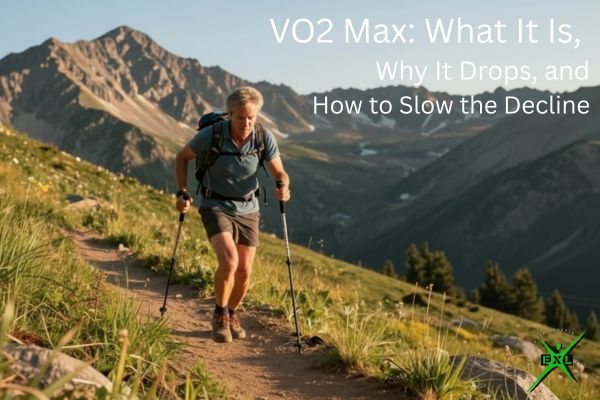
VO2 Max: What It Is, Why It Drops, and How to Slow the Decline
You don't have to accept the slope. Most of what drives VO2 max decline after 50 is behavior, not biology — and the research is clear on what to do about it.
A few years back, I took a group of clients on a summer hike in the Uintas. Good crew — mostly folks in their 50s, a couple in their 60s. We were about two hours in, solid elevation gain, when one of my clients pulled up next to me and said, “Mat, how come I can squat 185 pounds but I feel like I'm dying climbing this hill?”
It’s a fair question, and the honest answer is: strength and aerobic capacity are not the same system. You can build one without building the other. And as we age, aerobic capacity — specifically VO2 max — tends to get left behind while people focus on weights, body composition, or just getting through their workouts.
That gap has consequences. Not just on the trail. In the research, VO2 max is one of the most powerful predictors of how long you’re going to live and how well you’re going to function in your later decades. Low cardiorespiratory fitness has been found to carry a higher mortality risk than smoking, diabetes, or coronary artery disease.1 That’s not a typo.
So let’s talk about what VO2 max actually is, why it drops with age, and — most importantly — what you can do to slow that drop. Because most of it is not inevitable.
What VO2 Max Actually Means
VO2 max is the maximum amount of oxygen your body can consume and use during intense exercise, expressed in milliliters of oxygen per kilogram of body weight per minute (ml/kg/min). Think of it as a measure of your engine’s ceiling — how much fuel your cardiovascular and muscular systems can process at full output.
When you push hard — on a climb, in a sprint, chasing a grandkid across a park — your muscles need oxygen to produce energy. Your heart pumps oxygenated blood out, your muscles extract that oxygen and use it, and the byproduct (carbon dioxide) gets exhaled. VO2 max is the upper limit of how fast that whole system can run.
It’s measured in a lab on a treadmill or bike with a mask capturing your breath gases — the gold standard is a graded exercise test taken to failure. But consumer wearables like Garmin and Apple Watch also estimate it using heart rate data, and while those estimates aren’t as precise as lab testing, they’re directionally useful for tracking trends over time.
Here’s why it matters beyond athletic performance: VO2 max reflects the integrated health of your heart, lungs, blood vessels, and skeletal muscle simultaneously. It’s not one system. It’s a summary of all of them working together. That’s why it ends up being such a powerful predictor of longevity.
The Longevity Data Is Hard to Ignore
A landmark 2018 study published in JAMA Network Open analyzed over 122,000 patients and found a clear, graded relationship between cardiorespiratory fitness and survival. The least-fit group had 5.04 times the mortality risk of the most-fit group.1 Low fitness outperformed smoking, diabetes, and coronary artery disease as a risk factor. And there was no upper ceiling — every step up in fitness reduced risk.
A separate study published in the Journal of the American College of Cardiology followed middle-aged men for 46 years and found that each 1-unit increase in VO2 max was associated with an additional 45 days of life.2 That relationship held into the later decades of life, meaning fitness built in midlife was still paying dividends 40 years later.
And it’s not just about lifespan. Higher VO2 max is associated with lower risk of cardiovascular disease, better metabolic health, improved cognitive function, reduced fall risk, faster recovery from illness or surgery, and greater functional independence in old age.3 The number tells a story about multiple systems at once.
I’ve been coaching for nearly 30 years, and VO2 max is the one fitness marker I wish more people took seriously earlier. It’s trainable. It’s measurable. And the research is consistent across decades and populations.
Why VO2 Max Drops After 50 — and What’s Actually Driving It
VO2 max peaks in your 20s and begins a gradual decline that accelerates with age. On average, sedentary adults lose about 10–12% of their aerobic capacity per decade after age 30.4 That rate picks up in your 60s and 70s as multiple systems begin to compound against each other.
The mechanisms behind the drop are worth understanding because they tell you what’s actually trainable:
Reduced cardiac output. Your heart’s maximum pumping capacity declines with age — primarily due to a lower maximum heart rate and stiffer ventricular walls. Less blood delivered per minute means less oxygen delivered to working muscle.5
Reduced oxygen extraction. Young adults can extract roughly 80% of the oxygen delivered to their muscles at maximal effort. By ages 75–80, that figure drops to around 60%.5 Much of this is due to sarcopenia — specifically the preferential loss of the mitochondria-rich type II muscle fibers. Fewer mitochondria means less oxidative machinery to process oxygen.
Capillary thinning. The capillary networks that deliver oxygenated blood to individual muscle fibers thin with age, increasing the distance oxygen must travel to reach the cell. That diffusion delay shows up directly in aerobic capacity.
Mitochondrial dysfunction. Even the mitochondria that remain become less efficient with age, partly due to accumulated oxidative damage and reduced mitochondrial biogenesis — the process by which the body creates new mitochondria.5
Here’s the important nuance: research shows that 50–70% of the decline in VO2 max is attributable to inactivity rather than to biology.6 The biology sets a slope. Behavior determines how steep it gets.
Master athletes who continue training through their 50s, 60s, and 70s show a VO2 max decline rate roughly half that of sedentary, age-matched peers — about 5.5% per decade versus 12% per decade.7 Same age, same biology. Dramatically different trajectory.
A Story About My Neighbor’s Dad
I’ll share a quick one here. A few years ago, one of my clients asked me to talk to her father — a guy in his mid-60s who’d been sedentary for about a decade. He’d had a cardiac scare; his doctor told him to exercise, and he was terrified. He’d convinced himself that hard breathing during exercise meant something was breaking down.
He’d avoided anything that made his heart rate go up for so long that he’d built a real psychological wall around effort. Getting out of breath felt like a warning sign instead of a training signal.
We started slow. Really slow. Walks that got longer, then slightly faster. Bike sessions where he barely broke a sweat at first. Over a few months, we added some short intervals — nothing dramatic, just pushing the pace for 60–90 seconds and backing off. His fitness tracker showed his estimated VO2 max climbing. His resting heart rate dropped. He started sleeping better.
Within a year, he was doing things he’d written off entirely. Not because he’d found some miracle program. Because he’d started treating discomfort as information instead of danger.
That’s what the research shows, too. The aerobic system responds to training stimulus at any age. The ceiling is lower than it was at 25, but it can still go up.
What the Research Says About Improving VO2 Max After 50
The good news is unambiguous: VO2 max is trainable well into later decades of life, and the adaptations are meaningful.
A 2024 systematic review and meta-analysis of HIIT in older adults found that high-intensity interval training significantly improved VO2 max, with older adults achieving an average gain of approximately 2.5 ml/kg/min.8 For reference, that kind of improvement can shift someone from one mortality risk category to the next.
A separate umbrella review of multiple systematic reviews published in the Scandinavian Journal of Medicine & Science in Sports confirmed that HIIT consistently outperforms moderate-intensity continuous training for improving cardiorespiratory fitness in adults.9 The evidence is not subtle.
Even structured aerobic training at moderate intensity produces meaningful results. A 2024 meta-analysis of 38 randomized controlled trials found aerobic training improved VO2 max by an average of 1.8 ml/kg/min in middle-aged to older adults, with effects holding across health status, duration of training, and both men and women. 10
And here’s something that often surprises people: resistance training — the kind we do at EXL every day — also improves VO2 max in older adults, at least in the short to medium term. A meta-analysis in Age and Aging found that resistance training produced a mean improvement in VO2 peak of 1.89 ml/kg/min in healthy adults over 60.11 The mechanism appears to be increased capillary density and improved oxidative capacity in the muscle tissue — the same peripheral adaptations that support aerobic function.
What this means practically: your strength training is already building some of the biological infrastructure for aerobic performance. But to really move the needle on VO2 max, you need to add dedicated cardiovascular work — specifically, work that elevates your heart rate.
The Practical Framework: What to Actually Do
Here’s how I think about building VO2 max for the adults I work with. It’s not complicated, but it does require intentionality.
1. Build an aerobic base first.
If you haven’t been doing consistent cardiovascular work, start there. Walking briskly, cycling, swimming, hiking — anything that elevates your heart rate into a moderate zone (roughly 60–70% of your maximum heart rate) for 30–45 minutes, 3–4 times per week. This builds the aerobic infrastructure — capillary density, fat oxidation efficiency, baseline cardiac capacity — that makes higher intensity work both safe and effective.
2. Add intervals.
Once you have a base, intervals are where VO2 max actually moves. The research is clear that higher-intensity work — getting your heart rate up to 80–90% of maximum for 1–4 minutes, then recovering — produces larger gains than steady-state cardio alone.8,9 This doesn’t have to be complicated. It can be bike intervals, uphill walking intervals, rowing intervals, or simply alternating effort levels on whatever cardio you’re already doing.
A simple starting protocol: 5–6 rounds of 2 minutes at hard effort, followed by 2–3 minutes of easy recovery. Do this once or twice per week alongside your other training.
3. Use your outdoor activities as a training stimulus, not just recreation.
I’ve said this before, and I’ll say it again: Utah is an adult playground. Mountain biking in the Wasatch, skinning up in the Uintas, hiking elevation in the San Rafael Swell — these activities are legitimate aerobic training if you do them with some intention. A sustained climb on a bike or on foot at a challenging pace is essentially a long interval. Use the terrain.
The difference between someone who hikes casually and someone who hikes with purpose — pushing pace uphill and monitoring their perceived effort — is the difference between a leisure walk and actual cardiorespiratory training. Both are fine. Only one moves your VO2 max.
4. Protect your strength training.
Don’t drop your resistance training to add cardio. Muscle mass and VO2 max work together — more muscle means more mitochondrial machinery, more capillaries, more capacity to extract and use oxygen. The research on combined training in older adults shows that the two modalities complement each other.10 The goal is both, not either/or.
5. Track the trend.
Whether it’s a wearable estimate or an occasional lab test, track your VO2 max over time. The absolute number matters less than the direction. If it’s stable or rising, your training is working. If it’s declining over months, something needs to change.
A Note on Sleep and Recovery
I’d be leaving something out if I didn’t mention this. I’m known around EXL for my borderline-obsessive sleep habits — early bedtime, early rise, eye mask on, lights out. It’s not a quirk. It’s training.
Aerobic adaptations happen during recovery, not during the session. When you do cardiovascular work, you’re generating the signal — the actual mitochondrial growth, capillary expansion, and cardiac remodeling happens in the hours afterward, predominantly during deep sleep. Shortchange your recovery, and you shortchange the adaptation.
If you’re doing the work but not seeing results, check your sleep before you look at your program.
What This Looks Like at EXL
Most of what we do at EXL is strength-focused, and that’s intentional — muscle mass and strength are foundational to everything we care about for aging adults. But VO2 max is something I’ve been weaving into conversations with clients more deliberately lately, because the longevity data is too compelling to ignore.
For many of our clients, the cardio piece happens outside the gym — skiing, biking, hiking, pickleball, whatever Utah’s adult playground offers. For others, we’re adding short-interval blocks directly into their programming. Either way, the principle is the same: you have to give the aerobic system a reason to adapt.
The client who asked me on that Uinta hike why she could squat 185 but felt winded on the climb? She already knew the answer before I said it. We added cycling intervals twice a week. Six months later, she was leading the group up the hill. Same strength. Different engine.
The Bottom Line
VO2 max is not a number for athletes. It’s a number for everyone who wants to age well, stay independent, and keep doing the things they love into their 60s, 70s, and beyond.
The research is consistent: low cardiorespiratory fitness is one of the most significant and modifiable health risks adults face. And unlike many health markers, VO2 max responds robustly to training at any age — even if you’re starting from a low baseline, even if you haven’t done consistent cardio in years.
You don’t have to become an endurance athlete. You just have to give your aerobic system a real challenge regularly. The biology will respond.
~Mat Gover BS, CSCS
Want to build the kind of fitness that actually extends your healthspan?
Book a session at EXL: calendarapp.net/booking
Next week: Consistency beats intensity every time — and the research is surprisingly decisive about why. We'll get into what it actually means for how you should structure your training year.
Tags: VO2 max aging, VO2 max adults over 50, cardiorespiratory fitness longevity, improve VO2 max over 50, aerobic capacity aging, HIIT older adults, fitness and lifespan
About the Author
Mat Gover is the founder of EXL Fitness & Performance in Utah Valley. He studied athletic training at BYU and gained experience in physical therapy clinics before discovering his true calling in personal training. Since 2008, he’s specialized in the “gray area” of fitness — helping clients navigate injuries that don’t require formal PT and guiding others from post-rehab back to peak performance. Mat believes true success is measured in vitality: doing what you love with the people you love.
References
Mandsager K, Harb S, Cremer P, Phelan D, Nissen SE, Jaber W. Association of cardiorespiratory fitness with long-term mortality among adults undergoing exercise treadmill testing. JAMA Netw Open. 2018;1(6):e183605.
Laukkanen JA, Isiozor NM, Kunutsor SK. Objectively assessed cardiorespiratory fitness and all-cause mortality risk: updated meta-analysis with 33 studies and 100,000 subjects. Mayo Clin Proc. 2022. Also: Kodama S, et al. JAMA. 2009;301(19):2024–2035 (each 1 MET = 13–15% mortality reduction). Midlife CRF and longevity: Arena R, et al. J Am Coll Cardiol. 2018.
Harber MP, et al. Aerobic exercise training improves whole muscle and single muscle fiber size and function in older women. Am J Physiol Regul Integr Comp Physiol. 2009;297:R1452–R1459. Also: Blair SN, et al. Physical fitness and all-cause mortality. JAMA. 1989;262:2395–2401.
Fleg JL, et al. Accelerated longitudinal decline of aerobic capacity in healthy older adults. Circulation. 2005;112(5):674–682. Also: PMC4968829 (rowers study, ≈10% per decade after age 25).
Poole DC, Musch TI, Kindig CA. In vivo microvascular structural and functional consequences of muscle length changes. Circ Res. 1997. Also: Coggan AR, et al. Determinants of VO2max decline with aging. Applied Physiology Nutrition and Metabolism. 2007 (CDNSciencePub).
DexaFit. VO2 Max and Aging: What’s Normal vs. What’s Preventable. 2025. Summarizing evidence that 50–70% of VO2max decline is attributable to inactivity.
Kasch FW, Boyer JL, Schmidt PK, et al. Ageing of the cardiovascular system during 33 years of aerobic exercise. Age Ageing. 1999. Also: Hagberg JM, et al. Decline in VO2max with aging in master athletes and sedentary men. J Appl Physiol. 1990;68(5):2195–2199.
Sert H, Gulbahar Eren M, Gurcay B, Koc F. The effectiveness of high-intensity interval exercise on cardiometabolic health and quality of life in older adults: a systematic review and meta-analysis. BMC Sports Sci Med Rehabil. 2025. Also: Effects of HIIT on physical morphology in older adults, PMC11975580.
Poon ETC, et al. High-intensity interval training and cardiorespiratory fitness in adults: an umbrella review of systematic reviews and meta-analyses. Scand J Med Sci Sports. 2024.
Khammassi M, et al. Effect of aerobic training versus resistance training for improving cardiorespiratory fitness and body composition in middle-aged to older adults: a systematic review and meta-analysis of randomized controlled trials. Diabetes Metab Syndr. 2024.
Smart NA, et al. The role of resistance exercise training for improving cardiorespiratory fitness in healthy older adults: a systematic review and meta-analysis. Age Ageing. 2022;51(6):afac143.


