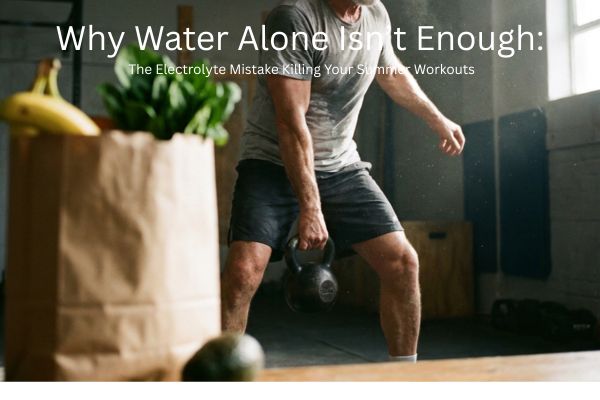
Why Water Alone Isn’t Enough: The Electrolyte Mistake Killing Your Summer Workouts
The problem isn’t that you’re not getting enough salt. It’s that nobody’s telling you what you’re actually short on.
Every July I get the same question, usually from someone holding a $40 tub of electrolyte powder: “Should I be adding this to my water?” The marketing on that tub is telling them they’re depleted, running on empty, one hard set away from cramping up. Here’s the uncomfortable truth: most of you aren’t short on sodium. You’re probably short on the two electrolytes nobody’s selling you a canister of — potassium and magnesium. Let’s get into what the research actually says, because the electrolyte conversation in this industry has the diagnosis backward for almost everyone I train.
The Sodium Story Nobody’s Telling You
American adults average roughly 3,400 mg of sodium a day — well above the American Heart Association’s ceiling of 2,300 mg, and more than double their “ideal” target of 1,500 mg1. More than 70% of that comes from processed and restaurant food, not the shaker on your table2. If you’re eating a normal American diet — even a reasonably healthy one — you are not walking into the gym sodium-depleted. You’re walking in with a surplus.
What the Exercise Science Actually Shows
The scary term here is exercise-associated hyponatremia (EAH) — dangerously low blood sodium brought on by exercise. It’s real, but the research doesn’t point to where the electrolyte industry wants it to. Studies of endurance athletes found that sodium intake before or during an event wasn’t reliably associated with the development of EAH6. What was linked: overhydrating with plain water during long events7. The people at real risk are marathoners, ultra runners, and multi-hour endurance athletes — not someone doing a 45- to 60-minute strength session in an air-conditioned studio.
Also worth knowing: how much sodium you personally lose in sweat is wildly individual — research puts the range at 200 to 2,000 mg per liter depending on genetics8. There’s no single blanket recommendation that fits everybody, which is exactly why generic “add this powder” advice is shaky ground.
The Electrolytes You’re Actually Short On
Here’s where it gets more useful. Potassium: fewer than 3% of American adults hit the recommended intake of 4,700 mg a day3. Magnesium: over half of adults over 20 fall short of the estimated average requirement4, and it’s worse in older adults — close to half of seniors are magnesium-low5. These two matter for blood pressure regulation, muscle cramping, and heart rhythm — unglamorous, unmarketed, and a far more common gap than sodium ever is for my clients.
Why This Actually Matters More After 50
Age changes the picture, just not in the direction most people assume. Thirst response blunts as you get older — several studies show older adults drink less even when their bodies need fluid because the signal that used to work doesn’t fire the same way. Kidney regulation of fluid and sodium shifts with age, too, and many common medications — diuretics, ACE inhibitors, other blood pressure meds — change how your body handles sodium and potassium. Older adults are 20–30% more prone to dehydration for exactly these reasons10. So for my 50+ clients, the real electrolyte conversation isn’t about your workout. It’s about daily food choices, medication awareness, and not relying on thirst alone as your cue.
When Electrolyte Drinks Actually Earn Their Spot
I’m not telling you electrolyte products are useless — I’m telling you most of my clients are reaching for them at the wrong time. If you’re out on a 90-plus-minute hike in July heat, doing all-day yard work, or riding for hours in Utah summer sun, sodium and fluid replacement genuinely matter, and an electrolyte drink is a reasonable tool. For your Tuesday strength session in a cool studio, it’s solving a problem you probably don’t have.
A Client Example
One of my clients — a woman in her mid-60s who’s been with me for a few years — started every session with an electrolyte drink because she’d read she “needed” it after 60. Meanwhile, her plate rarely included a potato, a banana, or leafy greens, and her at-home blood pressure readings were creeping up. We didn’t directly address the electrolyte drink habit — we just started building potassium- and magnesium-rich foods back into her week. Within two months, her at-home numbers had improved enough that her doctor noted it at her next visit.
What To Actually Do
Stop assuming a normal 45- to 60-minute training session requires electrolyte supplementation — your daily sodium intake almost certainly already covers it.
Build potassium into your plate daily: potatoes with the skin on, beans, spinach, bananas, avocado. You’re aiming for roughly 4,700 mg a day, and most people fall well short.
Add magnesium sources — leafy greens, nuts, seeds, dark chocolate — and if you’re 50+, ask your doctor whether a supplement makes sense for you.
Save the electrolyte drinks for genuinely long or hot efforts: hikes over 90 minutes, full days of yard work, multi-hour rides in July and August heat.
If you’re on a diuretic, an ACE inhibitor, or another blood pressure medication, talk to your doctor before changing your sodium or potassium intake — those meds change the math.
Don’t wait for thirst after 50. That signal weakens with age. On long outdoor days, drink on a schedule, not just when you feel thirsty.
Bottom Line
Electrolytes aren’t a myth, and they’re not irrelevant — but for almost everyone I train, the marketing has the diagnosis backward. You’re not salt-deficient. You’re probably short on potassium and magnesium, and that’s solved at your kitchen table, not in a $40 tub of powder.
If you want help building a plate that actually supports your training instead of just a drink that claims to, that’s exactly the kind of thing we dig into in a free intro session. Book yours here.
Next week, we’re tackling another topic everyone argues about at the dinner table: seed oils. Are they actually driving inflammation, or is that more internet noise than science? We’ll go through what the research really shows.
Tags: Nutrition, Hydration, Electrolytes, Healthy Aging, Utah Valley Fitness
References
1. American Heart Association. How Much Sodium Should I Eat Per Day? heart.org
2. U.S. Food and Drug Administration. Sodium in Your Diet. fda.gov
3. National Institutes of Health, Office of Dietary Supplements. Potassium — Health Professional Fact Sheet. ods.od.nih.gov
4. National Institutes of Health, Office of Dietary Supplements. Magnesium — Health Professional Fact Sheet. ods.od.nih.gov
5. Electrolytes in the Aging. PMC, National Institutes of Health. pmc.ncbi.nlm.nih.gov/articles/PMC2901254
6. Exercise-Associated Hyponatremia. StatPearls, NCBI. ncbi.nlm.nih.gov/books/NBK572128
7. Exercise-associated electrolyte disorders. ScienceDirect. sciencedirect.com/science/article/abs/pii/S2451965019300389
8. Sweating Rate and Sweat Sodium Concentration in Athletes: A Review of Methodology and Intra/Interindividual Variability. PMC, National Institutes of Health. pmc.ncbi.nlm.nih.gov/articles/PMC5371639
9. Age-Associated Abnormalities of Water Homeostasis. PMC, National Institutes of Health. pmc.ncbi.nlm.nih.gov/articles/PMC3682932
10. Adult Dehydration. StatPearls, NCBI. ncbi.nlm.nih.gov/books/NBK555956
Author
Mat Gover, BS, CSCS — owner and head coach of EXL Fitness & Performance, a personal training studio in Orem, Utah. Nearly 30 years in the fitness industry, specializing in coaching adults over 40 toward strength, mobility, and independence.


