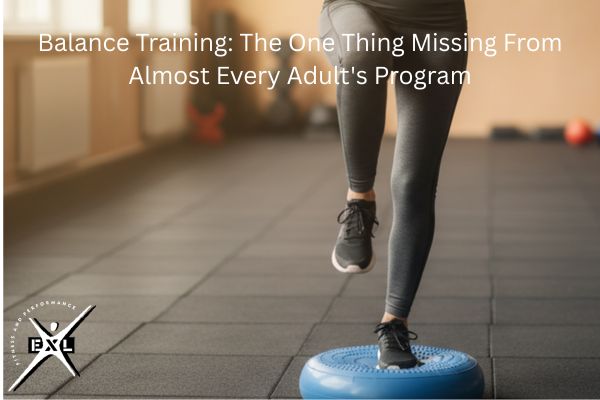
Balance Training: The One Thing Missing From Almost Every Adult's Program
Balance is the fastest-declining physical metric after 50 — and the one with the most direct connection to whether you stay independent, active, and alive. Here's what's happening and what to do about it.
Try this right now. Stand on one leg — your non-dominant leg — and see how long you can hold it.
If you're in your 50s and held it for 45 seconds or more, you're doing well. If you're in your 60s and hit 25 seconds, that's roughly average. If you couldn't make 10 seconds, the research has something important to tell you.
A landmark 2022 study in the British Journal of Sports Medicine tracked 1,702 adults aged 51 to 75 for an average of seven years. Those who couldn't hold a single-leg stance for 10 seconds had an 84% higher risk of dying from any cause within the following decade — even after adjusting for age, sex, BMI, and existing health conditions.1 Among those who failed the test, 17.5% died during follow-up. Among those who passed: 4.6%.
That's not a study about falling. That's a study about biological age. And balance — specifically, single-leg balance — turned out to be the most sensitive indicator of neuromuscular aging they could measure.2
Balance training is the one component I almost never see programmed adequately in adult fitness programs. Not because coaches don't know it matters — but because it doesn't feel like training. It's not glamorous. It doesn't produce soreness. There's no number that goes up on a whiteboard. So it gets skipped.
That's a mistake with consequences that compound every year you leave it unaddressed.
What Balance Actually Is — and Why It's So Complex
Balance isn't a single physical quality. It's the product of three sensory systems working in real-time coordination:
The visual system. Your eyes provide constant information about your position relative to your environment. This is why balance degrades noticeably when you close your eyes — you've removed one third of the system.
The vestibular system. The inner ear detects head position and movement, providing a spatial reference for your brain. Vestibular function declines with age — often silently, without obvious dizziness — and contributes directly to balance instability.3
The proprioceptive system. The network of sensory receptors in your muscles, joints, and connective tissue that tells your brain where your body is in space without you looking at it. Proprioception is what allows you to walk in the dark, catch yourself when you stumble, and adjust to uneven terrain automatically. It is profoundly affected by age — and profoundly affected by training.3
Your brain integrates all three streams of information continuously and makes rapid postural corrections to keep you upright. When one or more of these systems degrades, the brain has to work harder to compensate — and response time slows. That slowed response time is what turns a stumble into a fall.
Here's the critical point: the muscular system is the execution arm of all three. Your brain can detect the problem and send the correction signal, but if the muscles around your ankle, hip, and core can't respond fast enough or forcefully enough, the correction doesn't happen in time. Balance is not just sensory — it's neuromuscular. Which is why strength training and balance training are inseparable in a well-designed adult program.
How Fast Balance Declines — and Why
Of all the physical metrics that decline with age — strength, aerobic capacity, muscle mass, mobility — balance declines the fastest. A Mayo Clinic study examining healthy adults over 50 found that single-leg balance time on the non-dominant leg dropped by 21% per decade, more steeply than any other metric measured.2
The population statistics are sobering. About 30% of adults over 60 fall at least once per year.3 That number climbs to 60% by age 80.4 Falls are the leading cause of accidental death in adults over 65.3 Between 12% and 67% of older adults who fracture a hip die within one year.5 And the percent of people falling each decade after 65 increases from 40% to 65% to 82%.5
The physiological drivers are multiple and intersecting:
Sarcopenia. Muscle loss — particularly fast-twitch Type II fibers responsible for rapid, reactive movements — dramatically slows the muscular response time needed to recover from a stumble. You can't catch yourself with muscles that aren't there.
Proprioceptive decline. The density of proprioceptive receptors in the feet, ankles, and lower limbs decreases with age. Research shows proprioception deteriorates to the point where it can no longer provide meaningful functional assistance to postural stability in adults over 75, which may partly explain the twofold increase in fall risk in that age group.6
Vestibular deterioration. Slow, age-related loss of vestibular function is often asymptomatic — no dizziness, no obvious warning signs. But it quietly degrades the accuracy of the spatial reference your brain depends on.5
Slower neural processing. The brain's processing speed — including how quickly it integrates sensory inputs and sends postural correction signals — slows with age. The body takes longer to detect and respond to a perturbation.5
Inactivity. As with mobility, a substantial portion of balance decline attributed to aging is actually attributable to reduced physical demand. The proprioceptive and neuromuscular systems adapt to what you ask of them. Stop asking, and they downregulate.
The Real Cost: It's Not Just Falls
Fall statistics are important. But the cost of poor balance starts well before someone actually falls.
The first cost is fear. Adults who feel unsteady begin to restrict their activity — avoiding uneven terrain, stairs, busy environments, and activities they used to enjoy without a second thought. The restriction reduces physical activity, accelerating deconditioning and further reducing balance. It's a self-reinforcing spiral that can turn a person from active and independent to sedentary and dependent over just a few years.
The second cost is performance. Poor balance limits what you can do in training. If your single-leg stability is compromised, your squat mechanics suffer, your lunge is compensatory, and your ability to absorb force and change direction is reduced. Balance is the platform on which performance sits. When it degrades, everything built on top of it gets shakier.
I see this regularly at EXL. A client comes in strong on paper — good numbers on the barbell — but watch them do a single-leg Romanian deadlift and the instability is obvious. They've been building strength on a compromised base. That's fine for a while, until it isn't.
Outside the gym, the connection is even more direct. Hiking a ridgeline in the Uintas, navigating a rocky trail in Moab, or skiing variable snow in the Wasatch all demand reactive balance. The person who trains it keeps doing those things at 65 and 70. The person who doesn't start avoiding them, not because of age, but because of a trainable deficit they never addressed.
What the Research Says About Training It
The evidence for balance training is strong and consistent.
A 2025 systematic review and meta-analysis from Frontiers in Public Health found that multicomponent training programs — combining strength, balance, and aerobic exercise — are more effective at preventing falls than single-component programs.7 This aligns with how I've programmed adult training for years: balance work doesn't replace strength training, it integrates with it.
A 2024 review in Healthcare examining 155 studies on exercise and fall risk found that balance and strength training together improve postural control, gait stability, and neuromuscular coordination more effectively than either alone.8 The combination addresses both the sensory and muscular sides of the balance equation simultaneously.
A 2025 meta-analysis in Frontiers in Public Health specifically evaluated the effect of core training on balance in older adults and found significant improvements in both static and dynamic balance outcomes across 11 studies — consistent with the understanding that core stability is the foundation of all balance and postural control.9
Perturbation-based balance training — deliberately challenging your balance rather than passively standing on one leg — yields particularly strong results. A 2025 systematic review and meta-analysis found that it meaningfully reduces both falls and fall-related injuries in older adults.10
The timeline is encouraging: meaningful improvements in single-leg stance times have been observed in as little as 8–12 weeks of targeted training.1 You don't need years to make a dent in this. You need a few months of consistent, intentional work.
A Client Who Illustrates Why This Matters
A client came to EXL about three years ago — 63, active golfer, walked regularly. She'd had two near-falls in the past year, both on perfectly flat ground. Startled her both times. She came in wanting to get stronger but hadn't connected the near-falls to a trainable problem.
When we assessed her, her single-leg balance was poor — under 10 seconds on either side. Her ankle stability was weak. Her hip abductors couldn't maintain alignment during a single-leg stance. Her core had the strength to hold a plank but not the reactive stability to catch her when she was pushed.
We built balance work into every session from day one — not as a warmup afterthought, but as a programmed component with progression. Single-leg work in her strength exercises. Standing on an unstable surface. Reactive drills. Perturbation training, where I'd give her a light push during a single-leg hold, and she had to recover.
Eight weeks in, her single-leg balance had more than doubled. Three months in, she told me she'd been hiking a trail she'd avoided for two years because the terrain felt unpredictable. She hadn't changed anything about her golf swing, but her ball-striking had improved — because she was standing on a more stable base.
She hasn't had a near-fall since.
Test Yourself Right Now
The single-leg stance test is a reliable, validated, and accessible way to get a snapshot of your neuromuscular balance. Here's how to do it:
Stand near a wall or sturdy surface for safety. Lift one foot off the ground — knee bent to about 90 degrees, foot not touching the standing leg. Hands on hips or at sides (not bracing against anything). Start a timer. See how long you can hold it without touching down, grabbing something, or excessive hopping.
Do both legs. Do it with eyes open first, then eyes closed (which removes visual input and is significantly harder).
Eyes open benchmarks:
50s: 40–50 seconds is solid | 30s: worth addressing | Under 10s: prioritize this now
60s: 25–35 seconds is solid | 15s: worth addressing | Under 10s: prioritize this now
70s: 15–25 seconds is solid | 10s: worth addressing | Under 5s: prioritize this now
If there's a significant difference between your two legs, that asymmetry matters — the weaker side is the one that will fail you when you stumble.
How to Train It: A Progressive Framework
Balance training doesn't require special equipment or long sessions. It requires progressive challenge and consistency. Here's how to build it from the ground up:
Static single-leg holds. Stand on one leg for time. Start where you are. If that's 8 seconds, work toward 15, then 20, then 30. Progress by closing your eyes (much harder), standing on a folded towel or balance pad (unstable surface), or turning your head side to side while holding. Do 3 sets of max effort per side daily — this takes under 5 minutes.
Single-leg strength exercises. Program single-leg Romanian deadlifts, Bulgarian split squats, step-ups, and single-leg press into your training. These build the hip, glute, and ankle strength that underpins balance while simultaneously training the neuromuscular control that holds it together. Full-range, controlled reps — don't rush them.
Perturbation training. Train your reactive balance — the system that catches you when you stumble — not just your static balance. Have a partner give you light pushes during a single-leg hold. Step off a curb unexpectedly. Use a wobble board. Reactive drills — catching a ball while balancing, turning your head during single-leg exercises — train the nervous system to respond faster when real-world perturbations happen.
Core stability work. The core is the anchor of postural control. Research specifically links core training to improved balance outcomes in older adults.9 Anti-rotation work (Pallof press, cable chops), single-leg deadlifts, and carries (farmer's carry, suitcase carry) all train the core in the context of balance and movement — far more transferable than floor-based core exercises.
Functional movement that challenges balance. Walking on uneven terrain, hiking, tai chi, and similar activities provide low-intensity balance training volume that accumulates meaningfully over time. Tai chi, in particular, has strong evidence of fall risk reduction — a 43% reduction in some studies.1 If formal training isn't daily, incorporate uneven terrain into your outdoor activity. It all counts.
The Bottom Line
Of all the physical qualities that decline with age, balance declines the fastest and carries the most direct consequence for your independence, your activity level, and your life. And yet it's the one most consistently left out of adult training programs.
The good news is the same as it's been for the last two weeks: this is trainable. At any age. In 8 to 12 weeks of consistent work, most adults can make significant, measurable improvements in their balance metrics. The nervous system is plastic. The muscles respond. The proprioceptive system sharpens when you give it something to sharpen against.
Start with the test above. Find out where you are. Then start building from there — a few minutes a day, folded into your existing training or your morning routine.
Don't wait until a stumble reminds you that this matters.
→ Book a free intro session at EXL Fitness
—
Next week: Healthy fats — what your brain, joints, and heart are all asking for, and the practical guide to eating more of the right ones.
Tags: balance training adults over 50, fall prevention exercise, single leg balance test, proprioception aging, balance exercises older adults, neuromuscular training, EXL Fitness
References
1. Araujo CGS, et al. Successful 10-second one-legged stance performance predicts survival in middle-aged and older individuals. Br J Sports Med. 2022;56(17):975–980. doi:10.1136/bjsports-2021-105360. Also cited for tai chi 43% fall risk reduction: Superage.app. Single Leg Balance Test: The 10-Second Test That Predicts Mortality. Published March 3, 2026.
2. Kaufman KR, et al. Unipedal stance as a reliable measure of neuromuscular aging. PLOS ONE. 2024. doi:10.1371/journal.pone.0301965. (Mayo Clinic study: non-dominant leg stance time declines 21% per decade.)
3. Xie Y, et al. Ageing changes the proprioceptive contribution to balance control under different types of mastoid vibration. Exp Physiol. 2025. doi:10.1113/EP092548. (Falls are leading cause of accidental death in adults ≥65; ~30% fall annually.)
4. Chen X, et al. Relationship between proprioception and balance control among Chinese senior older adults. Front Aging Neurosci. 2022;14:1027289. PMC9797963. (60% of adults over 80 fall annually.)
5. Vestibular Disorders Association. Fall Prevention: Age-Related Dizziness and Imbalance. vestibular.org. (Fall rates increase from 40% to 65% to 82% per decade after 65; 12–67% hip fracture mortality within one year.)
6. Wu Y, et al. The relationships of postural stability with muscle strength and proprioception are different among older adults over and under 75 years of age. Front Aging Neurosci. 2022. PMC9395655. (Proprioception may deteriorate past functional utility by age 75+.)
7. Mayer F, et al. A systematic review of multicomponent vs. single-component training programs for fall prevention in older adults. Front Public Health. 2025;13:1636439. doi:10.3389/fpubh.2025.1636439.
8. Kehler DS, et al. Mechanism-driven strategies for reducing fall risk in the elderly: a multidisciplinary review of exercise interventions. Healthcare. 2024;12(23):2394. doi:10.3390/healthcare12232394.
9. Zhong Y, et al. Effects of core training on balance performance in older adults: a systematic review and meta-analysis. Front Public Health. 2025;13:1661460. doi:10.3389/fpubh.2025.1661460.
10. Zhu I, et al. Perturbation-based balance training reduces falls and fall injuries in older people. medRxiv. 2025. doi:10.1101/2025.07.23.25331962.
About the Author
Mat Gover, BS, CSCS, is the owner and head coach of EXL Fitness & Performance in Orem, Utah. With nearly 30 years of coaching experience and a specialization in strength and performance for adults over 40, Mat brings science-backed training and a no-fluff approach to every session. When he's not coaching, he's skiing the Wasatch, riding in Moab, or climbing something steep in the Uintas.


