You Dealt With the Stressor. So Why Do You Still Feel Stressed?
The meeting is over. The argument is resolved. The deadline has passed.
So why does your body still feel like it's running from something?
You're not imagining it. There's actually a scientific explanation — and once you understand it, a lot of things start to make sense: the tension you can't shake after a hard day, the restless nights even when nothing is "wrong," the low-grade exhaustion that just doesn't quit.
It comes down to a concept called the stress cycle — and the fact that most of us never complete it.
The Book That Changed How We Think About Burnout
In their New York Times bestselling book Burnout: The Secret to Unlocking the Stress Cycle, sisters Emily Nagoski, PhD, and Amelia Nagoski, DMA, introduced a distinction that seems simple but is genuinely transformative:
The stressor and the stress are not the same thing.
Dealing with the stressor — the thing causing your stress — does not automatically deal with the stress itself. Your body doesn't care that the problem is solved. It needs to complete a biological cycle before it can truly stand down.
If you're over 40 and you've ever wondered why you feel chronically wound up despite having a decent life, this is likely a significant part of the answer.
What the Stress Cycle Actually Is
Think back to our evolutionary roots. When your ancestors encountered a genuine physical threat — a predator, an attacker, a dangerous situation — their nervous system activated the fight-or-flight response. Cortisol and adrenaline surged. Heart rate spiked. Muscles tensed. Digestion slowed. Every system in the body is mobilized for survival.
And then — if they survived — they ran, fought, or escaped. The physical exertion of that response burned through the stress hormones. The nervous system got the signal: threat is over, you are safe. The cycle is completed. The body returned to baseline.
Here's the problem with modern life: we face the stressors without being able to complete the physical response.
Your boss sends a tense email. Your nervous system activates exactly the same way it would have for a predator. But you sit at a desk. You reply professionally. You move on to the next item. The cortisol is still in your bloodstream. The muscles are still braced. Your brain never got the message that you made it out safely.
Do that every day for months or years — without completing the cycle — and you end up in chronic low-grade activation. That's the engine behind burnout: not any single stressor, but the accumulated, unprocessed stress that was never given a way out.
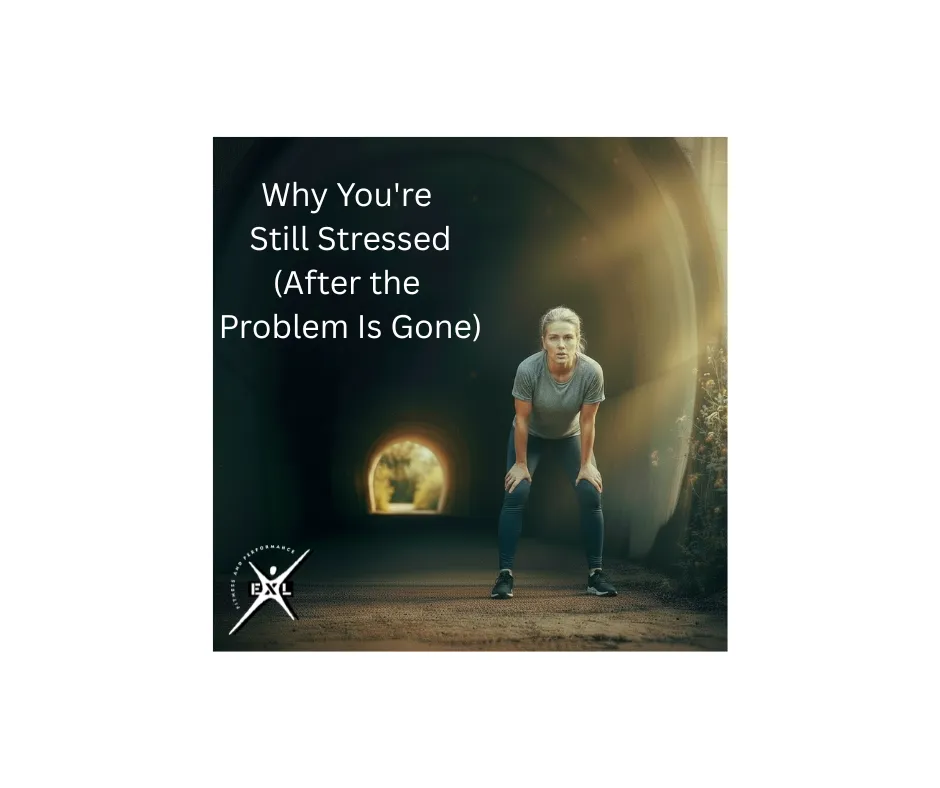
As the Nagoskis explain, emotions are neurological events with a beginning, a middle, and an end. They describe feelings as tunnels — you have to go all the way through to get to the light on the other side. When we get stuck in the middle of the tunnel — which most of us do, most of the time — exhaustion follows.
Why This Hits Harder After 40
For active adults in their 40s, 50s, 60s, and 70s, unresolved stress isn't just a mood issue. It has real, measurable physiological consequences — and the research connecting chronic stress to nearly every major lifestyle disease is both substantial and sobering.
When the stress cycle stays incomplete, your body remains in a state of low-grade physiological activation. Cortisol and adrenaline don't fully clear. The sympathetic nervous system remains partially activated. And over time, that state of chronic activation quietly dismantles your health from the inside out.
Cardiovascular Disease
The heart takes the most direct hit. Chronically elevated cortisol raises blood pressure, increases inflammation in arterial walls, promotes arterial plaque buildup, and elevates LDL cholesterol — all major drivers of heart attack and stroke. The American Heart Association recognizes psychological stress as an independent risk factor for cardiovascular disease, not merely a contributor to other risk factors. For adults over 50, where cardiovascular risk is already climbing, unresolved chronic stress is fuel on a fire.
Type 2 Diabetes and Insulin Resistance
Cortisol is a glucose-mobilizing hormone — it was designed to flood your bloodstream with energy so you could run from a threat. When cortisol remains elevated chronically, blood sugar remains elevated. The pancreas works overtime producing insulin to manage it. Over time, cells become resistant to insulin's signal. The result is a well-established pathway from chronic stress directly to type 2 diabetes — one of the most prevalent and preventable diseases in the 40-75 age group.
Muscle Loss and Metabolic Decline
For anyone working to stay strong and functional as they age, this one is particularly relevant. Cortisol is catabolic — it breaks tissue down for fuel. Chronically elevated cortisol accelerates the loss of lean muscle mass, impairs muscle protein synthesis, and undermines virtually every adaptation you're trying to build in the gym. You can train hard and eat well and still fight an uphill battle if chronic stress is constantly pulling in the opposite direction. Stress management isn't separate from your fitness program. It is part of your fitness program.
Immune Dysfunction
Acute stress actually briefly boosts immune function — another evolutionary feature. But chronic stress suppresses it. Long-term cortisol elevation dysregulates the immune system, increasing systemic inflammation while simultaneously reducing the body's ability to fight infection and repair damaged tissue. This helps explain why chronically stressed people get sick more often, recover more slowly, and show more markers of accelerated biological aging than their less-stressed peers.
Cognitive Decline and Brain Aging
Chronic stress is neurotoxic. Sustained cortisol exposure damages the hippocampus — the brain's memory and learning center — reducing its volume over time. It impairs prefrontal cortex function, which governs decision-making, impulse control, and focus. And it accelerates the kind of cognitive aging that people in their 50s and 60s are most worried about. The brain you're trying to protect through exercise and good nutrition is being quietly eroded if the stress cycle is never completed.
Sleep Disruption
Cortisol and melatonin operate on opposing rhythms — cortisol rises in the morning, and melatonin rises at night. Chronic stress throws this rhythm off. People stuck in unfinished stress cycles often describe lying awake with a busy mind even when exhausted, waking at 3 a.m. for no apparent reason, or feeling unrefreshed despite a full night's sleep. Poor sleep then compounds every other consequence on this list, because sleep is when the body clears stress hormones, repairs tissue, consolidates memory, and regulates virtually every metabolic process.
The Common Thread: Inflammation
What links all of these is inflammation. Chronic, low-grade inflammation — driven largely by unresolved stress and the sustained cortisol that accompanies it — is now understood to be the underlying mechanism behind most major lifestyle diseases. It's not that stress causes heart disease, diabetes, and cognitive decline independently. It's that chronic stress creates the inflammatory environment in which all of them thrive.
This is why stress management isn't a soft skill or a lifestyle preference. For anyone serious about healthy aging, it is a clinical priority.
The good news: you likely already have one of the most powerful stress cycle completers in your toolkit. You just may not have been thinking of it this way.
The 7 Ways to Complete the Stress Cycle
The Nagoskis identified seven evidence-based strategies that signal to your nervous system: you are safe. The threat is over. You can stop being stressed now.
1. Physical Movement
This is the most efficient and effective strategy — and it's not complicated. Moving your body 20 to 60 minutes a day is enough for most people to complete the stress response cycle. It doesn't have to be intense. Running, lifting, cycling, walking briskly, dancing — anything that gets your heart rate up and your muscles working.
Here's why this matters for you specifically: every workout you do isn't just building strength and endurance. It's also finishing the biological business your stress left undone. You're not just training your body — you're regulating your nervous system. That post-workout sense of calm isn't just endorphins. It's your brain receiving confirmation that the lion has been outrun.
2. Deep, Slow Breathing — and the Physiological Sigh
When your stress levels aren't extremely high, deliberate breathing can downregulate the fight-or-flight response on its own. The key is a long, complete exhale — breathing all the way out until your belly contracts. One effective pattern: inhale for a count of five, hold for five, exhale for a count of ten. The extended exhale activates the parasympathetic nervous system, essentially flipping the switch from threat mode to recovery mode.
But there's one breathing technique that deserves special mention — one that your body already knows how to do instinctively, and that neuroscientist Andrew Huberman at Stanford has called the fastest known way to reduce physiological arousal in real time.
It's called the physiological sigh.
You've done it thousands of times without thinking: a double inhale through the nose followed by a long, complete exhale through the mouth. It happens automatically when you've been crying, when you're falling asleep, when you've been holding tension for too long. Your body does it because it works.
Here's the biology. During stress, tiny air sacs in the lungs called alveoli partially collapse, reducing the surface area available for gas exchange. CO₂ builds up in the bloodstream, which keeps the nervous system in an elevated, anxious state. The double inhale re-inflates those alveoli. The long exhale then rapidly offloads a large volume of CO₂. The result is a near-immediate drop in heart rate and a measurable shift in autonomic nervous system state — from sympathetic (activated) toward parasympathetic (calm).
One to three physiological sighs are often enough to take the edge off an acute stress spike. Research from Huberman's lab, published in Cell Reports Medicine, found that it outperformed other real-time stress reduction techniques, including mindfulness meditation, in the speed of its physiological effect.
How to do it: Double inhale through the nose (a full breath, then a second sharp sniff on top of it), then a long, slow, complete exhale through the mouth. Repeat one to three times. That's it.
This is particularly useful in moments where you can't move — in a meeting, in traffic, in a tense conversation. It won't fully complete the stress cycle in a chronically activated state, but it immediately begins moving your physiology in the right direction.
3. Positive Social Connection
Even brief, warm interactions with other people signal safety to the nervous system. A genuine conversation with a friend, casual friendly banter with a colleague, connecting with a neighbor — these interactions tell your brain that you're part of a community, which, in evolutionary terms, meant you were protected.
For adults over 40, this one deserves special attention. Social isolation is one of the most significant risk factors for both physical and cognitive decline in later life. Community isn't a luxury — it's a biological need. And the research shows that people who maintain strong social connections manage stress far more effectively across the decades.
4. Laughter
Not polite chuckling. Real, deep, belly laughter — the kind that makes your eyes water. Neuroscientist Sophie Scott's research shows that this type of laughter activates an ancient mammalian system that maintains social bonds and regulates emotions. It's one of the fastest ways to interrupt a stress response and shift your physiology toward recovery.
This is one reason why people who laugh often with the people they love tend to age better in almost every measurable way. It's not incidental — it's biological.
5. Affection
Physical connection with a person you trust — a real, sustained hug — has a measurable effect on the stress response. Research cited in Burnout suggests that a 20-second hug can lower blood pressure and heart rate, alter cortisol levels, and increase oxytocin, the social bonding hormone. It's not the duration so much as the quality: a full, grounded embrace where both people are present and relaxed.
For those who don't have that kind of physical closeness readily available, time with a pet produces many of the same physiological effects. The key mechanism is the same: safe, warm physical contact that tells the nervous system it can stand down.
6. Crying
This one surprises people. Crying isn't weakness — it's a biological release mechanism. It's one of the body's built-in tools for completing an emotional cycle that's been stuck. The Nagoskis emphasize that you don't need to have "solved" whatever caused the emotion in order to cry it out. The emotion will run its course on its own — usually within five to ten minutes — and when it does, you'll feel a genuine physiological shift: deeper breath, relaxed muscles, a change in mental state.
Many adults over 40, particularly men, have spent decades suppressing this response. That suppression doesn't eliminate the stress — it just keeps you stuck in the middle of the tunnel. Learning to let the cycle complete, even when it's uncomfortable, is a genuine health skill.
7. Creative Expression
Art, music, writing, crafting, cooking — anything creative gives your emotions a container and a channel. The Nagoskis describe creative expression as a cultural loophole: a space where big emotions are not just tolerated but invited. You don't have to be good at it. You have to be in it. The process is what moves the emotion through; the product is beside the point.
The Key Insight: Fixing the Problem Is Not Enough
This bears repeating because it runs counter to how most high-achieving adults think about stress management.
You cannot think your way out of stress. You cannot resolve your way out of it. You cannot simply remove all your stressors and expect to feel better — partly because you can't remove all your stressors, and partly because even if you could, the accumulated biological residue of unprocessed stress would still be in your body.
The stress cycle has to be completed — physically, emotionally, physiologically. Your body started something when it perceived a threat, and it needs to finish that something before it can rest.
For people in their 40s, 50s, and beyond, this is particularly relevant because the stressors tend to multiply — career pressures, aging parents, health concerns, financial responsibilities, major life transitions. And the cultural message is almost always push through, keep going, figure it out. What that often produces is a body permanently stuck in the stress tunnel, wondering why rest never actually feels restful.
What This Looks Like in Practice
You don't need a major lifestyle overhaul. You need consistent small completions.
A 30-minute workout after a hard day at work isn't just fitness — it's biology. A genuine conversation with a friend isn't just social — it's regulatory. A good cry over a movie that hits close to home isn't weakness — it's your nervous system doing its job.
At EXL Fitness, we see this play out with our members every week. People come in carrying the weight of their day — work stress, family stress, the ambient pressure of modern life — and they leave different. Not because we fixed anything outside the gym. But because physical movement is one of the most powerful stress cycle completers available to us, most people are dramatically underutilizing it.
If you're ready to build a training practice that not only strengthens your body but helps regulate your nervous system — and you want a coach who understands what's actually happening at every stage of that process — we'd love to talk.
EXL Fitness is a personal training gym in Orem, Utah, specializing in strength training and functional fitness for active adults ages 40–75. Learn more or schedule a free consultation at exlfitness.com.


