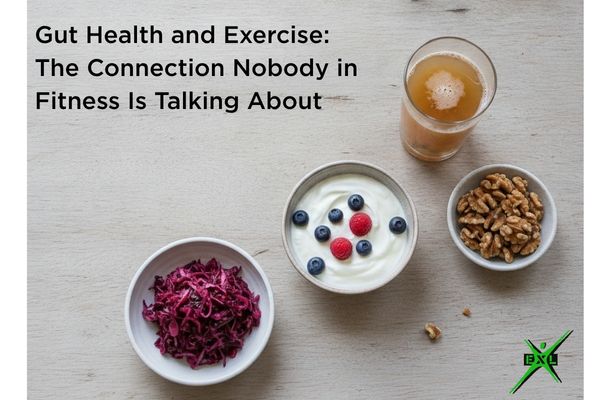
Gut Health and Exercise: The Connection Nobody in Fitness Is Talking About
Your gut microbiome affects your strength, inflammation, recovery, and brain. And exercise is one of the most powerful tools for protecting it. Here's what the research says.
When people ask me what the most underappreciated factor in health and performance is, sleep is still my first answer. But gut health is a close second — and it's the one I think is most consistently overlooked, especially in the fitness world.
The gut microbiome influences a surprising number of systems simultaneously. Your inflammatory status. Your immune response. Your ability to absorb nutrients. Your recovery from training. Your mood and cognitive function. Even your muscle mass. It's not the only thing that matters — far from it — but it's one of the few factors that touch almost everything else.
And it's a topic the fitness world has largely been quiet about.
That's changing. The research has accelerated substantially in the last few years, and what's emerging is a picture of the gut-exercise relationship that should change how every adult thinks about training, diet, and long-term health. This post is the overview I wish existed when I started digging into this.
What the Gut Microbiome Actually Is
Your gut microbiome is the ecosystem of roughly 38 trillion microorganisms — bacteria, fungi, viruses, and archaea — living primarily in your large intestine. The number of microbial cells in your body is roughly equal to the number of human cells. You are, in a very real sense, as much microbial as you are human.
These microorganisms aren't passive passengers. They metabolize nutrients you can't digest, produce vitamins, regulate immune signaling, manufacture short-chain fatty acids (SCFAs) that feed your gut lining and reduce inflammation, and communicate directly with your brain via the gut-brain axis. A healthy, diverse microbiome is one of the most functional organs in your body. An unhealthy one is a liability that affects almost every other system.
The key metric researchers track is diversity — specifically, the variety of different microbial species present. Higher diversity is generally associated with better health outcomes across almost every measure studied: lower inflammatory markers, better metabolic function, stronger immune response, better cognitive outcomes, and lower disease risk. 1 Reduced diversity — called dysbiosis — is associated with the opposite.
What Happens to the Gut After 50
The gut microbiome is relatively stable through mid-adulthood, then begins a meaningful shift after around age 65 — with the changes becoming more pronounced after 80.2But the groundwork for those changes is laid earlier, and the trajectory is heavily influenced by lifestyle factors that are well within your control.
Here's what the research shows is happening:
Diversity declines. The diversity of microbial species decreases with age, particularly beneficial bacteria that produce short-chain fatty acids such as butyrate — a compound that nourishes the gut lining, reduces intestinal inflammation, and regulates immune signaling.2
The gut barrier weakens. The lining of the intestine is maintained by tight junctions between cells and a mucus layer produced by goblet cells. Both degrade with age and dysbiosis. When the barrier weakens — "leaky gut" — bacterial toxins like lipopolysaccharide (LPS) enter the bloodstream and trigger a chronic systemic inflammatory response.3A 2024 study from the Wistar Institute confirmed distinct gut microbial signatures linked to accelerated biological aging, with leaky gut as the key mechanism.4
Harmful bacteria gain ground. As beneficial species decline, pro-inflammatory bacteria fill the void. This dysbiosis directly amplifies the inflammaging we covered two weeks ago — producing more pro-inflammatory metabolites, suppressing beneficial SCFA production, and accelerating the cellular senescence process.5
The practical consequence: a declining gut microbiome isn't just a digestive issue. It's a driver of the systemic inflammation, immune dysfunction, muscle loss, and cognitive decline that define accelerated aging. Address the gut, and you're intervening upstream on all of those simultaneously.
The Gut-Muscle Connection Nobody Told You About
This one surprised me when I first encountered the research, and it's the part I think is most underappreciated in the fitness world: your gut microbiome directly influences your muscle mass and strength.
A 2024 systematic review in the International Journal of Environmental Research and Public Health examined the relationship between gut microbiome composition and muscle parameters in adults over 50.6The findings were striking: gut microbiome diversity was positively associated with muscle mass, strength, and physical performance. Adults with sarcopenia — age-related muscle loss — consistently showed lower microbial diversity and altered bacterial composition compared to those with healthy muscle mass.
The mechanisms proposed include: SCFAs (particularly butyrate and propionate) may directly stimulate muscle protein synthesis; gut dysbiosis drives systemic inflammation, which accelerates muscle breakdown; a compromised gut barrier allows endotoxins to enter circulation and impair anabolic signaling; and the microbiome influences how effectively you absorb and utilize dietary protein.6
In other words, two adults with the same protein intake and training can get different results depending on their gut health. This is not a minor variable.
A 2025 pilot RCT — the DEMGUTS project — is investigating how different exercise modalities affect gut microbiome composition in older adults with sarcopenia, as evidence for the gut-muscle link has grown strong enough to warrant targeted intervention research.7 We don't have the full results yet, but the fact that this research is happening tells you where the science is heading.
Exercise Directly Improves Gut Health
Here's where this becomes actionable. Exercise is one of the most powerful tools available for improving gut microbiome composition — independently of diet.
A 2022 systematic review in Nutrients examined human studies on exercise and gut microbiome in older adults and found that physical activity consistently improves gut microbiome composition, increasing beneficial bacterial populations and diversity.8A 2024 meta-analysis of 25 studies and 1,044 participants confirmed that exercise modulates gut bacteria abundance and functionality, with consistent increases in beneficial microbes.9
A 2025 study comparing gut microbiome composition in physically active versus sedentary older adults found that both high-performance and low-performance active adults had significantly enriched beneficial bacterial species — including key butyrate producers — compared to sedentary controls.10The critical finding: it wasn't the intensity of exercise that drove the benefit; it was the regularity of it. Consistent movement, not elite performance, is what the gut responds to.
A pilot study of 22 older sedentary adults (mean age 58) found that 24 weeks of progressive aerobic and resistance training produced significant increases in beneficial Bifidobacterium, Oscillospira, and Anaerostipes—all associated with SCFA production and gut lining integrity—and decreases in pro-inflammatory bacterial species.11
Perhaps most directly relevant: a clinical trial of sedentary middle-aged adults with insulin resistance found that just two weeks of either sprint interval training or moderate-intensity continuous training three times per week significantly reduced intestinal inflammatory markers, including LPS — the endotoxin that leaks from a compromised gut barrier and drives systemic inflammation.11
Exercise doesn't just burn calories and build muscle. It feeds your gut ecosystem in ways that ripple outward through virtually every other health system.
The Gut-Brain Axis: Why Your Gut Affects How You Think and Feel
The gut and brain communicate via a bidirectional network of nerves, hormones, and immune signals — collectively called the gut-brain axis. The vagus nerve is the primary highway: it continuously carries information from the gut to the brain in real time.
Your gut microbiome produces or influences the production of roughly 90% of your body's serotonin — a neurotransmitter most people associate only with mood but which also regulates sleep, appetite, and gut motility.1It also produces GABA, dopamine precursors, and a range of other neuroactive compounds that influence anxiety, stress response, cognitive function, and emotional regulation.
The implication: gut dysbiosis doesn't just make you feel bloated. It can affect your mood, sleep quality, stress resilience, and cognitive sharpness. For adults over 50, where cognitive decline becomes a legitimate concern, the gut-brain connection is not an abstract concept — it's a modifiable pathway.
A 2025 review in Frontiers in Microbiology confirmed that butyrate-producing bacteria specifically reduce the SASP (senescence-associated secretory phenotype) — the inflammatory secretions from senescent cells that drive cognitive and tissue decline. Dysbiosis, conversely, amplifies SASP and accelerates senescence.12
A Client Story
A client, 58, had been struggling with low energy, inconsistent digestion, and what she described as "brain fog" that had been getting worse for a couple of years. She'd had a full medical workup. Nothing alarming came back. She was training two days a week but inconsistently, eating reasonably but relying heavily on packaged and processed convenience foods.
We made three changes simultaneously: got her training consistently three days per week, shifted her diet toward more whole foods with an emphasis on fiber and fermented foods, and added a daily probiotic. We didn't tell her to expect miracles. We told her to give it 90 days.
By week six, she was sleeping better, and the brain fog was noticeably clearer. By week twelve, her energy was more consistent than it had been in years. Her digestion had normalized. She wasn't doing anything exotic — she was just training consistently, eating more fiber, and adding fermented food to her diet most days.
I can't tell you definitively that her gut microbiome drove all of that — we didn't sequence it before and after. But the pattern matches what the research predicts when you combine regular exercise with a gut-supportive diet. The changes were real, meaningful, and fast.
What to Actually Do About It
The levers with the strongest evidence:
1. Train consistently. This is the most direct intervention. Consistent aerobic and resistance training improves microbiome diversity and beneficial bacterial populations in older adults. You don't need to be elite — you need to be regular. Three to four sessions per week, sustained over weeks and months, move the needle.
2. Eat more fiber. Dietary fiber is the primary fuel source for beneficial gut bacteria — particularly the butyrate producers. Most adults over 50 consume well under the recommended 25–38 grams per day. Vegetables, legumes, whole grains, nuts, seeds, and fruit all contribute. Variety matters as much as quantity — different bacteria feed on different fiber types, which is why dietary diversity drives microbial diversity.
3. Add fermented foods. Yogurt, kefir, kimchi, sauerkraut, miso, and kombucha all introduce live beneficial bacteria and have been shown to improve gut microbiome composition and reduce inflammatory markers.13A 2025 systematic review confirmed that fermented food consumption improves gastrointestinal well-being and beneficially modulates the gut microbiota.14You don't need a specialty product — plain Greek yogurt with live cultures and a regular rotation of fermented vegetables is a practical start.
A note on fermented vs. pickled foods — they're not the same thing.
Real fermented foods undergo lacto-fermentation: live bacteria — primarily Lactobacillus — consume sugars and produce lactic acid, which preserves the food and populates it with beneficial microorganisms. The bacteria are still alive and active in the final product. That's what delivers the gut health benefit.
Most commercial pickles, shelf-stable sauerkraut, and jarred pickled vegetables are preserved in vinegar — an acidic environment that mimics the sour taste of fermentation but uses no live bacteria. Vinegar kills microorganisms rather than cultivating them. The end product has no probiotic value.
How to tell the difference at the store:
Look for "live cultures" or "naturally fermented" on the label. Found in the refrigerated section. No vinegar in the ingredients list.
Skip: anything shelf-stable at room temperature or listing vinegar as a primary ingredient. Most national pickle and sauerkraut brands fall into this category. Bubbies is one widely available brand that makes genuinely fermented pickles and sauerkraut worth seeking out.
4. Reduce ultra-processed food. Processed foods — particularly those high in emulsifiers, artificial sweeteners, and refined carbohydrates — are consistently associated with reduced microbiome diversity and gut barrier degradation. This connects directly to last week's post on fats: replacing seed-oil-heavy processed foods with whole-food alternatives benefits your gut and improves your omega-3:omega-6 ratio.
5. Consider a quality probiotic. A 2025 study of 1,586 adults over 60 found that probiotic supplementation significantly improved gut microbiota composition, particularly increasing beneficial lactobacilli.15Look for multi-strain products with at least 10 billion CFU and strains that have been specifically studied in clinical trials (Lactobacillus acidophilus, Bifidobacterium longum, and Lactobacillus rhamnosus GG have the strongest evidence base for adults). Refrigerated products generally maintain viability better than shelf-stable ones.
6. Protect your sleep. Sleep deprivation disrupts the gut microbiome. The gut-brain axis runs both directions — just as gut dysbiosis impairs sleep quality, poor sleep impairs gut barrier integrity and microbial composition. Consistent, adequate sleep is gut medicine.
The Bottom Line
The gut microbiome is the most consequential health system most adults have never thought about strategically. It's influencing your inflammation, immune function, muscle mass, cognitive sharpness, mood, and recovery from training — simultaneously, continuously, and in ways that compound over years.
The good news is that the most powerful interventions for gut health are the same ones that drive everything else we've been covering in this series: consistent training, a whole-food diet, adequate sleep, reduced processed food intake. There's no exotic protocol here. The fundamentals, done consistently, are the intervention.
The fitness world will catch up to this eventually. But you don't have to wait for it to be mainstream to start benefiting from it.
→ Book a free intro session at EXL Fitness
—
Next week: How to eat well when life is busy, social, and full of bad options — practical strategies that work in the real world, not just on a meal plan.
References
ScienceDirect. Aging through the lens of the gut microbiome: Challenges and therapeutic opportunities. Published March 15, 2025.
Shen et al. Gut Microbiota Dysbiosis: Pathogenesis, Diseases, Prevention, and Therapy.MedComm.2025. doi:10.1002/mco2.70168.
Microbiota induces aging-related leaky gut and inflammation by dampening mucin barriers and butyrate-FFAR2/3 signaling.bioRxiv.2021.
Wistar Institute / ScienceDaily. Scientists discover link between leaky gut and accelerated biological aging.Microbiome.2024;12(1). doi:10.1186/s40168-024-01758-4.
Frontiers in Microbiology. Global research trends in gut microbiota and cellular senescence.Front Microbiol.2025;16:1623875. doi:10.3389/fmicb.2025.1623875.
Mayer MH, et al. Association of Gut Microbiome with Muscle Mass, Muscle Strength, and Muscle Performance in Older Adults: A Systematic Review.Int J Environ Res Public Health.2024;21(9):1246. doi:10.3390/ijerph21091246.
Merelim AS, et al. Distinct exercise modalities on GUT microbiome in sarcopenic older adults (DEMGUTS).Front Med.2025;12:1504786. doi:10.3389/fmed.2025.1504786.
Ramos C, et al. Systematic Review of the Effects of Exercise and Physical Activity on the Gut Microbiome of Older Adults.Nutrients.2022;14(3):674. PMC8837975.
Effects of Exercise on Gut Microbiota of Adults: A Systematic Review and Meta-Analysis. PMC11013040. 2024.
ScienceDirect. Gut microbiota composition and long-term physical activity in healthy older adults. Published November 2025. doi:10.1016/j.exger.2025.112786.
Institute for Functional Medicine. Gut Health: How Exercise Benefits the Gut Microbiome. ifm.org.
Frontiers in Microbiology. Global research trends in gut microbiota and cellular senescence.Front Microbiol.2025;16:1623875.
Pyo Y, et al. Probiotic Functions in Fermented Foods.Foods.2024;13(15):2386. PMC11311591.
Frontiers in Nutrition. Impact of fermented foods consumption on gastrointestinal wellbeing in healthy adults.Front Nutr.2025. doi:10.3389/fnut.2025.1668889.
Wang X, et al. Probiotic Supplementation Improves Gut Microbiota in Chronic Metabolic and Cardio-Cerebrovascular Diseases Among Chinese Adults over 60.Microorganisms.2025;13(7):1507. PMC12299297.
Mat Gover, BS, CSCS, is the owner and head coach of EXL Fitness & Performance in Orem, Utah. With nearly 30 years of coaching experience and a specialization in strength and performance for adults over 40, Mat brings science-backed training and a no-fluff approach to every session. When he's not coaching, he's skiing the Wasatch, riding in Moab, or climbing something steep in the Uintas.


