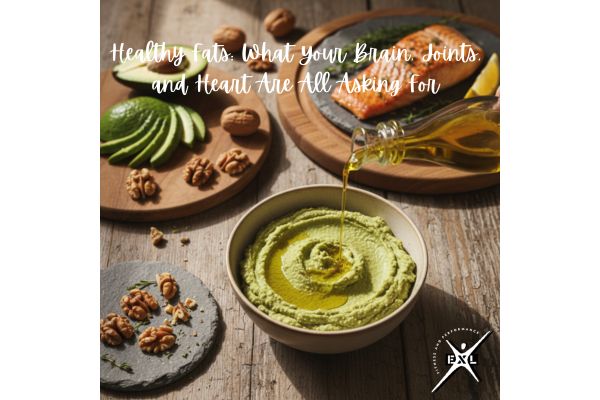
Healthy Fats: What Your Brain, Joints, and Heart Are All Asking For
Most adults still think of fat as something to avoid. The research has moved on, and getting the right fats has become one of the highest-leverage things you can do for your health after 40.
I grew up in the low-fat era. You probably did too. Fat-free everything lined the grocery shelves, egg yolks were treated like contraband, and the dietary advice of the day was simple: fat makes you fat, so eat less of it.
That advice was wrong. Not entirely — there are fats worth limiting — but the broad-strokes "avoid fat" message did real damage. It pushed people toward processed, low-fat products loaded with refined carbohydrates and sugar to compensate for the loss of flavor. And it obscured something the research has since made very clear: the right fats are not just acceptable, they're essential. Your brain, your joints, and your cardiovascular system are all, in a very real sense, asking for them.
Last week, we talked about inflammation as the real driver behind most joint pain. This week builds directly on that, because few things influence your inflammatory status as directly and as immediately as the type of fat you're eating.
Not All Fat Is the Same Conversation
"Healthy fats" is a vague catch-all, so let's be specific. There are three categories worth understanding:
Monounsaturated fats (MUFAs). Found in olive oil, avocados, and most nuts. These are broadly protective for cardiovascular health and metabolic function.
Polyunsaturated fats (PUFAs) — specifically omega-3 and omega-6. Both are essential, meaning your body can't produce them and must get them from food. The catch is the ratio between them, which we'll get into below.
Saturated and trans fats. Not the villain they were once made out to be in moderate amounts from whole foods, but trans fats in particular (found in many processed and fried foods) remain genuinely worth minimizing. This post isn't about those — it's about the fats most adults aren't getting enough of.
The Omega-3 to Omega-6 Ratio Problem
Here's the single most important concept in this entire post: it's not just about how much omega-3 you eat. It's about the ratio between omega-3 and omega-6 in your diet.
Historically, human diets carried an omega-6 to omega-3 ratio close to 1:1 or 2:1. The modern Western diet — driven by vegetable oils, processed foods, and grain-fed meat — now averages 15:1 or higher.1 Most researchers consider a ratio between 1:1 and 4:1 to be ideal for minimizing inflammation.2
Why does this matter? Omega-6 fatty acids aren't inherently bad — they're essential and play a real role in cell signaling. But in the disproportionate amounts most people consume them today (largely from soybean, corn, and sunflower oils baked into processed foods), they promote inflammatory pathways. Omega-3s do the opposite — they help regulate and resolve inflammation.1 A 2024 NHANES analysis covering data from 1999–2020 found that the omega-6 to omega-3 ratio was directly associated with systemic inflammatory biomarkers — the higher the ratio, the higher the inflammation.3
This connects directly to last week's post. If chronic low-grade inflammation is driving your joint pain, your cardiovascular risk, and your cognitive decline risk, the omega-6:omega-3 ratio in your diet is one of the most direct levers you have to pull on it.
Most Adults Are Genuinely Deficient
This isn't a minor gap. A major 2025 collaborative study from the University of East Anglia, the University of Southampton, and Holland & Barrett found that 76% of the global population does not consume adequate levels of EPA and DHA, the two long-chain omega-3s most directly linked to heart and brain health.4
Part of the problem is a common misconception: people think eating flaxseed, chia seeds, or walnuts solves the issue. These provide ALA (alpha-linolenic acid), a plant-based omega-3, but your body has to convert ALA into EPA and DHA, and that conversion is remarkably inefficient. Typically under 10% for EPA and under 5% for DHA.4 Plant sources alone, in other words, usually aren't enough. You need direct sources of EPA and DHA — which means fatty fish, or a supplement, in the conversation.
The symptoms of chronic omega-3 inadequacy are often subtle enough that people don't connect the dots: dry skin, joint discomfort, fatigue, mood fluctuations, difficulty focusing, and dry eyes.4 None of these scream "nutrient deficiency,” which is exactly why this gap goes unaddressed for years in so many adults.
What Omega-3s Actually Do
The breadth of omega-3 research is genuinely impressive at this point. A 2025 review in Nutrients examining their role across chronic disease found omega-3 PUFAs reduce inflammation, improve metabolic function, enhance cardiovascular health, mitigate insulin resistance, and alleviate neuroinflammatory and depressive symptoms.5
For your brain: DHA is a major structural component of brain tissue and cell membranes — it's not just helpful for cognition, it's a literal building block.1 Omega-3s are associated with reduced neuroinflammation and better outcomes across mood and cognitive measures, which matters increasingly as you move into the decades where cognitive decline becomes a real consideration.
For your heart: A 2019 meta-analysis in Scientific Reports found omega-3 supplementation lowered triglycerides and inflammatory markers in people with diabetes and heart disease.1 EPA and DHA help regulate the inflammatory processes that drive atherosclerosis and cardiovascular disease more broadly.
For your joints: As covered in detail last week, omega-3s directly compete with the inflammatory omega-6 pathways and have solid evidence for reducing joint stiffness and pain markers, particularly in inflammatory joint conditions.
The Monounsaturated Fat Case: Olive Oil and Avocado
Separate from the omega-3/omega-6 conversation, monounsaturated fats — particularly from olive oil — have one of the deepest evidence bases in all of nutrition science.
A systematic review and meta-analysis of cohort studies found that comparing the highest to the lowest intake of MUFA, olive oil, and oleic acid was associated with an 11% reduction in all-cause mortality, a 12% reduction in cardiovascular mortality, a 9% reduction in cardiovascular events, and a 17% reduction in stroke risk.6 Notably, the researchers found this benefit was specific to olive oil — MUFA from mixed animal and vegetable sources didn't show the same protective effect.6 Source matters, not just the fat category.
A 2025 review on extra virgin olive oil specifically highlighted its cardiovascular benefits as coming from both its monounsaturated fat content (primarily oleic acid) and its bioactive polyphenols — compounds like hydroxytyrosol and oleocanthal that carry their own anti-inflammatory and antioxidant effects.7 This is part of why whole-food sources of fat consistently outperform isolated supplements — you're getting a package of compounds working together, not just one isolated molecule.
Avocados tell a similar story. The American Heart Association highlighted a large prospective study finding that eating two servings of avocado per week was associated with a lower risk of cardiovascular disease.8 A 2025 GRADE-assessed systematic review and meta-analysis of randomized controlled trials found avocado consumption favorably influenced lipid profiles and cardiometabolic risk factors.9 A single medium Hass avocado contains roughly 13 grams of oleic acid — comparable to 1.5 ounces of almonds or 2 tablespoons of olive oil.8
A Personal Note
As I mentioned last week, I take 4–5 grams of fish oil daily — well above the standard recommendation — and I've watched it show up favorably on my lipid panel at my last few physicals. I cook almost exclusively with olive oil at home, and avocado finds its way into something I eat most days. None of this is complicated or expensive. It's just consistent. The compounding effect of getting this right, meal after meal, year after year, is bigger than people expect from something that feels this unremarkable day to day.
A Client Story
A client in his early 50s came to EXL primarily for strength training, but his physician’s bloodwork showed elevated triglycerides and an unfavorable HDL-to-LDL ratio. His diet wasn't bad by conventional standards — he'd cut back on red meat and was eating more chicken and other lean protein — but he was using vegetable oil for nearly everything and rarely ate fish.
We made two changes: switched his primary cooking fat to olive oil, and added wild-caught salmon or sardines to his rotation twice a week, with a fish oil supplement on the days he didn't eat fish. Nothing else about his diet changed meaningfully.
At his next physical, roughly four months later, his triglycerides had dropped substantially, and his lipid panel overall looked notably better. His doctor asked what he'd changed. The answer was almost embarrassingly simple.
A Practical Guide to Eating More of the Right Fats
Eat fatty fish two to three times per week. Salmon, sardines, mackerel, and anchovies are the most direct, bioavailable sources of EPA and DHA. Canned sardines and salmon are inexpensive, shelf-stable, and just as effective as fresh.
Switch your primary cooking fat to olive oil. If you're cooking with soybean, corn, sunflower, or generic "vegetable" oil, this single swap meaningfully shifts your omega-6 load and adds the polyphenol benefits unique to olive oil. Use it for sautéing, roasting, and dressings.
Add avocado regularly, not occasionally. Half an avocado on eggs, in a salad, or blended into a smoothie a few times a week gets you toward the two-servings-per-week threshold associated with cardiovascular benefit.
Snack on nuts instead of processed snack foods. Walnuts, almonds, and macadamias provide healthy fats, fiber, and protein and directly displace the processed, omega-6-heavy snacks most adults default to.
Read labels for hidden seed oils. Soybean, corn, sunflower, and "vegetable" oil are in far more packaged foods than people realize — salad dressings, sauces, crackers, baked goods. You don't need to eliminate them entirely, but awareness alone usually meaningfully reduces intake.
Consider a quality fish oil supplement as insurance. If you're not consistently eating fatty fish twice a week, a fish oil supplement with at least 1–2g combined EPA/DHA closes the gap. Look for third-party-tested products (NSF- or IFOS-certified), given the lack of regulation in the supplement industry.
A Note on Fish Oil Supplements: Fish Oil vs. Krill Oil vs. Cod Liver Oil
Not all omega-3 supplements are the same, and the differences matter depending on your goals and dose.
Concentrated fish oil is the most practical option for higher-dose protocols. It delivers the most EPA/DHA per gram, is well-researched, and is cost-effective at scale. This is what I use personally — at 4–5g daily, it's the only option that makes practical sense.
Krill oil packages EPA and DHA in phospholipid form — the same molecular structure found in human cell membranes — which makes it absorb roughly 1.5 to 2 times more efficiently than standard fish oil triglycerides. It also contains astaxanthin, a potent antioxidant carotenoid with its own anti-inflammatory properties. The tradeoff is cost: krill oil is significantly more expensive per gram of EPA/DHA. At moderate doses (500mg–1g EPA/DHA equivalent), it's a legitimate premium option, and it's notably better than fish oil for people who experience fishy burps. At high doses, the cost becomes impractical.
Cod liver oil provides EPA and DHA alongside meaningful amounts of vitamins A and D, which is both a benefit and a ceiling. At 1–2 teaspoons daily, it's a reasonable lower-dose option, but the vitamin A content limits how much you can safely take. Vitamin A is fat-soluble and accumulates; at high doses, it becomes toxic. For anyone aiming for higher omega-3 intake, concentrated fish oil is the safer and more scalable choice.
Other Oils Worth Knowing
Beyond olive oil, the following are worth having in your rotation for specific purposes:
Avocado oil deserves a separate mention from avocado as a food. Its MUFA profile is nearly identical to olive oil — roughly 60% oleic acid — but it has a significantly higher smoke point (around 500°F versus olive oil's 375°F). That makes it the better choice for high-heat cooking like searing and roasting, where olive oil starts to break down and lose its beneficial compounds. Use avocado oil for heat and olive oil for finishing and dressings.
Flaxseed oil has the highest plant-based ALA content of any oil, making it a useful option for people who are plant-based or simply don't eat fish. The caveat already covered in this post applies: ALA conversion to EPA and DHA is inefficient — typically under 10% for EPA and under 5% for DHA — so flaxseed oil supports but doesn't replace direct EPA/DHA sources. It has a low smoke point and oxidizes easily; use it in smoothies or as a dressing oil only, never for cooking. Store it in the fridge.
Walnut oil has one of the better omega-6:omega-3 ratios of any nut oil and contains polyphenols alongside its fat content. A good finishing oil or salad dressing base. Like flaxseed oil, it has a low smoke point and isn't suited for cooking. If you're already eating walnuts regularly, walnut oil is a natural extension of that habit.
MCT oil (medium-chain triglycerides, derived from coconut oil) sits in a different category from the others — it's not an omega-3 story and doesn't directly address inflammation. But medium-chain fats are metabolized rapidly and converted to ketones, which the brain can use directly as fuel. There's modest evidence for cognitive support and satiety benefits, and it's grown in popularity among the active adult crowd. Worth knowing about, though it's more of a performance-support fat than an anti-inflammatory one.
The Bottom Line
The "avoid all fat" advice most of us grew up with did more harm than good. The research has moved decisively past it. What matters now is the type and balance of fat you're eating — heavier on omega-3s and monounsaturated fats from whole foods, lighter on the omega-6-saturated processed oils that have quietly taken over the modern diet.
This is one of the lowest-effort, highest-leverage changes available to you. You're not restricting anything dramatically — you're redirecting. Cook with olive oil instead of vegetable oil. Eat fish instead of (or alongside) chicken twice a week. Add avocado where you'd normally add nothing. The fats your brain, joints, and heart are asking for are not exotic or expensive. They're sitting in the grocery store next to the fats you've been buying for years.
→ Book a free intro session at EXL Fitness
—
Next week: Gut health and exercise — the connection nobody in fitness is talking about, and why it matters more than you think.
Tags: healthy fats adults over 50, omega-3 benefits, omega-6 omega-3 ratio, olive oil heart health, avocado cardiovascular benefits, anti-inflammatory diet, EXL Fitness
References
1. Nutrition Diets UK. Omega-3 Benefits: Essential Fatty Acids for Brain, Heart Health & Inflammation. Published November 2025. nutritiondiets.co.uk.
2. InsideTracker. Omega-6 to Omega-3 Ratio: What Does It Mean and What's Optimal? Citing Dietary Guidelines for Americans 2020–2025 (1.1–1.6g omega-3/day) and 4:1 ideal n-6:n-3 ratio.
3. Li Y, et al. Associations of ω-3, ω-6 polyunsaturated fatty acids intake and ω-6:ω-3 ratio with systemic immune and inflammatory biomarkers: NHANES 1999–2020. Front Nutr. 2024. doi:10.3389/fnut.2024.1410154.
4. MVS Pharma. Global Omega-3 Deficiency In 2025: Why 76% Of People Lack Enough EPA & DHA. Published March 2026, citing University of East Anglia / University of Southampton / Holland & Barrett collaborative study.
5. Mode and Mechanism of Action of Omega-3 and Omega-6 Unsaturated Fatty Acids in Chronic Diseases. Nutrients. 2025;17(9):1540. doi:10.3390/nu17091540.
6. Schwingshackl L, Hoffmann G. Monounsaturated fatty acids, olive oil and health status: a systematic review and meta-analysis of cohort studies. Lipids Health Dis. 2014;13:154. PMC4198773.
7. Exploring the Cardiovascular Benefits of Extra Virgin Olive Oil: Insights into Mechanisms and Therapeutic Potential. PMC11852600. 2025.
8. American Heart Association. Eating two servings of avocados a week linked to lower risk of cardiovascular disease. newsroom.heart.org.
9. Hamednia, et al. Effects of Avocado Products on Cardiovascular Risk Factors in Adults: A GRADE-Assessed Systematic Review and Meta-Analysis. Food Sci Nutr. 2025;13(7). doi:10.1002/fsn3.70547.
About the Author
Mat Gover, BS, CSCS, is the owner and head coach of EXL Fitness & Performance in Orem, Utah. With nearly 30 years of coaching experience and a specialization in strength and performance for adults over 40, Mat brings science-backed training and a no-fluff approach to every session. When he's not coaching, he's skiing the Wasatch, riding in Moab, or climbing something steep in the Uintas.


