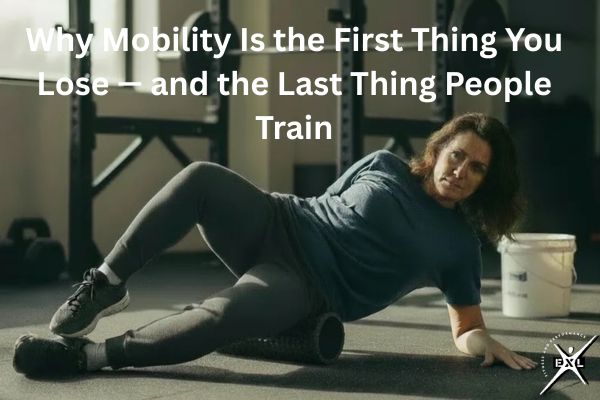
Why Mobility Is the First Thing You Lose — and the Last Thing People Train
It's not just stiffness. Losing mobility costs you strength, increases your injury risk, and quietly shrinks the life you can live. Here's what's happening — and what to do about it.
Here's something I've noticed after nearly 30 years of coaching adults: when new clients come to EXL and tell me what they want to work on, I hear a lot about strength, weight loss, energy, and endurance. Almost nobody walks in and says, "I want to work on my mobility."
But if you watch them move for five minutes, mobility is usually the thing that needs the most work.
They can't get full depth on a squat. Their hip flexors are locked from years of sitting. Their thoracic spine barely rotates. They reach overhead, and their lower back compensates instead of their shoulders doing the job. And they've been living like that for so long that they've accepted it as just the way their bodies are now.
It's not. And the cost of ignoring it is much higher than most people realize.
What Mobility Actually Is (and What It's Not)
Mobility and flexibility are often used interchangeably, but they're different things. Flexibility is the passive ability of a muscle or tissue to lengthen — what you measure when you sit and reach. Mobility is active: it's your ability to move a joint through its full range of motion under control, with the muscular system engaged.
You can be flexible without being mobile. Plenty of people can passively touch their toes, but can't control a deep hip hinge under load. Mobility requires both the tissue length and the neuromuscular control to use it. That's why stretching alone often isn't enough — and why mobility work needs to be integrated into training, not just tacked on as an afterthought.
For the purposes of this post, I'm using mobility in the broadest sense: your ability to move your joints freely, fully, and under control through the ranges of motion your daily life, outdoor activities, and training demand.
What Happens to Mobility After 50 — and Why
Joint range of motion decreases with age — that part is well-established. Both active and passive ROM decline, though active ROM tends to decrease more.1 But the mechanism matters, because understanding it points directly to what you can actually do about it.
Collagen changes. Collagen is the structural scaffold of your connective tissue — tendons, ligaments, joint capsules, and cartilage. After about age 25, collagen production declines by roughly 1% per year.2 The collagen that remains undergoes a chemical process called glycosylation — essentially, sugar molecules attach to collagen fibers and form cross-links that make the tissue stiffer and less extensible.3 The result: joints that were once supple become tighter and less forgiving.
Synovial fluid decreases. Synovial joints — your knees, hips, and shoulders — are lubricated by synovial fluid that reduces friction and nourishes cartilage. With age, synovial fluid production decreases and its viscosity changes, contributing directly to the "creaky" feeling many adults experience.1
Muscle mass loss (sarcopenia). Sarcopenia — the age-related loss of muscle — begins as early as your 30s and accelerates after 50.4 Weaker muscles provide less dynamic support and control around joints. When the muscular system can't properly stabilize a joint, the nervous system limits the range of motion as a protective response. You're not getting stiffer because your tissues can't move — you're getting stiffer because your brain has decided you're not safe to move that way.
Sedentary behavior. This is the big one — and the most modifiable. The body adapts to the positions it's held in most often. If you sit for eight hours a day, your hip flexors shorten, your thoracic spine rounds, your posterior chain lengthens and weakens, and your nervous system stops expecting to access the ranges of motion you've stopped using.4 Research consistently shows that much of what we attribute to "aging" is actually attributable to inactivity.4
Here's the number that gets my attention as a coach: maximum walking speed decreases about 24% between ages 25 and 75. Steps per day drop roughly 75% between ages 60 and 85. Falls relative to steps increase by 800%. Deaths caused by falls increase by 4,000% between the ages of 65 and 90.5
That's not a slow, gradual inconvenience. That's a cascade. And it starts with mobility loss that most people brushed off as normal stiffness a decade earlier.
Why Mobility Loss Compounds Everything Else
Mobility doesn't just affect how you feel during a workout. It affects the quality of every physical thing you do. And once it degrades enough, it starts pulling down your strength, your aerobic capacity, and your ability to train at all.
If your hip mobility is limited, you can't achieve proper squat depth. That means you're loading your lower back instead of your hips and glutes, leading to compensatory movement patterns and, over time, pain and injury. If your shoulder mobility is limited, you can't press overhead safely. If your thoracic spine won't rotate, your neck and lower back take the hit.
I see this constantly on the coaching floor. A client comes in with what they think is a lower back problem. But when you look at how they move, the lower back is the symptom — limited hip mobility is the cause. Fix the hips, and often the back quiets down without any direct back treatment at all.
Outside the gym, it's even more direct. I ski in the Wasatch most winters. Mountain biking and hiking in the Uintas and around Moab in the summer. These activities demand hip flexion, thoracic rotation, shoulder stability, and ankle mobility. When any of those are compromised, the activity suffers — or stops entirely. For my clients who golf, hike, garden, or chase grandkids around, the connection is identical.
Mobility is the prerequisite for everything else. You can't express strength through a range of motion you don't have.
The Good News: Mobility Responds to Training at Any Age
This is where the narrative gets better. Unlike some aspects of aging, mobility is highly trainable — and older adults respond to mobility training at rates comparable to younger adults.
A 2023 meta-analysis of 77 studies and 186 effect sizes found that chronic stretch training significantly increases range of motion, with a moderate-to-large effect size across populations.6 The gains were consistent regardless of age, which means there's no point at which it's too late to make a meaningful improvement.
A 2025 systematic review and meta-analysis in Sports Medicine confirmed that both acute and chronic static stretching improve ROM through two mechanisms: increased stretch tolerance (the nervous system becoming more comfortable with the range) and actual changes to tissue stiffness and fascicle length.7 In other words, it's not just that you feel less tight — the tissue is physically changing.
Perhaps most usefully for a strength-focused audience: resistance training and stretching produce comparable improvements in range of motion. A systematic review and meta-analysis of 11 randomized controlled trials found no significant difference in ROM gains between strength training and dedicated stretching protocols.8 Full-range-of-motion resistance training isn't just building strength — it's simultaneously maintaining and improving the joint mobility needed to do it safely.
This is why I program the way I do at EXL. We don't do 45 minutes of lifting and then tack on two minutes of hamstring stretches at the end. Mobility work is woven into the session — in warm-ups, in movement prep, in exercise selection, and in how we coach range of motion under load.
A Client Story Worth Sharing
A client came to me a few years back — 61, had been lifting on his own for most of his adult life. Strong guy. But he had this persistent right hip that "just didn't feel right," and his deadlift had stalled out at a weight that should've been moving for a man his size.
When we looked at how he moved, the problem was obvious: almost no internal rotation of the hip on the right side. He was getting compensatory movement from his lumbar spine every time he hinged. His body had found a way around the limitation, but the workaround was slowly grinding on the wrong structures.
We spent six weeks working specifically on hip mobility — targeted daily work, five minutes in the morning, mobility drills in his warm-up, and intentional cuing during his lifts to demand range of motion rather than allow compensation. His hip cleared up. His deadlift moved past where it had been stuck. And he stopped waking up stiff in the morning.
Nothing exotic. Just consistent, specific attention to a system he'd ignored for years.
The Most Important Areas to Address After 50
Not all mobility limitations are created equal. These are the areas I prioritize with adult clients because of how much downstream effect they have on everything else:
Hip flexors and hip mobility. Arguably, the most critical area for adults who sit. Tight hip flexors tilt the pelvis anteriorly, compress the lower back, and limit glute function. Hip mobility — both flexion depth and internal/external rotation — directly determines how well you squat, hinge, lunge, walk, and run.
Thoracic spine (mid-back) rotation and extension. The thoracic spine is designed to rotate. When it doesn't, the lumbar spine and cervical spine compensate — and neither of them is built for that kind of repeated load. Almost every overhead movement, every rotation in sport and daily life, and every deep breath benefits from thoracic mobility.
Ankle dorsiflexion. This one surprises people. Limited ankle mobility forces the knee to track inward during squats and on stairs, contributes to Achilles and plantar fascia problems, and is a major risk factor for falls. Years of shoes with elevated heels quietly steal dorsiflexion from most adults.
Shoulder mobility (specifically overhead and external rotation). Limited shoulder mobility means that anything overhead — a press, reaching for a shelf, putting on a jacket — is compensated by the neck or lower back. External rotation restriction is one of the most common contributors to shoulder impingement in adults over 50.
Posterior chain flexibility (hamstrings and glutes). Tight hamstrings limit hip hinge mechanics, contribute to low back strain, and affect gait. This is the one area most people are at least somewhat aware of — but consistent, progressive work is usually still lacking.
What an Effective Mobility Practice Actually Looks Like
You don't need to spend an hour a day on this. You need to be consistent, targeted, and progressive — which is exactly how you'd treat any other training goal.
Daily movement snacks. Five to ten minutes of targeted mobility work every morning does more than a 45-minute session once a week. The nervous system responds to frequency. Pick two or three areas and rotate through them daily. Hip 90/90 stretches, thoracic rotations, ankle rocks, wall slides — these take minutes and accumulate meaningfully over weeks.
Train through the full range of motion. Don't cheat depth on your squats to move more weight. Don't cut your hip hinge short. Full-range resistance training is mobility training. Use it intentionally, and you're building mobility and strength simultaneously — which is more efficient and more functional than doing them separately.
Active mobility over passive stretching. Passive stretching (holding a stretch without muscular engagement) improves flexibility but doesn't transfer as well to controlled movement. Active mobility work — moving into a range and resisting there, or using the muscles at the end range — produces better functional results.7 Both have value, but if you have limited time, prioritize active work.
Warm up with a purpose. Your warm-up before training is prime time for mobility work. Five minutes of joint circles, hip openers, thoracic rotations, and ankle work before you load a barbell does double duty: it prepares you for the session and accumulates the mobility work you should be doing anyway.
Don't just stretch what's tight — strengthen what's weak. Mobility limitations are often as much about weakness as tightness. A hip that won't externally rotate may need strengthening of the external rotators just as much as stretching of the internal ones. Look at both sides of the joint.
A Simple Mobility Protocol to Start With
You don't need a complicated program. This three-step sequence works for any major joint — hips, thoracic spine, shoulders, ankles — and takes ten minutes or less. Run through it every morning or as your warm-up before training.
Step 1: Release (1–2 minutes)
Use a foam roller or lacrosse ball to work through the target muscle and surrounding tissue. Move slowly — spend 20–30 seconds on any spot that feels dense or tender. You're not trying to eliminate all discomfort; you're reducing tissue stiffness and increasing blood flow before you ask the tissue to lengthen. For hips: roll the glutes, hip flexors, and TFL (the outer hip). For the thoracic spine, foam roll the mid-back. For ankles: a lacrosse ball under the calf works well.
Step 2: Stretch (2–3 minutes)
Move into a static or active stretch targeting the specific range you want to improve. Hold for 30–60 seconds per side and repeat 2–3 times. The research supports longer hold times for tissue-level change — brief 10-second holds improve immediate tolerance but don't produce lasting structural adaptation. For hips: the 90/90 hip stretch or kneeling hip flexor stretch. For the thoracic spine: a seated or quadrupod thoracic rotation. For shoulders: a doorway pec stretch or cross-body shoulder stretch. For ankles: a wall ankle dorsiflexion stretch with the knee over the toe.
Step 3: Strengthen the New Range (2–3 minutes)
This is the step most people skip — and it's the most important one. Stretching opens the range; strengthening teaches your nervous system to own it. Without this step, gains from stretching tend to fade quickly because the brain doesn't trust the new range under load. Immediately after stretching, do 2–3 sets of 8–10 reps of a movement that requires the muscle to work through that newly accessed range. For hips: banded hip CARs (controlled articular rotations), single-leg glute bridges, or goblet squats to depth. For the thoracic spine: a light landmine press or cable rotation. For shoulders: a lightweight overhead press or wall slide. For ankles: single-leg calf raises through full range, or slow bodyweight squats focusing on knee tracking. The load doesn't need to be heavy — you're training motor control, not max strength.
Do this sequence for one or two target areas per day, rotate through your priority joints across the week, and you'll have done more for your long-term mobility in 10 minutes than most people do in a month of occasional stretching.
The Bottom Line
Mobility is the most neglected component of fitness for adults over 50. It's not as glamorous as strength. It doesn't show up on a scale. And because it declines gradually, most people don't notice how much they've lost until something goes wrong.
But the research is clear: mobility is trainable at any age, responds to consistent work, and maintaining it is one of the most effective ways to protect your strength, reduce injury risk, and keep doing the things you love as the decades stack up.
I've watched clients in their 60s and 70s regain ranges of motion they thought were gone permanently. It takes patience and consistency — which, as we talked about last week, is always the answer. But the capacity is there.
Don't wait until something hurts to pay attention to this. Start now, while you can, make it a project instead of a recovery.
→ Book a free intro session at EXL Fitness
—
Next week: The real reason your joints hurt — and why inflammation, not aging, is the more accurate (and more actionable) explanation.
Tags: mobility training adults over 50, joint mobility aging, flexibility vs mobility, how to improve mobility after 50, hip mobility, thoracic spine mobility, EXL Fitness
References
1. Physio-pedia. Effects of Ageing on Joints. physio-pedia.com. Summarizing age-related changes in synovial fluid, ROM, and collagen across joint structures.
2. Ubie Health. Collagen for Seniors: Rebuilding Bone & Joint Strength. Published February 2026. ubiehealth.com. Citing the ~1%/year decline in collagen production after age 30.
3. Bataller A, et al. Limited joint mobility in diabetes and ageing: recent advances in pathogenesis and therapy. Int J Immunopathol Pharmacol. 2010;23(4):997–1003. doi:10.1177/039463201002300404.
4. Science News Today. The Role of Flexibility and Mobility in Healthy Aging. September 2025. sciencenewstoday.org. Summarizing sarcopenia, sedentary behavior, and reversibility of mobility decline.
5. Buesing C, et al. Mobility-related physical and functional losses due to aging and disease. J NeuroEngineering Rehabil. 2019;16(1):2. doi:10.1186/s12984-018-0458-8.
6. Arntz F, et al. Chronic effects of stretching on range of motion with consideration of potential moderating variables: a systematic review with meta-analysis. J Sport Health Sci. 2023;12(4):453–465.
7. O'Brien J, et al. Mechanisms underlying range of motion improvements following acute and chronic static stretching: a systematic review, meta-analysis and multivariate meta-regression. Sports Med. 2025. doi:10.1007/s40279-025-02204-7.
8. Afonso J, et al. Strength training versus stretching for improving range of motion: a systematic review and meta-analysis. Healthcare. 2021;9(4):427. PMC8067745.
About the Author
Mat Gover, BS, CSCS, is the owner and head coach of EXL Fitness & Performance in Orem, Utah. With nearly 30 years of coaching experience and a specialization in strength and performance for adults over 40, Mat brings science-backed training and a no-fluff approach to every session. When he's not coaching, he's skiing the Wasatch, riding in Moab, or climbing something steep in the Uintas.


