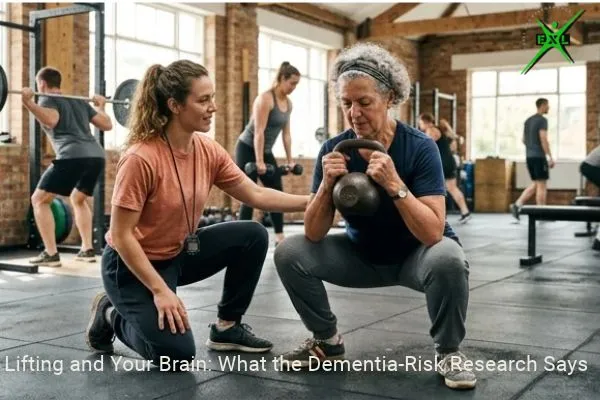
Lifting and Your Brain: What the Dementia-Risk Research Says
I looked for proof that lifting weights prevents dementia. Here's what exists instead, what it can and can't tell you, and why I still think it belongs in your week.
Nobody has shown that strength training prevents dementia. I want to say that before anything else, because a lot of headlines on this topic skip it.
Dementia develops over decades. A trial that could prove lifting prevents it would need thousands of people, years of supervised training, and a diagnosis at the end. I couldn't find one, and I'm not going to pretend otherwise.
What does exist is a trail of evidence: large studies linking strength to lower dementia risk, trials showing lifting changes memory scores and brain measures, and one big trial showing that structure and support help. None of it is proof. All of it points in the same direction. This post walks through what each piece can and can't tell you, then I'll share what I see in the gym.
Keeping This in Proportion
The 2024 Lancet Commission on dementia identified 14 risk factors, including physical inactivity, high blood pressure, hearing loss, depression, and social isolation. If we eliminated all of them, the Commission estimates about 45% of dementia cases could be prevented or delayed.¹ That's a ceiling, not a forecast: it assumes the factors are causal and can be fully removed. Physical inactivity is one of the 14, but it accounts for a smaller share. The biggest are untreated hearing loss and high LDL cholesterol in midlife, at about 7% each, followed by low early-life education and social isolation at about 5% each.
So lifting is not a shield. It's one piece of a bigger picture, and the rest of this post is about how strong that piece is.
Stronger People Develop Dementia Less. But Which Way Does It Run?
The best-known evidence is observational, and a lot of it uses grip strength. In the UK Biobank, a study of about 190,000 adults aged 39 to 73 found that each 5-kilogram (about 11-pound) drop in grip strength went with a higher dementia risk: roughly 20% higher in men and 12% higher in women.² A second UK Biobank analysis of nearly 467,000 adults found that people in the weakest-grip fifth had a 72% higher risk of developing dementia than those in the strongest fifth.³
Here's the catch. These studies show an association, not causation, and the arrow could point either way.
Direction one is the hopeful one: staying strong protects your brain. Direction two runs the other way. Dementia-related brain changes start years, even decades, before anyone gets a diagnosis. If those early changes also make people move less and lose muscle, then weak grip isn't causing dementia. It's an early symptom. Researchers call that reverse causation. Think of a car's check-engine light: it comes on before the breakdown, but the light didn't cause the breakdown.
Here's how researchers try to tell the two apart. If low strength or inactivity truly protects the brain, it should predict dementia no matter how long you follow people. If it's an early symptom, the link should be strongest in the years just before diagnosis and fade with longer follow-up. A 2019 analysis of 19 cohort studies found the second pattern: inactivity predicted dementia within 10 years but not beyond that, which the authors read as reverse causation.⁴ Other researchers dispute that reading, and the data can't settle it. One point in favor of strength as a cause: in the first UK Biobank study, genetic risk for Alzheimer's wasn't linked to grip strength.² That suggests weak grip isn't just a marker of an inherited Alzheimer's tendency. It doesn't rule out early, undiagnosed disease, though.
A 2026 study of about 1,600 older adults, followed for roughly 24 years, found that frail people were diagnosed with dementia 2 to 3 years earlier than people who weren't frail.⁵ That's interesting, but it didn't test exercise. You'll see headlines saying strength training "delays dementia by six years." This study did not show that.
My read: being strong is a good sign, and nobody knows how much of it is cause and how much is a marker. This is the same thing I said about grip strength in the longevity frameworks post: it's a marker of what you've built, not a lever you pull on its own.
What Happened When People Actually Lifted
Association studies can only take you so far, so the useful question is what happens when you randomly assign people to lift.
In healthy older adults, the answer is: something, but not everything. A 2025 meta-analysis of 17 randomized trials (739 adults aged 60 and older) found that resistance training improved overall cognition, working memory, verbal learning, and spatial memory by a small to moderate amount. It found no significant effect on executive function, attention, or processing speed.⁶ An older review of 25 trials found much less, with resistance training beating stretching and toning only on reasoning tests.⁷ The honest summary is that the findings are positive but selective, and the trials are small and short.
The most interesting recent trial is from Denmark. It's a brain-imaging study within the LISA trial, which randomly assigned 309 adults aged 62 to 70 to one year of heavy resistance training, moderate-intensity training, or no training.⁸ The heavy group trained three times a week under supervision, doing 3 sets of 6 to 12 reps at about 70–85% of their one-rep max.⁹ The moderate group used lighter loads and higher reps, partly at home with bands.
What the researchers found:
Only the heavy group showed increased connectivity in the prefrontal cortex, the part of the brain that handles planning, focus, and working memory.
Both the heavy and moderate groups had lower estimated "brain age" afterward, by about 1.4 to 2.3 years. The control group didn't change.
Two honest cautions. First, "brain age" is an estimate computed from resting MRI scans, not a memory test and not a diagnosis. It's in the same family as the biological age tests I told you to skip: promising research, but not something to build your life around. The authors suggest the prefrontal changes could be a link to better cognition, but they didn't test that. Second, heavy lifting wasn't clearly better than moderate on the brain-age result. It's a good reminder that you don't have to go all-out to benefit.
People Who Already Have Memory Problems
The best trials of lifting and the brain have been done in people with mild cognitive impairment (MCI), a stage where memory slips beyond normal aging but daily life is intact.
The SMART trial randomized 100 adults aged 55 to 86 with MCI to six months of supervised high-intensity resistance training (2 to 3 days a week) or a control program. 48% of strength-training participants had normal cognitive scores, compared with 27% of those who didn't lift, and the benefit remained 18 months later.¹⁰ A follow-up reported that parts of the hippocampus, a memory region that shrinks early in Alzheimer's, lost less volume in the people who lifted.¹¹
A smaller Brazilian trial of 44 people with MCI found that six months of twice-weekly weight training protected the right hippocampus and precuneus from shrinking, while the control group lost volume in both regions.¹²
These are encouraging, and they're also small, short, and in a different group than most people reading this. If you don't have memory problems, they don't tell you lifting will keep you from developing them. They say the brain stays responsive to training even under strain.
Structure and Support Matter
The biggest trial in this area is U.S. POINTER, which followed 2,111 adults aged 60 to 79 at higher risk of cognitive decline for two years. Everyone got a lifestyle program that included exercise, diet, brain training, and health check-ups. One group got a structured version, with 38 facilitated team meetings, specific goals, and clinician check-ins. The other got a self-guided version with 6 meetings.¹³
Both groups improved. The structured group improved more. The difference was small but statistically significant.¹³ Strength training was one part of a package, so this trial can't tell us what lifting did on its own. It does show that the group with more accountability and support did better. That fits what we covered in Why Willpower Isn't the Problem and The Real Reason Group Training Works: structure and people carry you further than motivation alone.
What I See in the Gym
I've worked with dozens of clients in their 70s and 80s. I don't have studies on them, and I can't measure their cognition. What I can see is that their balance, agility, mobility, coordination, and strength improve.
I know that doesn't prove anything about dementia. Too many other things are going on in a person's life for me to say what causes what. But those are real changes in real people, and they're the abilities that let someone stay independent.
I also see something else: the relationships they build here. People who didn't know each other end up checking in, noticing when someone's missing, and sharing the hard weeks. That connection matters on its own. Social isolation is one of the 14 risk factors on the Lancet Commission's list,¹ and I'm not claiming a gym fixes it. But I can tell you that the people next to them notice when they're missing.
A Personal Note
My grandmother died of dementia. I wasn't around her in her final years, so I can't speak to what that was like for the people who were. If you have, you know more about it than I do. But it's part of why I wanted to read the research on this instead of skipping it.
Dementia has many causes, some of them out of anyone's control. Lifting isn't a promise. It's one of the better-supported things you can do, and the evidence says it's worth it for how you move, think, and connect with people.
What to Actually Do
Lift two or three times a week. The trials above used two to three sessions a week. If you're already training with us twice a week or more, you're in the same range as the trials. You don't need a new program for your brain. You need to keep showing up to the one you have.
Progress the load over time. Progressive overload is what the trials had in common. Heavy didn't beat moderate on the brain-age result, so don't chase heavy for its own sake. Work with your coach on what's right for your joints and your history.
Keep the cardio. POINTER paired strength work with regular aerobic exercise, and its VO2 max research is among the best in the longevity field.
Train with people. Structured, accountable programs did better in POINTER, and social isolation is a risk factor in its own right.
Don't use this as a test. If you or someone in your family is noticing memory changes, talk to a doctor. Training doesn't replace an evaluation.
Start where you are. The trial participants ranged in age up to their mid-80s. If you're new to lifting, begin with a coach.
The Bottom Line
No one has shown that lifting weights prevents dementia, and I won't tell you it does. Research shows that stronger people develop dementia less (though the direction of cause is unclear), that lifting improves some memory measures and brain markers in randomized trials, and that structure and support make lifestyle programs work better. That's a solid case for lifting as part of a bigger plan, not a guarantee. And if you're already training with us two or three times a week, you're doing what the trials did. Keep going.
Next week: should you exercise outside when Utah Valley's air is bad? [Mat: confirm. This is the Nov 9 post on the calendar.]
References
Livingston, G., et al. (2024). Dementia prevention, intervention, and care: 2024 report of the Lancet Standing Commission. The Lancet, 404(10452), 572–628.
Duchowny, K. A., Ackley, S. F., Brenowitz, W. D., et al. (2022). Associations between handgrip strength and dementia risk, cognition, and neuroimaging outcomes in the UK Biobank cohort study. JAMA Network Open, 5(6), e2218314.
Esteban-Cornejo, I., et al. (2022). Handgrip strength and all-cause dementia incidence and mortality: findings from the UK Biobank prospective cohort study. Journal of Cachexia, Sarcopenia and Muscle, 13(3), 1514–1525.
Kivimäki, M., Singh-Manoux, A., Pentti, J., et al. (2019). Physical inactivity, cardiometabolic disease, and risk of dementia: an individual-participant meta-analysis. BMJ, 365, l1495.
Strating, T. R., Haapanen, M. J., Ma, D., et al. (2026). Frailty and accelerated dementia onset in genetic, sociodemographic and neuropathologic subgroups. Journal of Neurology, Neurosurgery & Psychiatry. Published online July 21, 2026.
Wu & Huang (2025). A systematic review and meta-analysis of the effects of resistance exercise on cognitive function in older adults. Frontiers in Psychiatry, 16, 1708244. [Confirm full author names before publishing.]
The impact of exercise on the cognitive functioning of healthy older adults: a systematic review and meta-analysis. (2014). Aging Research Reviews, 16, 12–31. [Confirm author list before publishing.]
Gonzalez-Gomez, R., Demnitz, N., Coronel, C., Gates, A. T., Kjaer, M., Siebner, H. R., Boraxbekk, C. J., & Ibanez, A. M. (2026). Randomized controlled trial of resistance exercise and brain aging clocks. GeroScience. https://doi.org/10.1007/s11357-026-02141-x
Bloch-Ibenfeldt, M., et al. (2024). Heavy resistance training at retirement age induces 4-year lasting beneficial effects in muscle strength: a long-term follow-up of an RCT. BMJ Open Sport & Exercise Medicine, 10, e001899.
Fiatarone Singh, M. A., Gates, N., Saigal, N., et al. (2014). The Study of Mental and Resistance Training (SMART) study: resistance training and/or cognitive training in mild cognitive impairment. Journal of the American Medical Directors Association, 15(12), 873–880.
Broadhouse, K. M., Fiatarone Singh, M., Suo, C., et al. (2020). Hippocampal plasticity underpins long-term cognitive gains from resistance exercise in MCI. NeuroImage: Clinical.
Ribeiro, I. C., et al. (2025). Resistance training protects the hippocampus and precuneus against atrophy and benefits white matter integrity in older adults with mild cognitive impairment. GeroScience. https://doi.org/10.1007/s11357-024-01483-8
U.S. POINTER Study Group (2025). Effects of structured vs self-guided multidomain lifestyle interventions for global cognitive function: the U.S. POINTER randomized clinical trial. JAMA. https://doi.org/10.1001/jama.2025.12923
→ Book a free intro session at EXL Fitness. If you want a plan that builds strength, balance, and confidence with a coach and a group that notices when you show up, we'll put it together in a free intro session. Book yours here.
Mat Gover, BS, CSCS, owns and coaches EXL Fitness & Performance in Orem, Utah. With nearly 30 years of coaching experience and a specialization in strength and performance for adults over 40, Mat brings science-backed training and a no-fluff approach to every session. When he's not coaching, he's skiing the Wasatch, mountain biking the Uintas, or out in the red rock around the San Rafael Swell.
Tags: Brain Health, Strength Training, Healthy Aging, Longevity, Utah Valley


